Building cheaply
How to Build Dirt Cheap Houses
[This information comes from:
Author: Owen Geiger at http://EarthbagBuilding.com
Owen Geiger is the former director of Builders Without Borders, a Mother Earth News Green Home Adviser, The Last Straw Journal Correspondent and the director of the Geiger Research Institute of Sustainability, and there is more.
If you can access his website, please do. This site, PT, is for villagers who do not have reliable internet connections or modern computers.
This article is associated with a site called "Instructables" which covers many topics.]
How to Build Dirt Cheap Houses
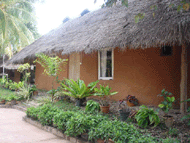
Loei Leela Wadee Resort:
adobe vault and thatch roof
in Loei, Thailand.
Ever wonder how to build a simple home for very little money, without going into debt? The key is to use low-cost, locally available natural materials such as earth, small diameter wood and straw. These are often free and freely available, yet produce a very comfortable home.
Our earthbag projects confirm that building at around $100/m2 ($10/sq.ft) for materials only, is possible. Other aspects of earthbag building such as strength, durability, sustainability, are also important but nothing is as important as affording the house in the first place. These tecniques make housing affordable to virtually everyone on the planet. The last section of this Instructable includes a list of $100/m2 projects built by others.
A big reason for the growing popularity of earthbag building is its low cost. You can build shelters for under $1,000. For $1,000-$5,000 you could have a nice, small home that would outlast most conventional wood-framed houses, and be quieter, non-toxic and more comfortable.
If cash is short then
- use local natural materials
- build small
- build in stages
- add on as you can afford it.
- avoid debt (interest on debt keeps you poor).
For example, build one roundhouse and live in it until you’ve saved enough to build another. You could join the roundhouses with arched or gabled covered walkways, vine covered pergolas, enclosed passageways or additions, or just leave them free standing. Extending rectilinear structures (adding one room at a time) would be even easier. Building a little at a time like this requires planning ahead for future doorways, views, noise and such, but it enables you to build debt free.
Step 1: Potential Savings
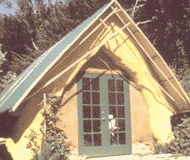
Vault by Simone Swan
The following list summarizes some of the potential savings from using natural building materials and alternative construction methods. If you’re wondering why they’re not more widely used, it’s because contractors, banks, realtors and others in the housing industry make more profit from the current system. It’s up to you to get informed and switch to a sustainable lifestyle:
1. Foundation: Insulated frost-protected foundations do not have to be as deep as standard foundations and therefore use fewer materials, require less excavation and backfill, less form work and less labor. Earthbag foundations – polypropylene bags filled with gravel, scoria or pumice on a rubble trench – make an excellent foundation. They also reduce long-term energy costs because they are very energy efficient. This type of foundation is well within the scope of most owner-builders. Potential savings: $2,000 (more in cold climates where foundations are typically very deep), and lower energy costs.
2. Earthen floor:
- Earthen floors last indefinitely and eliminate the need for other floor coverings. (Earthen floors in Taos Pueblo are over 600 years old.)
- provide thermal mass by absorbing heat from the sun and releasing it gradually at night, which reduces energy costs.
- Adding insulation under the floor can produce even greater energy savings.
- They are very comfortable to walk on.
- Pigments can be troweled onto the surface to create any number of designs. Some of the most beautiful resemble leather.
- Flooring products such as linoleum and synthetic carpet need to be replaced regularly and usually off-gas harmful fumes.
- Earthen floors are well within the reach of most do-it-yourselfers, although you might want to hire a couple of semi-skilled laborers to speed the process. Major savings come from not hiring a contractor and not building the floor with wood floor joists, beams, subflooring, and eliminating the need for finish flooring materials such as carpet.
- Potential savings: $4,000 (much more in many cases), and lower long-term replacement costs.
3. Radiant floor heating: Radiant heating uses hot water that flows through plastic tubing in the floor (for example, inside an earthen floor). Radiant heating is the most comfortable and efficient form of heating. The floor is always warm and comfortable and the air temperature is always uniform because the air warmed by the floor, rises.
Insulation under the slab (scoria, perlite, etc.) ensures that most of the heat radiates up into the home.
Forced air furnaces contribute to cold and allergy problems because they create dust and dry out the air; but radiant heat is clean, safe, and quiet. The savings here come from installing it yourself, which is very feasible. You may need assistance installing the mechanical systems, but most homeowners could easily install the tubing. Suppliers often design the system for free if you buy the parts from them. Potential savings: thousands of dollars over the life of the home in energy savings.
4. Strawbale or earthbag walls: The main benefit of straw-bale construction, in addition to the environmental aspects, is the energy efficiency of thick, super-insulated walls. Strawbale is especially practical in cold, dry climates, and is very fast and easy to learn. Earthbag is ideal for many regions, especially hot climates and areas subject to tornadoes, hurricanes and flooding. Both are well suited for seismic areas. Potential savings: lower cost for DIY versus hiring contractors, and thousands of dollars over the life of the home in energy savings.
5. Small diameter wood: As a result of poor management, US forests are choked with small trees. Thinning this excess wood improves the health of forests, reduces risk of forest fires and provides a nearly unlimited source of wood for those who harvest it. These small trees can be used in the round (which is inherently stronger than milled lumber) for pole trusses, posts, beams, etc. They can also be turned into door and window bucks, studs, plates, rafters, cabinets and furniture using a portable sawmill or an inexpensive chainsaw guide. Potential savings: thousands of dollars, depending on how much you use instead of milled lumber.
6. Earthen plaster: Using earthen plaster on walls has proven effective for many thousands of years. With wide roof overhangs of 1m/36" or so, earthen plaster will hold up very well in most climates, requiring only minor maintenance. Earthen plaster is a favorite among DIY natural builders. People of all ages and skill levels can participate with almost no training. Potential savings: thousands of dollars, depending on what materials are eliminated.
7. Passive solar design: Solar energy is free from the sun, so it makes sense to maximize its potential:
- Locate the longest axis of the house towards south (in the northern hemisphere).
- Install additional high-efficiency windows on the south side and use fewer windows on the east, west, and north walls.
- Balance this with other factors such as daylighting, ventilation, curb appeal, etc.
- Protect south facing windows with a properly sized roof overhang. You want to block the hot summer sun but allow the lower winter sun to shine into the home.
The main benefits of passive solar energy are lower long-term energy costs and a brighter, more pleasant living space. Potential savings: thousands of dollars over the long term in energy savings.
8. Lower mortgage rate: It is best to build small, build in stages and pay with cash. But if you decide to get a mortgage, some lending institutions will charge a lower rate on homes with energy saving features that are rated by a recognized source such as Energy Rated Homes of Colorado (ERHC). ERHC is a state sponsored organization whose ratings are accepted by every bank and lender. Potential savings: $2,000, plus thousands of dollars over the life of the loan.
9. Metal roofing:
- One of the most cost-effective, durable and practical roofing materials
- will last several times longer than asphalt shingles; with less chance of leaks and water damage
- resistant to hail
- probably the fastest and easiest roofing material to install
- Because metal roofing is fire resistant, you may be able to get a discount on your home insurance.
- a good choice environmentally. Metal roofing contains recycled steel and can be recycled again in the future.
- Additional savings can come from using white or light-colored roofs to reflect heat in hot climates. A properly designed and well insulated home often will not need a cooler or air conditioning system.
- The estimated savings here assume you will install your own metal roofing, but would have hired a contractor to install the heavier asphalt shingles. Potential savings: $3,000 initially, plus long term energy savings and lower maintenance costs.
Step 2: Additional Savings
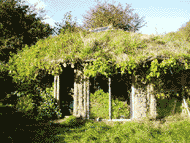
Roundhouse by Tony Wrench and Jane Faith.
Miscellaneous: There are many other ways to reduce the cost of the home and cut energy bills. Here are a few additional ideas:
- Heat with wood scraps from sawmills, cabinet shops and tree trimming companies. You can also use coppiced wood and pallets. No need to buy wood in most cases. And no need for an expensive wood stove. For about 10 years, we heated our old farmhouse in Colorado with an old $50 Ashley stove, and then sold it when we moved for $50.
- Using recycled materials can save you a small fortune, and add unique character to your home.
- Blown-in cellulose insulation has a higher insulation value per inch than fiberglass, and maintains a higher value due to less settling.
- Get free cost estimates if possible from lumber yards and then shop and compare prices – typically no one lumber yard has lower prices on everything.
- Only hire contractors who come highly recommended by those you know and trust, and whose work meets your standards.
- Add ceiling fans to help circulate air and cut utility costs.
- Use energy-efficient windows, doors, lighting and appliances such as solar or on-demand water heating.
- Ventilate your house on hot summer nights by opening some windows.
- Be diligent on caulking and weatherizing – high rates of infiltration will greatly increase utility bills.
- Choose low maintenance materials whenever possible (stucco, metal roofing, windows that don’t require painting, etc.).
- Affordable roof options such as domes, reciprocal roofs, living roofs, pole construction, pallet trusses, thatch, etc.
- Provide adequate attic ventilation with soffit and ridge vents.
- Earth-berming and earth-sheltering for improved energy performance.
- Grow your own food. This can include a small indoor kitchen garden or attached greenhouse. Potential savings: thousands of dollars and additional energy savings long term.
Step 3: Additional Savings from Building with Earthbags
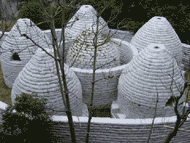
Earthbag Dome by Akio Inoue, Tenri, Japan.
Here are just a few ways of saving money by building with earthbags:
- The answer may be right under our feet – the earth. Building with earth is a timeless building tradition with some structures lasting many hundreds of years. Over a third of the buildings in the world are earthen structures. Earth is probably the least expensive building material (literally dirt-cheap), and therefore holds enormous potential for solving our housing crisis.
- Recycled bags are readily available in most places. Polypropylene or burlap bags are ubiquitous, being used for all types of grain, fertilizer and animal feed, and sometimes for concrete, plaster and other products. Talk to local farmers and feed supply outlets.
- Misprinted bags are often available direct from manufacturers at greatly reduced prices. Between misprinted bags and recycled bags (in good condition) you can cut the main expense of earthbag building to almost nil.
- No special mix is required. Most soils, including those on or near most building sites, are adequate or can be adjusted with sand or clay to create an appropriate mix. This makes the other primary material for earthbag building basically free or close to it.
- You can order special mixes of earth from sand and gravel producers, such as road base and reject fines at very low prices. The main expense is delivery, but this has to be weighed against your time and effort to dig it from the ground. Spending $200
- $300 for delivery of an excellent mixture that’s free of large rocks and roots can save a great deal of hard labor. And, they'll dump it in piles around the building site to speed construction and save even more work.
Step 4: Conclusion
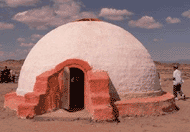
Gobi adobe
The two largest obstacles to home ownership are expensive building materials and overly complex construction methods that require specialized skills and equipment. The problem is so acute that over 70 percent of Americans are unable to afford contractor-built homes. With the current downturn in the economy and the loss of millions of jobs, the housing situation in the U.S. is definitely taking a turn for the worse.
Everyone needs a place to live - shelter is a basic need. But since the current system is bypassing the vast majority of the population, it's time to turn to simpler, more affordable building methods.
Using dirt-cheap building materials -- earth, sand, gravel, straw, recycled materials, etc. -- and eliminating expensive contractors and specialized equipment, the cost of construction can be slashed to a fraction of conventional housing costs.
Natural building – using locally available, minimally processed natural materials – is the logical solution. There is simply no other way to create affordable housing for all those in need.
Step 5: Links to Other Low Cost Projects

A Green Home by Simon Dale
Here are a few links to show what others have done using earthbags and other low-cost natural building methods:
- Simon Dale: Low Impact Woodland Home , Pembrokeshire, UK: Reminiscent of a Hobbit house, this incredibly beautiful home offers inspiration for those seeking a simpler, better way of living and building.
- EarthDome House: at TerraSante Village, Tucson, Arizona: This small, 12′ dome is right at home in the desert. It is made of earthbags with a ferrocement roof insulated with recycled styrofoam.
- Tony Wrench and Jane Faith: That Roundhouse , West Wales: Author Tony Wrench and his partner have enjoyed the good life in their sod-covered roundhouse for many years. They have become internationally recognized champions for their efforts to create more equitable housing rights.
- Pedro and Christina: House Alive cob house in Xipolite, Mexico: House Alive does great work through their workshops and seminars. This particular structure demonstrates the use of cob and thatch to make a beautiful, affordable home in Mexico.
- Simone Swan: Adobe Vault in Presidio, Texas: Trained under the renowned Egyptian architect Hassan Fathy, Simone Swan carries on the timeless tradition of building vaults and domes of earth. The vault shown on this web page could be built almost for free by an owner-builder (excluding mechanicals, permits, etc).
- Penny Livingston: Straw Bale Vault , Permaculture Institute of Northern California: This vault utilizes straw bales for both the walls and roof. This minimizes materials and labor, and creates a superinsulated structure.
- Akio Inoue: Earthbag Domes, Tenri, Japan: Professor Inoue has completed at least 23 earthbag buildings in 7 countries.
- Khimsar Sand Dunes Village,: Adobe Guesthouses , Africa: These strikingly beautiful guesthouses are based on centuries-old indigenous building techniques that enable them to blend in to the environment seamlessly.
- Loei Leela Wadee Resort: adobe vault and thatch roof in Loei, Thailand: Simple yet elegant, these guesthouses are designed to stay cool in the summer and comfortable in the winter.