Rammed earth
[From Wikipedia, Mar, 2012]
Intro
Rammed earth builds walls using the raw materials of:
- clay
- sand
- chalk
- lime
- gravel.
The English version, cob, contains straw.
Rammed-earth walls are:
- simple to construct
- cheap in materials but costly in labor/time
- noncombustible
- thermally massive
- strong
- durable
- easily and cheaply maintained
They can be labour-intensive to construct without machinery (powered tampers), however, and they are susceptible to water damage if inadequately protected or maintained.
Rammed-earth buildings are found in cold to hot and wet to dry regions across the world, limited only by design appropriate to the climate.
Overview of use
Model of mold
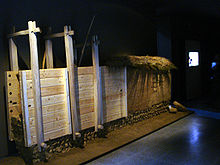
Building a rammed-earth wall involves compressing a damp mixture of earth that has suitable proportions of sand, gravel and clay (sometimes with an added stabilizer) into an externally supported formwork or mold, creating either a solid wall of earth or of individual blocks/bricks.
Historically, such additives as lime or animal blood were used to stabilize the material. Modern construction uses lime, cement or asphalt emulsions. Some modern builders also add coloured oxides or other items, such as bottles, tires, or pieces of timber, to add variety to the structure.
Formwork
The construction of an entire wall begins with a temporary formwork, usually made of wood or plywood, to act as a mold for the desired shape and dimensions of each wall section. The form must be sturdy and well braced, and the two opposing wall faces clamped together, to prevent bulging or deformation from the large compression forces involved.
Process
Farmer's mold, North Vietnam
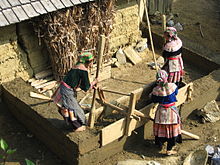 Damp material is poured in to a depth of 10 to 25 cm (4 to 10 in) and then compacted to around 50% of its original height. The material is compressed iteratively, in batches, gradually building the wall up to the top of the frame. Tamping was historically done by hand with a long ramming pole, and was very labour-intensive; modern construction can be made more efficient by employing pneumatically powered tampers.
Once a wall is complete, it is strong enough that the forms can be removed immediately. This is necessary if a surface texture will be applied (e.g. by wire-brushing), since the walls become too hard to work after about an hour.
Construction is best done in warm weather so that the walls can dry and harden. The compression strength of the rammed earth increases as it cures; it takes some time to dry out, as much as two years for complete curing. Exposed walls should be sealed to prevent water damage.
In modern variations of the method, rammed-earth walls are constructed on top of conventional footings or a reinforced concrete slab base.
Where blocks made of rammed earth are used, they are generally stacked like regular blocks but are bonded together with a thin mud slurry instead of cement. Special machines, usually powered by small engines and often portable, are used to compress the earth into blocks.
Strength
The compressive strength of rammed earth can be up to 4.3 MPa (620 psi). This is less than that of concrete, but more than strong enough for use in domestic buildings. Indeed, properly built rammed earth can withstand loads for thousands of years, as many still-standing ancient structures around the world attest.
Rammed earth using rebar, wood or bamboo reinforcement can prevent failure caused by earthquakes or heavy storms. Adding cement to clay-poor soil mixtures can also increase a structure's load-bearing capacity. The USDA has observed that rammed-earth structures last indefinitely and could be built for no more than two-thirds the cost of standard frame houses.
Cost
Soil is a widely available, low-cost and sustainable resource, and utilizing it in construction has minimal environmental impact. This makes rammed-earth construction highly affordable and viable for low-income builders. Unskilled labour can do most of the necessary work, and today more than 30 percent of the world's population uses earth as a building material.
While the cost of material is low, rammed-earth construction without mechanical tools can be very time-consuming; however, with a mechanical tamper and prefabricated formwork, it can take as little as two to three days to construct the walls for a 200 to 220 m2 (2,200 to 2,400 sq ft) house.
Thermal mass
One of the significant benefits of rammed earth is its high thermal mass; like brick or concrete construction, it can absorb heat during the day and release it at night. This moderates daily temperature variations and reduces the need for air conditioning and heating. For colder climates, rammed earth walls can also be insulated with a Styrofoam or similar insert. It must also be protected from heavy rain and insulated with vapour barriers.
Humidity
Rammed earth can effectively control humidity where unclad walls containing clay are exposed to an internal space. Humidity is held between 40% and 60%, the ideal range for asthma sufferers and for the storage of such susceptible items as books. The material mass and clay content of rammed earth allows the building to "breathe" more than concrete structures do, avoiding condensation issues without significant heat loss.
Surface detail
Surface detail of a rammed-earth wall: apart from the patches of damage, the surface shows regular horizontal lines from the wooden formwork used in constructing the wall and subtler horizontal strata from successive layers of compacted earth.
Untouched, rammed-earth walls have the colour and texture of natural earth. Moisture-impermeable finishes, such as cement render, are avoided because they impair the wall's ability to desorb moisture, necessary to preserve its strength. Well-cured walls accept nails and screws easily, and can be effectively patched with the same material used to build them. Blemishes can be repaired using the soil mixture as a plaster and sanded smooth.
Sound insulation
The thickness, typically 30 to 35 centimetres (12 to 14 in), and density of rammed-earth walls make them suitable for soundproofing. They are also termite-resistant, non-toxic, inherently fireproof and ultimately biodegradable.
Environmental aspects and sustainability
Because rammed-earth structures use locally available materials, they usually have low embodied energy and generate very little waste. The soils used are typically subsoils low in clay (between 5% and 15%), the topsoil being retained for agricultural use. Where soil excavated in preparing the building's foundation can be used, the cost and energy consumption for transportation are minimal.
Rammed-earth buildings reduce the need for lumber because the formwork is removable and can be repeatedly reused.
When cement is used in the earth mixture, sustainable benefits such as low embodied energy and humidity control will not be realized. Manufacture of the cement itself adds to the global carbon dioxide burden at a rate of 1.25 tonnes per tonne of cement produced.
Partial substitution of cement with alternatives such as ground granulated blast furnace slag has not been shown to be effective, and raises further sustainability questions.
Rammed earth can contribute to the overall energy-efficiency of buildings. The density, thickness and thermal conductivity of rammed earth make it a particularly suitable material for passive solar heating. Heat takes almost 12 hours to work its way through a wall 35 cm (14 in) thick.