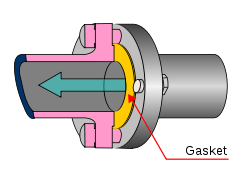
Various types of gaskets are available depending upon their construction, materials, and features. The following are types of gaskets commonly used:
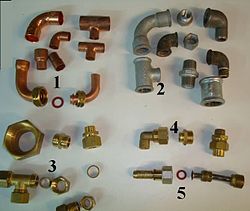
When two copper tubes are being connected, one can be heated and expanded, to fit over the other, and then the two are brazed together. In contrast, to save time, piping and tubing are usually inserted into fittings to make connections. To avoid confusion, connections are conventionally assigned a gender of male or female, abbreviated as "M" or "F", with the implication that, when coupled, the male fitting always goes inside the female fitting.
|
An elbow is a pipe fitting installed between two lengths of pipe or tubing to allow a change of direction, usually a 90o or 45o angle, though 22.5o elbows are also made. The ends may be machined for butt welding, threaded (usually female), or socketed, etc. When the two ends differ in size, the fitting is called a reducing elbow or reducer elbow.
Elbows are categorized based on various design features as below:
A 90o elbow is also called:
It is a fitting which is bent in such a way to produce 90 degree change in the direction of flow in the pipe. A 45o elbow is also called a "45 bend" or "45 ell". |
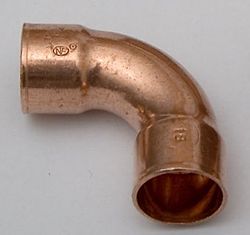
Long radius or sweep 90o elbow (copper sweat)
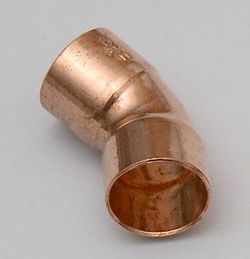
Short radius or regular 45o elbow (copper sweat)
|
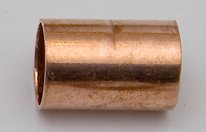
A coupling or connection connects two pipes to each other. If the size of the pipe is not the same , the fitting may be called a reducing coupling or reducer, or an adapter. By convention, the term "expander" is not generally used for a coupler that increases pipe size; instead the term "reducer" is used.
|
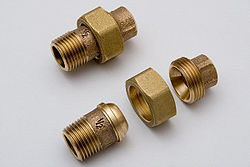
A union is a coupling designed for easy disconnection of pipes.
Disconnection at a future date might be for maintenance or fixture replacement. A standard union is made in three parts consisting of a nut, a female end, and a male end. When the female and male ends are joined, the nuts then provide the necessary pressure to seal the joint. Since the mating ends of the union are interchangeable, changing of a valve or other device can be achieved with a minimum loss of time. Pipe unions are essentially a type of flange connector, as discussed further below. |
A combination pipe union and reducer (threaded brass)
|
| A reducer allows for a change in pipe size to meet hydraulic flow requirements of the system, or to adapt to existing piping of a different size. Reducers are usually concentric but eccentric reducers are used when required to maintain the same top- or bottom-of-pipe level. The reducer is also a coupler/connection. If the size of the ends of the coupling are not the same, the fitting may be called a reducing coupling or reducer, or an adapter. By convention, the term "expander" is not generally used for a coupler that increases pipe size; instead the term "reducer" is used. |
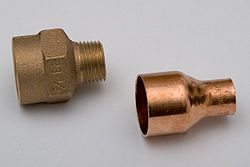
Reducer fittings, bronze threaded (left) and copper sweat (right)
|
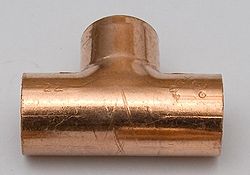
Tee is the most common pipe fittings.It is available with all female thread sockets, all solvent weld sockets, or with opposed solvent weld sockets and a side outlet with female threads. It is used to either combine or split a fluid flow. It is a type of pipe fitting which is T-shaped having two outlets, at 90o to the connection to the main line. It is a short piece of pipe with a lateral outlet. A tee is used for connecting pipes of different diameters or for changing the direction of pipe runs. They are made of various materials and available in various sizes and finishes. They are extensively used in pipeline networks to transport two-phase fluid mixtures. They are categorized as:
| Pipe tee (copper sweat)![]() |
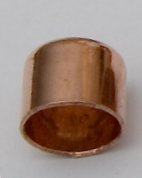
A plug is a pipe fitting, usually liquid- or gas-tight, which covers the end of a pipe. A cap is used like plug, except that the pipe cap screws or attaches on the male thread of a pipe or a nipple. A cap may have a solvent weld socket end or a female threaded end and the other end closed off.
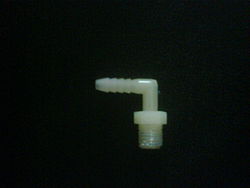
| A plastic elbow fitting with a hose barb on one arm, and a male pipe thread on the other.
A barb is used to connect flexible hoses to pipes. A barb clamp fitting has a male-threaded end used to mate with the female-threads. The other end of the fitting has either a single or multiple barbed tube having a tapered stub with ridges which is inserted into the flexible hose to secure it. An adjustable worm driver screw clamp helps to keep the hose from slipping off the barbed tube. Barb fittings can be made of plastic or brass. Brass is used for hot water applications while plastic is used for cold. The barb fitting can be either elbow-shaped or straight. |
|
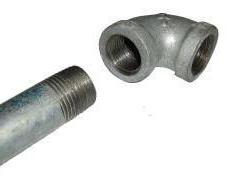
| A threaded pipe is a pipe with a screw thread at one or both ends for assembly. Steel pipe is often joined using threaded connections, where tapered threads (in the US/Canada see National Pipe Thread, in Commonwealth Nations such as the UK, Australia, New Zealand see British standard pipe thread) are cut into the end of the tubing segment, sealant is applied in the form of thread sealing compound or thread seal tape (also known as PTFE or Teflon tape), and it is then threaded into a corresponding threaded fitting using a pipe wrench. |
MIP pipe and FIP elbow fitting (steel threaded)
|
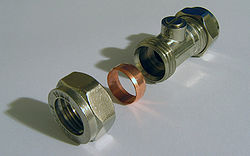
| Compression fittings consist of a tapered concave conical seat, a hollow barrel-shaped compression ring, and a compression nut which is threaded onto the body of the fitting and tightened to make a leakproof connection. Fittings are typically made of brass or plastic, but stainless steel or other materials may be used. |
Compression connectors on an isolating valve. Red metal is a copper compression ring.
|
| Compression connections do not typically have the long life that sweat connections offer, but are advantageous in many cases because they are easy to make using basic tools. A disadvantage of compression connections is that they take longer to make than sweated joints, and sometimes require retightening over time to stop leaks. | |
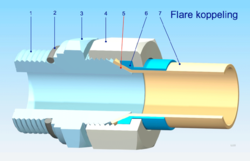
Flare connection:

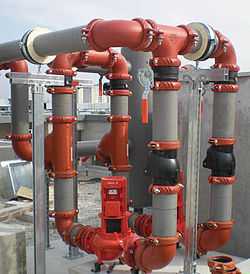
Manufacturers such as Victaulic or Grinnell produce special sleeve clamp fittings that are increasingly replacing classic flanged connections. They typically attach to the end of a pipe segment by using circumferential grooves pressed (or cut, in older designs) around the end of the pipe to be joined. Mechanical connectors are widely used on larger steel pipes, but can also be used with other materials.