Chisels are divided into two general classes:
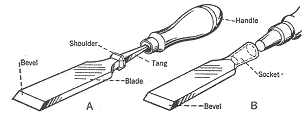
| Parts of the chisel![]() |
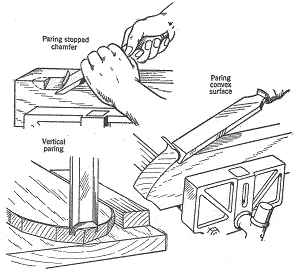
| The grain of the wood must be taken into account when paring with a chisel. If paring is done against the grain, the chisel will have a tendency to follow the grain, digging into the wood and splitting it. If the direction of the grain is not definitely known, make a thin trial cut to see if the chisel digs into the grain. | How to pare![]() |
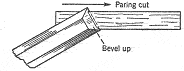
| When paring, the chisel is placed on the surface, bevel side up, with the blade at a slight slant to the line of the wood. This position will produce a shearing or slicing cut. Place one hand on the blade of the chisel, pressing it against the surface of the stock.
This hand controls the forward movement of the chisel. The force that drives the chisel is exerted by the other hand, which is placed on the handle. The depth of cut taken by the chisel is controlled by raising or lowering the handle. Light cuts should be made with a paring chisel. If it is necessary to remove much wood, make a series of fine cuts. | Paring with a chisel![]() |
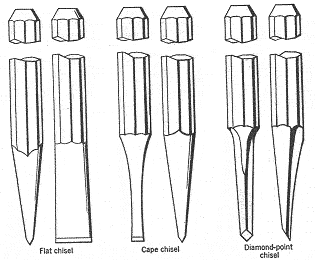
| The cape chisel is used for cutting rectangular grooves such as keyways. Its cutting edge is made wider than the stock immediately behind it to give clearance to the edge. Without this clearance it would bind in the groove as it cut.
Chisels can be made or dressed and ground to many different shapes to meet special conditions, but the same general principles are followed as those which apply to the three described. | 3 types of chisels ![]() |