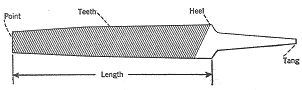
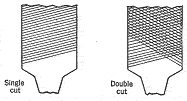
Teeth are formed by pressing or 'cutting' into the file metal, either all one way or by doubling back at an angle to the first cut. There are 3 cuts or three tooth types:
- Single cut: A single-cut file has teeth slanting only in one direction, from left to right toward the point, or end of the file. This type of file is used with light pressure, and produces a fine, smooth finish on metal surfaces or a sharp edge on such cutting tools as scissors, knives, and saw teeth.
- Double cut: A double-cut file has one set of teeth slanting as in a single-cut file with another set, finer than the first, crisscrossing over it in the opposite direction — from right to left toward the point. Greater pressure is used with this type than with the single-cut. Metal is removed f aster, and, therefore, the finish is not so smooth.
- Rasp cut: A rasp-cut file does not have grooves as does a single-cut file. Rather, it consists of rows of individual, separated teeth made by a short, narrow, punch-like cutting chisel. The half-round cabinet rasp which the woodworker uses can be obtained in lengths ranging from 6" to 16". The degree of coarseness may be second-cut or smooth. It provides an extremely rough cut and is used chiefly on wood, leather, aluminum, lead, and other such soft materials. The rasp is used in the same manner as the file. It removes material very fast, but leaves an extremely rough finish.
- A curved-cut file has symmetrical curved grooves extending across its face. It has a rather coarse cut, and is used principally on lead and babbitt.
|
Teeth of files
 |