Hacksaw
The metalworker uses a hacksaw for cutting metal just as the carpenter uses the crosscut and ripsaws for cutting lumber. The hacksaw consists of a rigid frame with replaceable saw blades.
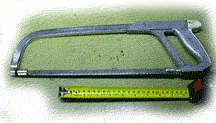 The frame may be solid or adjustable. An adjustable frame, since its length can be changed, will take blades of various lengths. A solid frame takes a blade of just one length.
Grades of hacksaw blades
Hacksaw blades are made of tool steel, properly tempered. The all-hard type is hardened throughout; only the teeth are hardened in the flexible type.
Blades range in length from 6" to 18".
Length is the distance between the two holes, one near each end of the blade. The blade is mounted on the frame by inserting the frame pins (on each end) in the blade holes. Blades are from 7/16” to 9/16" wide and are 0.025" thick. They contain from 14 to 32 teeth per inch. (The number of teeth per inch is called "pitch of teeth.")
Hacksaw frames are so constructed that the blade can be attached parallel to the frame or at right angles with the frame.
Direction of teeth with relation of cutting stroke
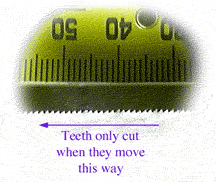 If the teeth of any saw are just as thick as the rest of the saw, there is no clearance for moving the saw through the material; there is no space for the chips to come out. The result is that the saw binds. Therefore there must be a set to the teeth of the hacksaw blade. This set consists of a slight bend to the teeth so that they are at a small angle to the rest of the blade. With the teeth thus set, the saw makes a cut a trifle wider than the rest of the blade.
Hacksaws have three kinds of set:
alternate, raker, and undulated. With alternate set, every other tooth is slightly bent to one side and all the other teeth are slightly bent to the opposite side. In a raker set, every third tooth remains straight, or unbent. The other teeth are bent as they are in alternate set. When the set is undulated, short sections of teeth are bent in opposite directions, the teeth in each section gradually increasing and decreasing in degree of bend.
Selecting blades
In choosing the correct blade for the particular job, there are two main considerations: (1) Should it be all-hard or flexible, and (2) what should the number of teeth per inch (pitch) be? The answers vary:
- Use the all-hard blade for brass, tool steel, cast iron, rails, and other stock of heavy cross section.
- Use a flexible blade for hollow shapes and metals of light cross section, such as channel iron, tin, tubing, copper, babbitt, and aluminum.
- Use a coarse pitch, such as 14 teeth per inch, on machine, cold-rolled, or structural steel.
- Use an 18-tooth blade on solid stock, aluminum, tool steel, babbitt, high-speed steel, cast iron, and the like. In fact, this pitch is for general use.
- For tubing, tin, copper, brass, channel iron, and sheet metal of over 18 gage, use blades with 24 teeth per inch.
- For thin-wall tubing, conduits, and sheet metal thinner than 18 gage, use blades with 32 teeth per inch.
Using the hacksaw
Using the hacksaw:
- Select the proper blade, as explained in the previous section.
- Mount it tightly in the frame with teeth pointing forward (away from you).
- In cutting very thin metal, place the work between two pieces of wood or soft metal or against one piece of thick wood alone. Cutting through this assembly prevents chattering, produces a smoother cut, and avoids damage to the material.
- Mark the stock where it is to be cut, with a scriber, pencil, or soapstone. If high accuracy is required, mark the place with a file cut. This can be used to start the saw.
- Grip the work tightly in the vise so that the place of cutting will be very near the jaws of the vise. To prevent marring the work by the clamping of the vise jaws, wood or a softer metal should be placed between the work and the jaws. To hold oval or circular work in a square-j aw vise, filler pieces of wood, leather, or copper should be used to grip the work and prevent scarring. Be sure that metal fillers are bent down over the jaws of the vise out of the way of your fingers.
- Expose as much surface as possible of any odd-shaped work, so that a corner can be cut gradually, not sharply. In this way, a maximum number of teeth can engage the work at one time.
- Start hacksaw cuts by having the blade almost parallel to the surf ace along which the cutting is to be done — never at a broad angle to it.
- The teeth of the blade should always point toward the work and away from the worker. Mounting the blade in the frame in this manner makes the cutting take place on the pushing motion, away from the body.
- At the end of the pushing motion, relieve the pressure on the saw, lift it slightly, and then draw the blade straight back. Never saw faster than 60 strokes per minute.
- After starting the cut with a number of short strokes, make all other strokes as long as possible without banging the saw frame against the work.
- Always keep the blade at the same angle. Changing the angle will bind the blade in the cut and prevent its being moved.Always keep the blade at the same angle. Changing the angle will bind the blade in the cut and prevent its being moved.
- To make a cut deeper than the frame, turn the blade sideways.
- When the work is nearly cut through, raise the saw slightly to prevent the teeth from catching.
Safety precautions
Safety precautions:
- Do not bear too hard on the cutting stroke. The strain may break the blade, and when the pressure is suddenly removed the blade or material may jab into your hand.
- Keep the blade cutting in the same direction all the time. Twisting the blade may break it and result in an accident.
- Do not use a blade with broken teeth, for they prevent smooth sawing strokes. When the jagged part of the broken teeth hits the work, the saw may jump out of the cutting groove and throw you off your balance.
- If the work is not held tightly in place, it may slip and break the saw blade.
- Slow up the last few cuts. Towards the end, the saw may cut through suddenly and let your hands hit on the sharp edges of the metal.
- When using filler pieces of metal in a vise to prevent scarring the work, be sure that they are bent down over the vise jaws. Jagged edges sticking up in the air may cut your fingers.
Power hacksawing
Just as the woodworking shop has its circular saw, so the metal shop has its power hacksaw. The power hacksaw does all the work just described for hand hacksaws, but does it more efficiently and more quickly. The power hacksaw is found in every machine shop except the very smallest. It is used for cutting up bar stock, tubing, pipe, and similar metal forms.