Threads
Back to metal & wood index
Purpose
Nuts, bolts, screws, and studs are used for holding machine parts together or in place. All of these devices depend on threads. A thread is defined as a spiral ridge, uniform in size and shape, placed regularly on the outside or inside of a cylinder.

Threads can be cut by machine or by hand. Special machines are used for quantity production of threaded machine parts. For general requirements in a machine shop, a screw-cutting lathe is employed.

By using taps and dies, threading can be done by hand. This is the means commonly used when the work cannot be brought to the machine, as when threading holes in a steel doorway to receive the screws that will hold the door hinges. In this section on cutting threads, we shall consider only the use of taps and dies.

It is not absolutely necessary for the mechanic to know all the terms and definitions of threading, but for reference the more important ones are included here.
Thread forms
The three commonly used forms of screw threads are:
  • the American National
  • the acme
  • the square.
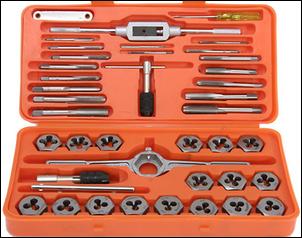
Tap & die kit
not found
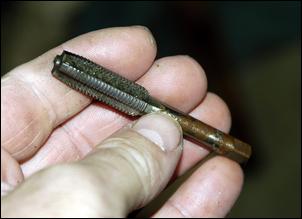
Tap for internal (female) threads
not found
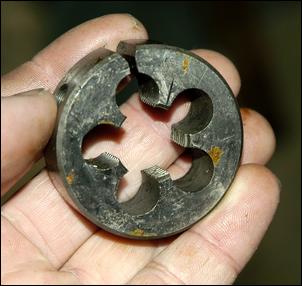
Die for external (male) threads
not found
The American National is most common in US motor vehicle assembly. The rest of the world uses metric threads, but these have 2 categories, coarse threads and fine threads.
The male thread is external, on the outside of a machine part, as outside a pipe or rod end, or on a bolt or screw. The female thread is internal, on the inside of a machine part, as inside a pipe coupling or bolt nut.
Screw parts and measurements
Definitions:
Internal threading
Threads on the walls of drilled holes are made with a tap and tap wrench. Taps are made of highly tempered brittle tool steel, with square ends, or shanks, threaded and fluted for the distance of the threading. They look like screws that have three or four evenly spaced grooves cut across the threads along the length of the tap. These grooves or flutes make up the cutting edges. By permitting the metal that was removed to come out, they prevent binding. They reduce friction by presenting less surface than an unfluted screw would. And they permit lubrication to reach all parts of the tap and hole.

All taps have square shanks to permit the use of a wrench for turning them to cut the thread. Different tap wrenches are used for small and large taps. Each is adjustable to fit all taps in its clans. Generally on the shank of each tap is stamped the manufacturer's name, diameter size of screw, number of teeth per inch, and the type or form of thread.

There are three kinds of taps:
Hole sizes
Taps cannot drill holes. For a tap to be used, a hole of the proper size must first be made. If the hole is too small, the extra pressure and friction of tightness may be so great that the tap will break because of the increased force needed to turn it. If the hole is too large, the threading will be very shallow. This will result in a weak union with the part that is to be screwed into the threaded hole. However, it should be understood that the hole drilled must be smaller in diameter than the required bolt or screw diameter.

Before drilling the hole, read the information stamped on the tap: With this information, consult a table, to find the size of drill to use for the particular hole. When a table is not available the following formulas will give approximately the correct size of the hole to drill for tapping:
If the answer gives a drill hole that does not match a standard drill size, the next larger size in the drill table should be selected. (If the next smaller size is chosen, the hole may be too small and cause the tap to break.) These formulas are not based on a full depth thread, but on a 75% thread, which is the depth used for commercial production work. It is only 5% less efficient than full-depth thread, but it is cut much more easily.
Steps in cutting internal threads
Steps in cutting internal threads:
Removing broken taps
If a tap breaks above the surface of the work, it can be simply removed by grasping it with a pair of pliers or a wrench and using this tool to back out the broken tap. However, if the tap breaks flush with the surface of the work, or below it, it is not so simple to remove. Several methods, though, are available.

Using a small, blunt, cold chisel or a taper punch, gently tap the edge of the tap in a backing-out direction. When it is loosened, a tap extractor can be used. The prongs of the extractor are small enough to fit into the flutes of the broken tap. The collar that holds these prongs is moved down flush to the work and set rigidly in place. Then a tap wrench is used to back out the broken piece.

Instead of using the tap extractor you may back the screw out a few more turns with the cold chisel or taper punch and then remove it as you would remove a tap that breaks above the surface of the work.

Or, you may break the tap further into smaller pieces with a solid punch and hammer. You can then piek out the pieces with a center punch or a magnetized scribe.
External threading
Threads on the outside of a rod or bolt blank are made with a die and stock. The die does the cutting; the stock holds the die and provides the needed leverage. The die may be adjusted and held in the stock by means of a screw place.

Dies are made of hardened tool steel, threaded like a nut but with four evenly spaced grooves cutting across the threads. As with taps, these flutes or grooves provide the cutting edges for removing metal. Also, they provide a path for the metal chips to come out, they reduce friction, and they allow for lubrication. To permit plating the die squarely on the work, the threads on one side of the die are of wider diameter than those on the other side.

Because thread terms and definitions apply to both inside and outside threads, dies agree with taps in diameter, pitch, coarseness of thread, and the like.

A solid die makes threads of just one size. In an adjustable die, however, there is an inset screw which regulates the size of the hole and therefore of the threads cut. An adjustable die is good to use when the material is a little off size or when looser or tighter fits are wanted.

As with taps, the die usually has the following information stamped on one face: manufacturer's name, diameter of screw, threads per inch, and coarseness and type of thread.
Steps in cutting external threads :
Back to metal & wood index