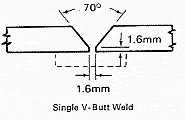
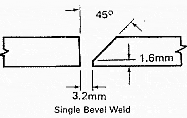
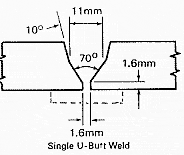
Where either access is more difficult and/or the material is thicker, the edge should be ground away to allow better penetration. This is called a single V butt joint.

| Plate thickness | Single-V butt | Double-V butt |
|---|---|---|
| 4.8mm (3/16") 6.3mm (1/4") 8.0mm (5/16") 9.5mm (3/8") 12.5mm (1/2") 16.0mm (5/8") 19.0mm (3/4") 22.0mm (7/8") 25.4mm (1") 32.0mm (11/4") |
0.416 0.525 0.862 1.190 2.005 2.823 3.869 |
1.265 1.785 2.305 3.125 3.865 5.803 |
| A butt joint occurs where two pieces of metal are offered up to one another. They are on the same level and a small gap is left in between. The weld fills the gap, penetrating through the thickness of the sheet.
Where either access is more difficult and/or the material is thicker, the edge should be ground away to allow better penetration. This is called a single V butt joint. | |
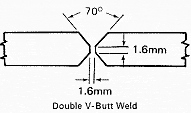
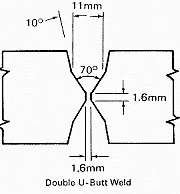
| Material that is thicker again, and which can be accessed from both sides, can use a double V butt joint, where material is bevelled away on both sides. This uses less filler than the single-V butt joint and is therefore less costly. | |
|
| |
| |
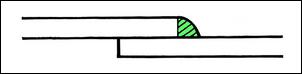
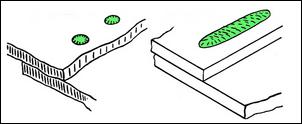
| A lap joint, where the two pieces of material overlap each other, can be a much stronger join than a simple butt joint. Not only is the weld guaranteed full penetration on the exposed end of the material but holes or slots can also be cut to allow plug welds (left) or slot welds (right) to be made. With appropriate penetration, these welds can be very strong. |
|
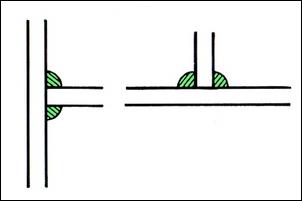
| Another type of join is a T-joint. As with butt joints, the material can be bevelled to allow better access and weld penetration. |
|
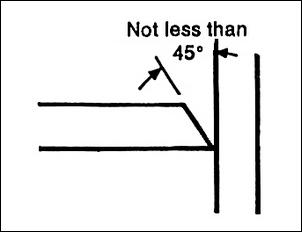
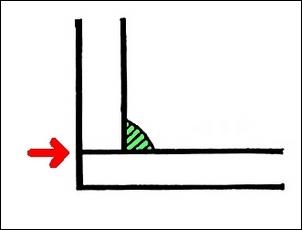
| A fillet weld is used where surfaces join at 90 degrees. This type of weld can have another bead added at the arrow, the latter being especially effective if the surfaces are bevelled to allow better penetration. |
|
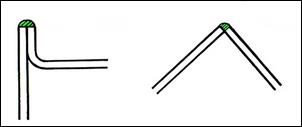
| Finally in common welds, there are edge welds. |
|