Gas welding techniques
To enlarge images and text, hold [CTRL] + click [+/=] several times.
To shrink images and text, hold [CTRL] + click [-/_] several times.
Back to metal & wood index
Nozzles/tips
Tip gauges: Divide by 10 to get the bore tip in mm.
Example: Gauge 12 => 12/10 = 1.2 mm bore diameter.
I use mainly 3 tips - 8, 10, and 12 - and for bigger jobs I use arc welding because the heat given out by bigger tips causes distortion that is hard to allow for. Tip 10 covers a good range of metal thicknesses, with tip 12 for jobs needing a big blast of heat. Practice with them all to see what they can do.
Thick pieces of weld metal abosrb a lot of heat, and are more easily welded if they are pre-heated with the torch especially where you will begin welding. Copper and aluminium conduct heat rapidly away from your advancing weld, so they too may need pre-heating.

Gas pressures:
Flame adjustment - oxy
Quality depends upon flame adjustment. There are 3 types of flame adjustment:
Flame adjustment - LPG
For efficient combustion of LPG, 4 volumes of oxygen match each volume of LPG. Such a flame will provide the high tempeature required and efficient heat input withut wasteful combustion of oxygen. This flame looks like a highly oxidising oxy-acetylene flame, but is nominally neutral.

To obtain this flame:
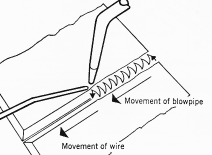
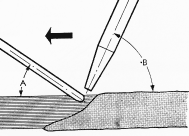
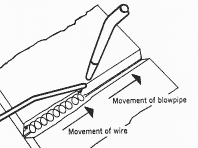
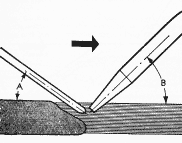
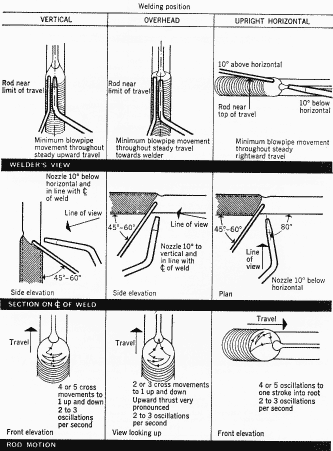
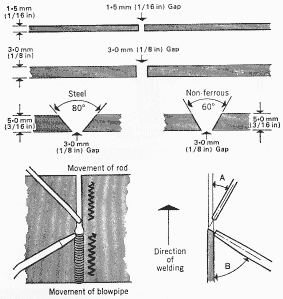
Oxy-acetylene technique
Techniques include:
These techniques elaborated:
Welding rods
Welding rods come in huge numbers, each with its own properties, and identified by its manufacturer's choice of code. It is therefore pointless my recommending any. Your choice will be limited by what your country's manufacturers make and by what your supplier carries in stock. You are dependent upon your supplier's recommendations.

With a little experience you will soon be able to test them to find which work best for you. Since, as a beginner, you will be working mostly with mild steel, you will have no problems with mild steel welding rods. You do not need a flux for mild steel welding. Your only choice is the diameter of rod, and you should buy several so you can match the diameter to different jobs on the site.
Butt joints welding data
This table is a gem because it relates filler rod diameters to plate thickness.
1 op = 1 operator; 2 ops = 2 operators, both welding at the same time.
The image below made formatting this table complicated. It worked perfectly in Firefox (in 2011), but may not in IE (95% of PT.org users, browse with Firefox).
 
TechniquePreparationMetal thicknessFiller rod diameter
D
o
w
n
h
a
n
d
F
o
r
e
h
a
n
d
not found mm
0.8
1.5
2.5
3.0
4.0
5.0
6.0
mm
1.5
1.5
1.5
2.4
2.4
3.2
5.0
B
a
c
k
h
a
n
d
5.0
6.3
8.0
10.0
13.0
16.0
3.0
5.0
5.0
5.0
6.3
6.3
V
e
r
t
i
c
a
l
1

o
p
1.5
3.0
5.0
1.5
1.5
2.4
2

o
p
s
5.0
6.0
10.0
13.0
16.0
2.4
3.2
3.2
5.0
5.0
Recommendations: metal-process-flame-rod-flux
MetalProcessFlameFiller rodFlux
Iron
Wrought iron

Low carbon iron

Galvanised iron

Fusion weld
Braze weld
Fusion weld
Braze weld
Braze weld

Neutral
Slightly oxidising
Neutral
Slightly oxidising
Slightly oxidising

Mild steel
? Combond 411
Mild steel
? Combond 411
? Combond 411

None
Cu&brass
None
Cu&brass
Cu&brass
Carbon steels
Low carbon (M.S.)
(<=0.30% C)
Medium carbon
(0.3-0.5% C)
High carbon
(0.5-0.9% C)
Tool steel
(0.8-1.5% C)

Fusion weld
Braze weld
Fusion weld
Braze weld
Braze weld

Braze weld

Neutral
Slightly oxidising
Slightly oxidising
Slightly oxidising
Slightly oxidising

Slightly oxidising

High test
? Combond 411
Super steel
Nickel bronze
Nickel bronze

Nickel bronze

None
Cu&brass
None
Cu&brass
Cu&brass

Cu&brass
Cast steels
Plain carbon
(<= 0.25% carbon)
Low alloy

Fusion weld
Braze weld
Fusion weld
Braze weld

Neutral
Slightly oxidising
Neutral
Slightly oxidising

High test
? Combond 411
Super steel
Nickel bronze

None
Cu&brass
None
Cu&brass
Cast irons
Grey cast iron

Malleable iron

Fusion weld
Braze weld
Braze weld

Neutral
Slightly oxidising
Slightly oxidising

Cast iron
? Combond 411
? Combond 411
Bronze tng
Cast iron
Bronze
Bronze
Stainless steel
Stainless iron
(12-28% Cr)
Stainless steel
(18%Cr-8%Ni)
Molybdenum Bearing

Fusion weld

Fusion weld

Fusion weld

Strictly neutral

Strictly neutral

Strictly neutral

347 Stainless

347 Stainless

316L Stainless

Stainless

Stainless

Stainless
Cu = copper; C = carbon; Cr = chromium; Ni = nickel; Bronze tng = bronze tinning.
Steel welding
The steels include:
Welding copper and its alloys
These include:
Back to metal & wood index