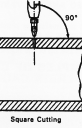
 Give the pipe a quarter of a turn to bring the finishing position (B) back to the starting point (A).
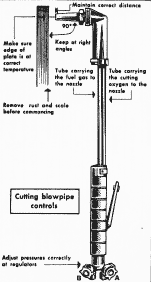
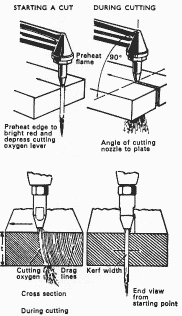 Cutting procedure:
| Plate thickness (mm) | Nozzle size | Cleaning drill sizes | Pressure kPa (psi) | Cutting speed mm/min | Consumption | |||
|---|---|---|---|---|---|---|---|---|
| For Cutting | For Preheat | Oxygen | Acetylene | Acetylene (l/min) | Oxygen (l/min) | |||
| 6 12 20 25 40 50 75 100 125 150 |
8 12 12 15 15 15 15 20 20 20 |
8 12 12 15 15 15 15 20 20 24 |
5x6 6x7 6x7 6x8 6x8 6x8 6x8 6x10 6x10 6x11 |
200 200 250 220 350 400 450 400 450 450 |
100(15) 100(15) 100(15) 100(15) 100(15) 100(15) 100(15) 100(15) 100(15) |
450 380 340 320 270 240 180 150 150 130 |
3.5 4 4.5 6 7 7.5 8 9 10 11 |
17.5 38 42 56 75 85 95 134 155 211 |
| Plate thickness (mm) | Nozzle size | Cleaning drill size | Pressure kPa (psi) | Cutting speed mm/min | Consumption | ||
|---|---|---|---|---|---|---|---|
| For Cutting | Oxygen | LPG | LPG (l/min) | Oxygen (l/min) | |||
| 6 12 20 25 40 50 75 100 125 150 |
8 12 12 15 15 15 15 20 20 24 |
8 12 12 15 15 15 15 20 20 24 |
200 200 250 220 350 400 450 400 450 450 |
100(15) 100(15) 100(15) 100(15) 100(15) 100(15) 100(15) 100(15) 100(15) |
450 380 340 320 270 240 180 160 160 130 |
3.5 4.0 4.5 5.5 5.5 5.5 6.0 6.0 6.5 7.0 |
30 50 58 73 90 99 111 149 171 228 |
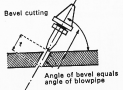 The blowpipe is held at an inclined angle instead of vertically, the angle determining the degree of the bevel. As the thickness to be cut is greater than than the thickness of the plate, decrease the cutting speed and increase the oxygen pressure and preheating flames or increase the nozzle size. The length of the angled cut, not the plate thickness, determines the pressures, speed and nozzle size. Chalk the angle on the end of the plate, and measure the length of the chalk line with your rule.
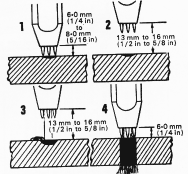 Procedure
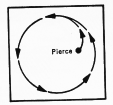
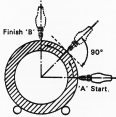 Give the pipe a quarter of a turn to bring the finishing position (B) back to the starting point (A).
| Cause: Correct cut
Appearance Top edge sharp. Smooth surface, draglines barely visible. Very light scale of oxide easily removed. Square face. Sharp bottom edge. Remarks Very light draglines should be almost vertical for profile cutting. For straight cutting a drag of up to 10% would be permissible. |

|
| Cause: Speed too slow.
Appearance Top edge melted and rounded. ower part of cut face fluted or gouged very irregularly. Bottom edge rough. Heavy scale on cut face which is difficult to remove. Remarks The bad gouging in the lower half of the cut is caused by molten steel scouring the cut surface and the hot metal and slag which congeals on the underside is always difficult to remove. |

|
| Cause: Speed too fast.
Appearance Top edge not so sharp and may be beaded. Undercutting at top of cut face. Draglines have excessive backward drag. Slightly rounded bottom edge. Remarks The excessive backward drag of the cut line would result in the cut not being completely severed at the end. The occasional gouging or fluting along the cut indicates that the oxygen pressure is too low for the speed. In other words, if the speed was dropped and the oxygen pressure maintained, a perfectly good cut would result. |

|
| Cause: Nozzle too high above mark.
Appearance Top edge shows excessive melting and rounding. Undercut at top of cut face with lower part square and sharp bottom corner. Remarks The melting of the top edge is due to heat spread each side of the cut. The undercutting is caused by the oxygen stream being above the work, so that it spreads or tends to 'bell-out' as it traverses down the karf. |

|
| Cause: Nozzle too low.
Appearance Top edge slightly rounded and heavily beaded. Cut face usually square with fairly sharp bottom corner. Remarks Having the nozzle too low does not usually spoil the cut face badly, but it does badly burn the top corner. Very often it retards the oxidation reaction and makes it appear that the cut has been too slowly. |

|
| Cause: Pressure of cutting-oxygen too high.
Appearance Regular bead along top edge. Kerf wider at top edge with undercutting of face just below. Remarks This is probably the commonest fault in cutting which causes the rounding of the top part of the cut face caused by turbulence of the oxygen stream due to the high pressure at which it leaves the nozzle. On thiner material it may cause a taper cut which sometimes leads to the incorrect supposition that the cutter is incorrectly mounted in relation to the plate. |

|
| Cause: Preheat flame too large.
Appearance Top edge rounded with melted metal falling into kerf.Top edge rounded with melted metal faliCut face generally smooth, but tapered from top to bottom.Top edge rounded with melted metal faliExcessive tightly adhering slag. Remarks This is the easiest and most obvious condition to correct, which, provided other conditions are correct, usually gives a fairly clean, although excessively oxidised, cut face, but with a very heavy rounding at the top edge. |

|