Net making - intro
This fine work was the creation of:
Percy W Blandford (1941) Netmaking Brown, Son & Ferguson, Glasgow.
He wrote many books and articles of a practical nature, for which he will always be remembered with widespread gratitude. I hope this helps to perpetuate our memory of him.
Tools are few and easily made:
- netting or seine needle:
to wind the line for ease of passing the line thru the knot, and to avoid entangling. It acts as a shuttle and takes several forms:
- For medium and large nets
make the needle from hard wood such as ash, beech, box,
tas Oak, Stringybark.
- For small meshes
use metal or plastic, which allow for springy ends not possible with wood.
- For practise nets
use plywood or softwood, even tho they might not last long.
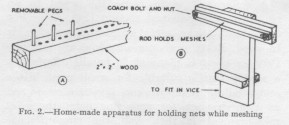 wood bar:
with nails or pegs to hold net when starting. When working on some nets it is convenient to be able to suport a part of the net in a spread-out position. This can be done with a row of nails driven into a bench or table. A board carrying a row of pegs is better. This can be held in a vice or cramped to t table (fig 2A)- mesh gauge:
mesh stick, spool or mesh; to regulate the width of one side or one bar of the mesh. Thus its own width has to be slightly less than the desired mesh width. If thick then the size of the mesh stick is taken to be width + thickness. Choose a flat wood of the right width and between 100mm and 300mm long.
Round the corners. 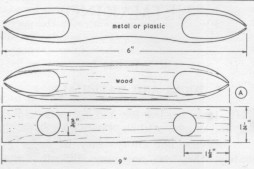
- knife:
A knide with a narrow thin blade is better than a jack-knife or sheath knife. Scissors are useful only with finer lines.A spike is useful for coaxing knots into shape or unpicking work for repair. This can be a marlin-spike, or an engineer's scribe for finer work, or a handled ice-pick for comfortable use.
Types of needles
Descriptions of types of needles:
- Fig 1A:
- A good double-ended needle has springy ends; is popular for small meshes when made of metal or plastic, but the ends are weak if made of wood.
- For nets 40 - 75mm mesh, a wooden needle can be made from 5mm hardwood, about 225mm long. The length is not exact, and the longer length carries more line
- To minimize the bulk, a metal or plastic needle can be narrowed at the middle. Needles should have edges well rounded.
 For extremely fine nets in silk or thread, there are round steel needles with sprung double ends which are loaded in the same way.
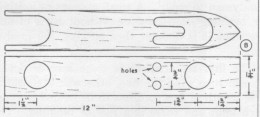
- Fig 1B. This is used more for all nets except those with the smallest meshes.
It must be used always with the point leading. Small sizes are not easy to load and do not hold much line.
For average work a well-rounded hardwood needle, 300mm long by 32mm wide and 5mm thick is good. Sides should be straight of hollowed to reduce bulk, and not curved outwards.
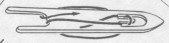 Fig 1C. To load the needle, take a line around the tongue or peg, back down the same side, thru the gap at the bottom, then up around the tongue from the opposite side, and down thru the bottom ap to start the first side again.
 Fig 1D. The 3rd type of needle is only of use in making nets with very large meshes, using comparativley coarse line. When fully wound with line the whole is roughly ball-shaped.
For extensive netting prepare several needles to avoid delay rewinding each time a needle empties.
Needles must be smaller in width than the mesh to allow for the bulk of the line. The longer the needle the more the line it can carry.
Fig 1E. For a mesh stick, choose a flat thin wood between 100 - 300mm. Round the corners.
Fig 1F. A refined mesh stick is planed to an elliptical cross-section. For small meshsticks, metal or plastic is preferable to wood. Brass or aluminium alloys are OK; and perspex is pleasant to handle. Tufnol is strong and suitable for small mesh sticks and needles.
Some prefer a round rod for very fine nets, and this makes the important meazurement half the circumference instead of the width.A very large mesh stick can be lightened by cutting away its middle.
Materials
Any kind of rope, cord, twine, hair, etc can be used for netmaking, so you need to choose what you can afford, what materials are available, and its strength, appearance, and durability.
Choices include:
- Natural fibres
Tend to rot with fresh water immersion, so may need to be treated against bacteris and fungus, and this rot-proofing may need to be repeat thru its life. Small nets can be soaked in Cuprinol or similar, which contains copper naphthenate (giving a green hue).:
- hemp, manila:
for large meshes withstanding heavy weights such as ship-loading by cranes. Coir is not very strong but will float.
- sisal:
Cheaper than hemp and manila, but is less strong and is very rough on the hands.
- cotton:
Is soft and flexible; and is often used for finer cordage.
- Synthetic fibres
tend to be rot-proof, unaffected by chemicals, do not absorb water, have a long life if not left in the sun:
- terylene:
Most common synthetic; smooth, flexible, strong, with very little stretch. Smooth and slippery; difficult to make knots fixed, altho some versions imitate natural fibre. Braided ropes can be pleasant to work with.
- nylon:
Similar to terylene but is more elastic. Smooth and slippery; difficult to make knots fixed, altho some versions imitate natural fibre. Nylon on nylon can lead to rope failure.
- polypropylene:
floats, relatively cheap, but inferior to good terylene.
- others:
Check them in your area.
For dimensions, it is easy to remember that diameter, mm = circumference in 1/8 inch
Example: 10mm dia --> 10*1/8 = 11/4 inches circumference.
Some smaller cords are meazured in obscure traditional ways, so check before buying.
Lengths are usually in metres.
Cord with a matt finish tends to hold its knots better than slippery cord. Nylon and propylene are very difficult.
Some other materials:
- cotton
- hemp
- whipcord or chalk line from a tool shop.