Sizes and knots
Fig 3: Shapes of meshes
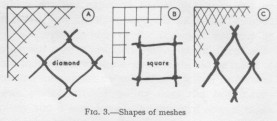 Nets are:
- diamond-meshed
the sides are diagonal to the head of the net
Number of meshes = height / (bar*√2
- square-meshed
the sides are parallel to the head of the net and at right-angles to it.
Number of meshes = height / bar
Diamond-mesh is easier to make, and the diamond shaped from a square to a narrow spearhead, depending on how the net is stretched. A net using square mesh cannot be altered in size without distorting it.
It is unwise to stretch a net too much in the width since this has a tendency to loosen the knots, so it is better to have enough meshes in the width so that each hangs longer than it is wide in normal use, rather than the other way.
Fig 4: Meazuring mesh
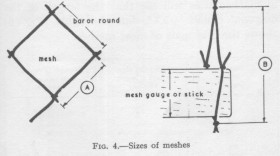 The side of the mesh is usually known as the bar and this length is normally quoted as the mesh size (Fig 4A). It is a little more than the width or half-circumference of the mesh stick. Unfortunately it is the custom in some places to this a "round" and to give twice this (extended mesh) as the mesh size (fig4B).
Another custom is to quote size as so many round pre foot or yard of fully-extended net. The width of the gauge or mesh stick is the best guide and this is the recommended way of quoting a mesh size.
The size of the mesh will depend upon the purpose of the net, and local laws. Altho exact calcualtions are unnecessary, remember that if the net is stretched one way, it shrinks in the other.
If a diamond mesh is drawn with its sides at 45 degrees (Fig 3A) its diagonal meazurement can be determined and divided by the required width to give the number of meshes.You can use either the rule:
Length of the diagonal = bar*√2.
Number of meshes per metre = 1m/(bar*√2)
Fig 4b: Meazuring mesh
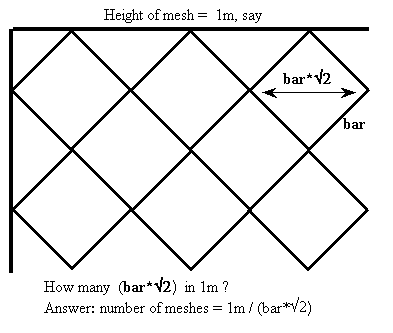
If height of net = 1.5m
and the law says the smallest mesh is 50mm,
then number of meshes = 1.5m/(50mm * √2 = 35.35
which we might take to the nearest,
as 35 diamonds to span this height.
For a quick result
:
Number of meshes = height * 0.707 / bar
and do not forget to include your units
because 1m / mm = 1000, so 1m * 0.707 / 50mm = 35 mesh,
not 0.014 mesh.
For diagonal mesh
Calculations in imperial units (inches).
Fig 5a: Diamond-mesh sizes (inches)
Bar =
side of mesh
(inches) | Diagonal when
mesh is square
(inches) | Number of meshes
per yard
(36 inches) |
|---|
1/2
3/4
1
11/4
11/2
13/4
2
21/2
3
31/2
4
5
6
|
11/16
11/16
17/16
13/4
21/8
21/2
213/16
39/16
41/4
415/16
55/8
71/16
81/2 |
51
33
25
20
17
141/2
13
10
81/2
7
61/2
5
41/2 |
Calculations in metric units (mm).
Fig 5b: Diamond-mesh sizes (mm)
Bar =
side of mesh
(mm) | Diagonal when
mesh is square
(mm) | Number of meshes
per metre
(1000mm) |
|---|
13
19
25
32
38
44
50
63
75
100
125
150 |
18
27
35
45
54
62
71
89
106
141
177
212 |
55.6
37
28.6
22
18.5
16
14
11
9
7
5.6
4.7 |
Security
It is better for security of knots to have the meshes longer than they are wide, which adds up to 25% more meshes.
Nets are:
- diamond-meshed
the sides are diagonal to the head of the net
Number of meshes = height / √(bar2 + length2)
Multiply the bar by itself, bar * bar; multiply the length of the mesh by itself, length * length.
Add the two together: bar * bar + length * length.
Take the square root of this number: √(bar2 + length2)
and divide it into the height of the net: height / √(bar2 + length2)
- square-meshed
the sides are parallel to the head of the net and at right-angles to it.
As before, number of meshes = height / bar
For elongated diagonal mesh
When the diamond is off-square to make knots more secure, the width is reduced and the length increased.
Fig 6: Elongated-diamond-mesh sizes
Bar =
side of mesh
(inches) | Reduced
horizontal
diagonal
(inches) | Number
of meshes
per yard height
(36 inches) | Lengthwise
diagonal
(inches) | Number
in 1 yard
length
(36 inches) |
|---|
1/2
3/4
1
11/2
13/4
2
21/2
3
31/2
4
5
6
|
9/16
7/8
11/8
13/4
2
21/4
23/4
31/2
4
41/2
51/2
7 |
Before
(51 -->)
(33 -->)
(25 -->)
(17 -->)
(141/2 -->)
(13 -->)
(10 -->)
(81/2 -->)
(7 -->)
(61/2 -->)
(5 -->)
(41/2 -->) |
64
41
34
20
18
16
13
10
9
8
61/2
5 |
7/8
11/2
111/16
27/16
27/8
33/8
41/4
47/8
53/4
63/4
81/2
93/4 |
41
24
21
15
13
11
81/2
7
6
51/2
4
31/2 |
Knots
Knots are designed to have 2 characteristics:
- easy to loosen
- with minimal reduction of rope strength.
If a knot is difficult to untie, it becomes dangerous in a difficult situation, as in a storm.
If the knot weakens the rope, even temporarily, the rope under strain may break at the knot. With a 'bad' knot, a rope which normally might lift 1 tonne, might break at half a tonne or less. If you do not know how far you can trust it, why trust it at all ? Choose a safer knot.
Since there are many knots from which to choose, why choose one which does not untie easily and which weakens the rope ?
Sheet-bend
The main knot in net-making is the sheet-bend.
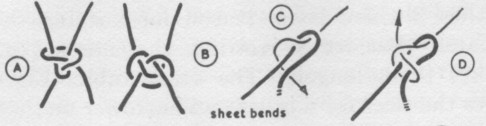
Fig 7: Diamond-mesh sizes
The sheet is the rope attached to the flappy end of the sail (while the halyard hauls the sail up the mast).
A bend is a knot used to tie to something. Not every knot ties to somethng. A reef knot, a turk's head knot, or monkey knot, do not tie to anything but themselves. So we say I am bending the sheet to the mainsail.
Sheet bend = common bend = weaver's knot.
In netmaking, the upper mesh takes the place of the cringle at the clew of the sail (the ring on the flappy end of the sail) and a line is worked thru it (Fig 7A). The knot must take the correct shape or it will fail, that is, slip (Fig 7B).
The sheet bend is one of the best joining knots. It can join ropes of different thicknesses, in which case, the thicker is bent back on itself while the thinner threads up thru the loop (Fig 7C), around the back, then forward around the loop and under itself (Fig 7D). It does not matter if the two ends are on the same or opposite sides.
Fig 7 Reef, granny
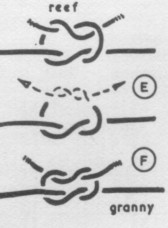 Never use a reef or square knot for this purpose. A reef knot is for reefing a sail and nothing else. It is designed to undo easily and quickly with a simple one-hand tug, and so cannot be trusted.
In a reef knot each end is on the same side as the standing part, that is, the long part of the rope (Fig 7E). this is achieved by twisting the second time in the opposite way to the first.
In a granny knot both are twisted the same way, resulting in the ends being on opposite sides to each other (Fig 7F). The granny knot can slip easily yet, after the rope has been under strain, is impossible to untie by hand. It also weakens the rope. Never use a granny knot.
Stopper, thumb, 8
Stopper knots are tied to the ends of lines ot prevent strands unlaying (unravelling) or to prevent the lines pulling thru holes or loops. The simplest stopper knot is the thumb or overhand knot (Fig 7G).
Figure-of-8, thumbs
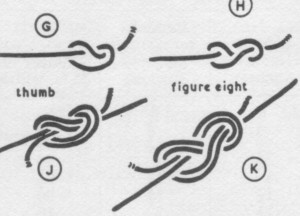 If the end is taken around and into the loop the opposite side, the slightly bulkier figure-of-8 knot results (Fig 7H). Both have their uses in joining lightline by taking the new line back around the knot (Fig 7J, 7K). One of these knots is preferable to the common way of putting the two ends together and making an overhand knot (Fig 7L) since this weakens the line by putting an acute bend in it.
An overhand knot to make a loop (Fig 7M) is satisfactory in a light line, but in heavier line a bowline is better (Fig 7N).
Fig 7 L, M - thumb joint, thumb loop

Fig 7 N, P - Bowline
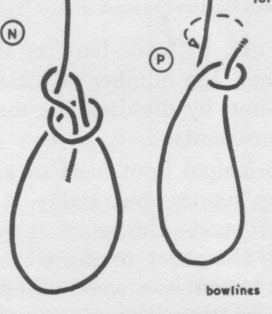
Bowline (bo-lin)
The beginner's way is to make a small ring (Fig 7P) then bring the end up thru the ring, around the back, then forward and down thru the ring again. (The line to remember is the rabbit pops up out of the hole, runs around the tree and back down into the hole.)
The better, one-handed version is:
- pass the rope around something, such as a post, ring or your waist, so the standing part is held in place but remains loose
- the end comes up your wrist, along your palm to be held between 2 fingers and thumb, with about 300mm hanging free.
- lay your wrist across and over the standing part
- bend your wrist down over the standing part, curling inwards towards your body, and up to flick the free end up and outwards so it falls outside the far standing part (Fig 7Q, 7R)
- with your 2 fingers, pass the free end around the standing part, guiding it with your middle finger, to be grasped between index finger and thumb, whence it is pulled thru the loop made by your wrist.
- still with one hand, snug down the knot, that is, make it shapely and firm so as not to distort and fail.
- tug the bowline towards you against the standing part, to test it
Fig 7 Q, R - Bowline
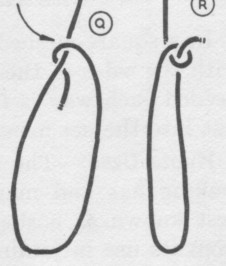 This second method is much quicker, more reliable, can be done with one hand and be done easily in the dark. Why use the beginner's way ?
Fixing net to rope
Netting sometimes has to be fixed to a stout rope or a rod. The standard knot for this is a clove hitch (Fig 8A). If the end of th erod is accessible, 2 loops can be made (Fig 8 B) and dropped over. Alternatively, the working part is taken over the rod, around it and over it own standing part (Fig 8C). Continue around the same way, keeping clear of the standing part and pass the end under the loop just formed (Fig 8D).
Fig 8 A, B, C, D - sheet bends
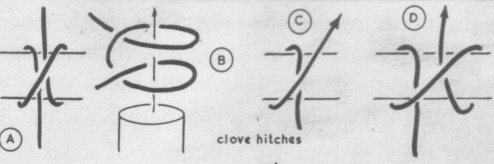
Fig 8 E, F, G - Lark's or cow hitches, clove hitch
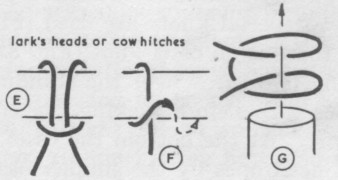 Sometimes it is preferable to use a lark's head or cow whitch since this brings the ends out together (Fig 8E). This is started like a clove hitch but after the first hitch around a post the direction is reversed. (Fig 8F). If the end of the post is accessible, a loop is doubled back on itself and slipped over (Fig 8G)
Where a fishing net has to be suspended below a stout backing rope by a number of short ropes called "ossels", 2 special knots are used. (Fig 8H). At the top there is an ossel knot (fig 8J), formed by working 2 turns over the standing part, then another turn before tucking the end under the first part. At the bottom the ossel is joined to the net headropes by the simpler ossel hitch (Fig 8K).
Fig 8 H, J, K, L, M - ossel knots
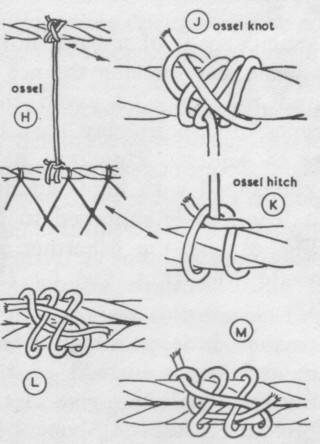 A single rope, particularly if of natural fibre, will swell and twist when wet, causing the net it supports to foul and roll up. To avoid this trouble, 2 headropes of oppositie laymay be used for the edges of seines. They are held together and buoys attached with knots similar to the osssel knots. The end is supposed to be tucked away (Fig 8L) by the fishermen of Looe and the opposite way (Fig 8M) by the fishermen of clovelly.
For decorative reasons it is possible to use some of the ornamental knots instead of the basic sheet bend. Some examples are given later and more cand be found in a knotting book. It is also possible to join heavy ropes with seizings instead of knots and details are given in Ch IX.
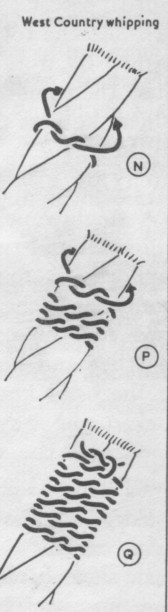
When anything bigger than cord is used for nets, the ends must be whipped. There are several whippings, but a good general-purpose is the "West Country" (Fig 8N, P, Q).for most netmaking, ropes use stout thread or sail twine and pull it thru a lump of wax or piece of candle before use. Put the middle of a piece of line behind the rope and ite an overhand knot in front (Fig 8N). take the ends to the back and tie another knot there. Continue tying back and front tightly (Fig 8P) and closely until the whipping is about the same length as the thickness of rope, or 10mm (3/8 inch) if the rope is thicker than that, and make the last overhand knot into a reef knot (Fig 8Q).
Fig 8 N, P, Q - whipping
 An end of most synthetic cordage can be melted by heating wiht a flame, then the molten fibres are rolled with a mostened finger and thumb to seal the end. (Caution: molten plastic, nylon, etc can stick to the skin while continuing to burn.) This may be all the finish needed for small line, but rope should also be whipped for additional security, as stranded rope will unlay quickly for a considerable distance if not restrained. For this reason any cut ends should be sealed immediately, even if they will get other treatment later. A flame from a gas cigarette lighter gives a cleaneer finish than one from a match, but a red-hot knife is best, with a knife-edge soldering iron adequate.