Netmaking - version 2
Back to net & rope index
From: Steven, GA (1950) NETS - how to make, mend, and preserve them Routledge & Kegan Paul Ltd, London

In his preface, Mr Steven acknowledged his learning from the fishermen of various British Colonies, including British West Africa.
Braiding a net
The usual term applied to the making of nets is "braiding". Almost any kind of rope, twine, cord, string and some kinds of hair can be made into netting.
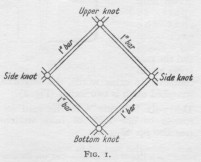
Fig 1
Fig 1
Definitions
A net is a fabric of uniformly-sized squares hung horizontally or diagonally from a rope, woven from thread, twine or cord, by knotting at the intersections for the squares.
The net is connected to the horizontal rope by using clove-hitches.
The knots at the corners of the squares are sheet-bends.
(For explanations on how to tie them, see below.)

The open squares are called meshes. A normal mesh has 4 sides or "bars" of equal length
Bar is the length of one side of a mesh.
Round is the length of each side of a stretched mesh. Round = bar.
Braiding is the making of nets by hand.
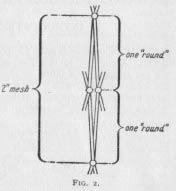
Fig 2
Fig 2 "Xmm mesh" is one way of stating the type of net. Xmm is the distance between opposite knots, center to center, when one mesh is fully stretched. See Fig 2.

To describe a net in England:
50mm net = 50mm mesh
50mm net = 25mm round
50mm net = 25mm bar.
Therefore 50mm mesh = 25mm bar.

Terminology may differ from country to country.

Caution: some people say "25mm net" or "25mm mesh" when they mean "25mm bar". Imagine contracting a netmaker to make you a 100m long 50mm mesh net, when you mean "50mm bar net". (Give him a diagram with the meazurements on.)
Introduction
A piece of netting is easy to recognize and hard to define The Encyclopedia Britannica gives "a net consists of a fabric of thread, twine, cord, the intersections of which are firmly knotted so as to form meshes or interspaces of fixed dimensions - the meshes being usually lozenges of uniform size."
Fig 1
A mesh A normal mesh has 4 sides or "bars" of equal length and it is the length of the bar that determines the size of the mesh. To state the length of a bar is therefore the best way of describing the size of a mesh. Unfortunately makers and users of nets use 4 ways:
Fig 2
Meazuring mesh The second way above, is confusing since a "mesh" is often taken to mean "bar". Use only the first for large mesh and the third for small mesh nets.
The usual term applied to the making of nets is "braiding". Almost any kind of rope, twine, cord, string and some kinds of hair can be made into netting.
Tools
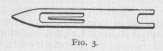
Needle shuttle The tools are few and simple and can be made from wood with a small knife.
Tools:

Gauges

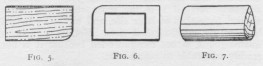
The size of the meshes is regulated by forming them over a mesh-stick or gauge (figures 5, 6, 7). A different gauge is required for each size mesh. Make them from a close-grained wood, such as beech. This table gives a list of gauge sizes matched to mesh sizes. Using the size appropriate for the type of fish you are seeking, checked against the legal size determined by your government, select the gauge size and convert to metric. (1" = 25.4cm)
Fig 5, 6, 7
Types of gauges. The table I have provided is a direct conversion of the scanned table. In this country I would go to the fishing authorities and obtain their tables to avoid law infringement.
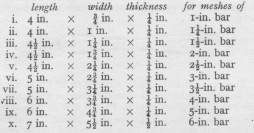
These tables show gauge-sizes matched to mesh-sizes. The left table is in millimetres and the right table is in inches.

Gauge sizes

Length
(mm)
Width
(mm)
Thickness
(mm)
For mesh
(mm)
Gauge-sizes
(inches)
100
100
113
113
113
125
125
150
150
175
19
25
32
45
57
70
83
95
120
140
6
6
6
6
6
6
6
6
6
13
25
32
38
51
64
76
89
102
127
152
Gauge sizes

When using gauges of this pattern the length of a bar will be roughly equal to the width plus the thickness of the gauge.
bar ≈ gauge width + thickness
Gauges for meshes outside this range of sizes will generally be of different length and thickness. All gauges should have one corner rounded off, so that, in use, the rounded corner lies in the palm of the left hand where it fits more comfortably than a sharop corner would do. Some net-makers prefer gauges shaped as in figure 7, in which the length of a bar is 1/2 the girth of the gauge.
Twines
The original cotton fibers are twisted together into long thin threads or yarns that are then further twisted together to form the finished twine.
Twines differ in:
Definitions
Denier: The denier is a unit of weight expressing the size or coarseness of a fiber or yarn. The weight in grams of 9000 meters of a fiber or yarn; the lower the denier, the finer the yarn.
1 denier = mass per 9000 metres (g/9000 m)
1 tex = mass in grams per 1000 metres of yarn = 9 * denier
Yarn: A single thread of the finest part of the material making a twine, cord or rope. For example, a piece of shorn wool is pulled to straighten the single hairs. At the same time, those hairs or fibers are twisted, always either clockwise or anti-clockwise, into a single yarn to bind the hairs together. Two or more yarns (threads) are then twisted together in the opposite of the yarns. If the yarns were made by twisting clockwise then the twine will be made by twisting the yarns anti-clockwise. If a rope is required, then several twines will be twisted together in the opposite (clockwise) direction.
Ply: The ply is the total number of yarns twisted together to make the twine.
Strand: Yarns are twisted into strands; strands are twisted into twine; twine is twisted into rope.
Laid: A laid twine or rope is another name for a twisted twine or rope. (Compare braid.)
Braid: Single braid consists of even number of strands, eight or twelve being typical, braided into a circular pattern with half of the strands going clockwise and the other half going anticlockwise. The strands can interlock with either twill or plain weave. There is a hollow channel down the center of the circular cross-section.
Size: Size can be given as "gauge" denoted by #1, #2, ... , #12, and so on, but fortunately nowadays, size is often given in the more meaningful "mm diameter". The size of the yarn is given as 'denier".

Here is an advertisement from the internet:
Fishing net size: Twine:0.10mm 210D/2PLY
The twine that makes the net is extremely fine, having a diameter of 0.1mm diameter.
This twine is made of 2 yarns (threads), each of 210 denier, that is 9000 metres of this yarn weighs 210 grams.

Here is another advertisement:
Fishing net size: Twine:0.90mm 210D/54PLY
The twine that makes the net is fine, having a diameter of 0.9mm diameter.
This twine is made of the same denier yarn, 210g/9000m, but this time there are 54 yarns plied together.
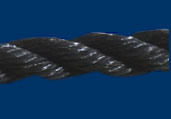
Fig 7b
Making rope Twisted or laid ropes are built up in three steps. First, fibers are gathered and spun to form yarns. A number of these yarns are then twisted together to form strands. The strands are then twisted or plied together to form the rope. The twist of the strand is opposite to that of the yarn, and the twist of the rope is opposite to that of the strand. This counter-twisting helps keep the rope together. However, under tension, this type of rope tends to untwist, which is the cause of spinning, kinking, hockling and stretching. Braided rope solves this problem but is much more expensive.
In figure 7b you can see that the rope and its twine are twisted in opposite directions. With closer study you can see the strands of the twine are twisted in the same direction as that of the rope, that is, opposite to those of the twine. The yarns are too fine to be seen in this photo.
Unfortunately I cannot provide a diagram of the gauges for you because users can alter the dpi and font-size of their monitors, and so change the diagram gauges.
Back to net & rope index