Shaping a net
 Setting-up and braiding a simple piece of flat netting is easy. Shaping a net to meet some particular requirement requires skill and care.
First we need some definitions.
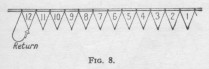
Let us assume that on the original 12 half-meshes we set (Fig 8), we have 9 rounds of half-meshes, which is a net 12 meshes wide and 10 rounds deep (Fig 39). 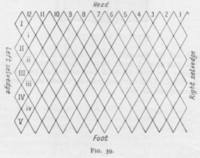 The edge of the net where it was started is known as the head; that where it was finished is the foot; the 2 side edges are the selvedges or selvages.
Altho there are 10 rounds of half-meshes in its depth there are only 9 rows of knots, that is, number of rounds = number of rows of knots +1.
This is because the 1st row of of starting clove-hitches disappeared when the line on which the net was originally set up, was pulled out.
This does not apply to any piece of netting that includes neither the starting nor finishing round. In fig 39 there are 10 rounds of half-meshes to make 5 full-meshes (I-V) and 4 full-meshes (i - iv) in alternate vertical lines along its width, and that there are 12 of each.
That is, there are (12 x 5) + (12 x 4) = 60 + 48 = 108 full-meshes.
This is 12 fewer than the 12 x 10 but the discrepancy is accounted for by there being 12 half-meshes along the head of the net and 12 at its foot which, being the equivialent of 12 full-meshes, make up the correct number.
There would have been no difference in the number of meshes in alternate lines from the head to foot if it was 11 rounds deep; the number would have been 5 in each case. The total number of full-meshes would then have been (12 x 5) + (12 x 5) full-meshes plus 24 half-meshes = (60 + 60 + 12 = 132 (that is, 12 x 11) full-meshes.
In describing the depth of a net it is usual to refer to the number of full-meshes in one vertical line form head to foot, that is, half the number of rounds, disregarding the extra row if the number is odd. Thus a piece of netting having 10 rounds is 5 meshes deep, and apiece having 11 rounds is also 5 deep.
Straight selvages
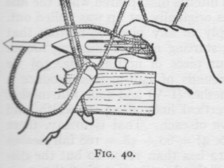
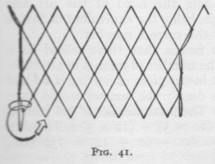
The selvages in alternate rows in the net in Fig 39, hang free. To give a straight edge take up the long arm of the first mesh of every round in its own knot (Fig 40).
The selvages will then appear as in fig 41.
These are also known as double selvages; they increase the strength of the net at its edges.
Bating
The shape of a flat net may be altered by creating a slope in one or both of its sides.
To do this, alter the number of meshes in successive round.
Decreasing = bating. Increasing = creasing.
To bate or reduce the number, pick up 2 half-meshes of the previous round in a single knot of the round that is being made.
To do this, pass the needle first thru one half-mesh and then thru the next one beyond it (Fig 42) before proceeding with the formation of the knot in the usual way (Fig 43).
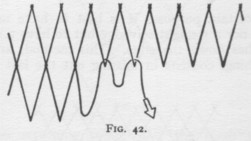
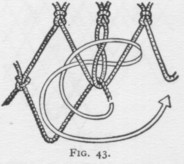
Bating should not be done in the middle of the round but near the selvage that is to be sloped. If the net is to be strongly sloped a bating will be made in every round; lesser slopes are made by bating in every 2nd, 3rd or 4th round and so on.
Fly-meshing
For certain purposes it is best to have neither a normal nor a straight selvage but to have a series of fly-meshes down the edge.
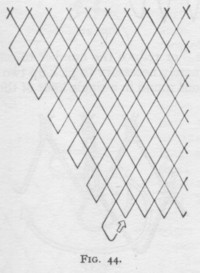
This method, fly-meshing, misses out the last mesh of the previous round (Fig 44). It is not usual to fly-mesh both selvages but this can be done if any special purpose demands it.
Fly-meshing one selvage results in reducing the width by one mesh in every other round. Itis thus equivalent to losing one half of one mesh in every round.
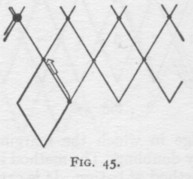
Where special strength is required in fly-meshes, as in the wing positions of fishing trawls, they should be doubled. This is done by doubling the first mesh of each returning round, that is, the mesh that will become the fly-mesh in the next round.
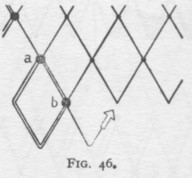
The method is: After making the 1st return in the usual way carry the needle up to the last knot of the previous round and make another knot (Fig 45). This doubles one side. Then continue the return round as before, thus doubling the remainder of the mesh (Fig 46). There will be a double knot at 'a' and b' in each fly-mesh.
Bating by doubling
Another method of sloping, one mesh in every other round, is calleddoubling.
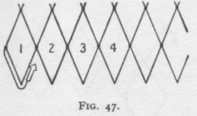
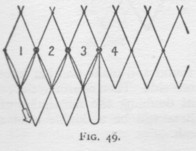
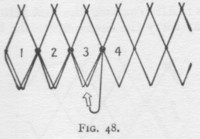
On the completion of any round double over the last few meshes, say 3, (Fig 47), tho any number can be doubled, and return to the selvage (Fig 48). This makes 2 normal single meshes and one long-armed mesh (Fig 49).
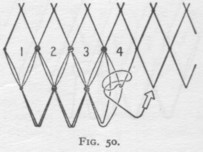
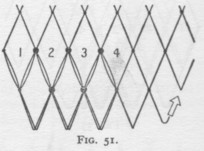
Return again, doubling over the first 2 normal meshes by picking up meshes 2 and 3 of the previous round. Then carry on normally to mesh 4 of the previous round, and pick up the long-armed mesh in the knot. Fig 50 shows this being done and Fig 51 illustrates the knot drawn tight.
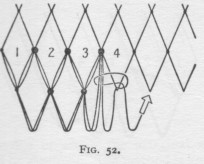
Inspection will show that this reduces the breadth of the net at the rate of one mesh in every other round. A double selvage of this kind can be made without bating if the long-armed mesh is itself doubled over in the 2nd doubling (Fig 52) and the trebled twine is included in the next knot.
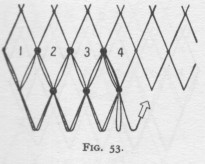
The 3rd part of the long arm then forms a small loop (Fig 53) that can be picked up in the following round and no reduction in the number of meshes takes place.
Doubling & fly-meshing
This is another method for sloping a net.
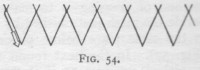
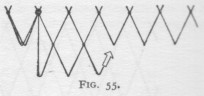
On completion of a row, double over the last mesh and then continue in the usual manner (Fig 54, 55).
On return leave out the long-armed mesh, thus forming a special kind of fly-mesh.
Return, and again double over the 1st mesh as before.
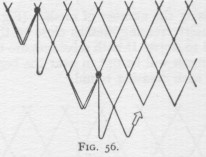
The selvage when examined will then be found to consist of: long-armed mesh, bar of ordinary mesh, double mesh, and so on. (Fig 56).
Creasing
 Creasing is to increase the number of meshes in successive rounds.
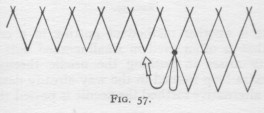
The usual method is to make a small extra mesh beside the mesh just finished by making a 2nd knot in the same place before picking up the next mesh (Fig 57).
In the next round this extra small mesh is picked up just as if it were an ordinary mesh, thus increasing the number of meshes (Fig 58).
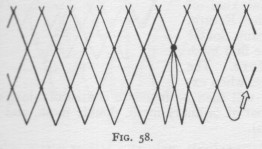
It is usual to insert creasing meshes close to the selvage it is desired to slope.
If both selvages are to be sloped a creasing mesh will be put near the beginning and the end of each creasing round.
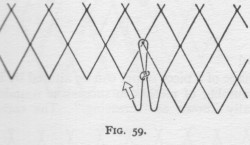
There is another method for small-meshed nets where difficulty arises in pushing the needle thru the small extra loop formed in the way already desribed. In this alternative method the needle is passed thru the nearest half-mesh of the previous row but one. An overhand knot is then made round the long arm so formed before picking up the next mesh in the ordinary way (Fig 59).
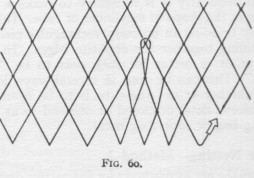
The small loop thus made is not locked as in ordinary creasing, but is free to slide about and is therefore often known as a "slippery mesh". Fig 60 shows what the creasing looks like when completed.