Square netting
In all ordinary pieces of flat, sleeve and bag netting, the meshes hang diamond-wise. In other nets, such as tennis nets and the armouring of some trammel nets, the meshes hang square. In netting made in the ordinary way the meshes cannot satisfactorily be made to hang square no matter how they are mounted on the supporting ropes.
If a net is required to hang squareit must be specially made in exactly the same way as in ordinary diamond netting and the proper hang is given by an ingenious series of batrings and creasings.
The method is as follows.
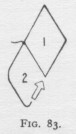
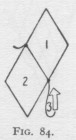
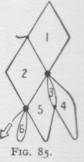
Begin:
- Begin with one mesh, as in chaining out, hung from a hook.
- On it make another mesh (2), working as usual from left to right.
- Make a creasing mesh (3) before beginning the nest round right to left (Fig 84).
- On reaching the left selvage again (with mesh 5) make another creasinf mesh (6) before turning back on the next round, left to right again (Fig 85). In this way, making a creasing mesh on each selvage before beginning the following round, continue until the necessary depth of the net is reached on selvage 'A' (mesh 45 in fig 86).
- When this occurs, make one more row as before, crease again on the far selvage, B, and return to A.
- But when the selvage at A is reached this time, make a bating by picking up meshes 46 and 47 together in one knot when making mesh 64.
- Continue thus, creasing and bating in alternate rounds on opposite selvages, until the required length of net is reached along selvge B.
- Then finish off by bating on both selvages until only one mesh remains.
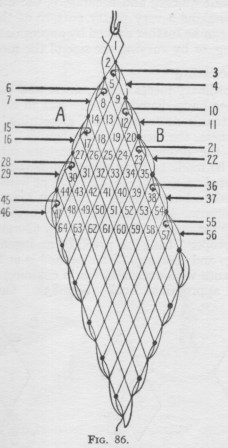
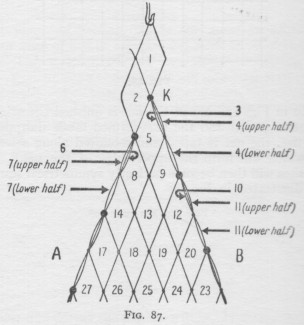
Normal selvages are shown in Fig 86. A stronger margin and neater appearance are obtained by making straight selvages in the usual way, that is, by including in its own knot the long arm of the first mesh ineach row. The result will appear as in Fig 87 with triple twine and double twine alternating along both selvages and at the head an foot of the net. In practice the long arm of mesh 2 would have been included in its own knot at K but this has not been done in Fig 87. When the net is finished the original knot is untied and the first-formed mesh disappears.
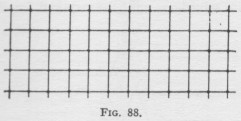
In use, the net is taped and mounted along selvage B which will form the upper edge of the net. The meshes will then become perfectly symmetrical squares as in Fig 88.