Skeleton 1
Large bodies need some inflexible or barely flexible frame to provide shape. Muscles are then attached to provide movement.
As animal life evolved from single-celled organisms to elephants, skeletons had support bigger and bigger masses of animal, so that different solutions were tried. We can assume that most 'experiments' failed, and that the ones which lasted were the best.
The proven best are:
- endoskeleton of silica, calcium carbonate or keratin:
Of rods and fibers. Examples are sponges which have rods and fibres secreted by cells within the sponge.
- exoskeleton of shell:
An inflexible external covering, predominantly of calcium carbonate, such as protozoa radiolarians with hardened secretions surrounding the cell membrane, and mussels having shells of calcium carbonate with muscles attached to the inside. Shells of molluscs do not need to be molted because the space inside increases with the shell, which grows at the lip. Movement is slow, and may be limited to simply opening and closing the shell in order that mouth parts may extrude to gather food (examples, molluscs like clams, oysters, mussels). Mussels which have locomotion do so by extruding a foot, looking like a tongue, which acts like a sucker to pull the shell across the rock.
- exoskeleton of chitin:
An inflexible or barely flexible external covering to which muscles are attached inside. Composed mainly of organic chitin and often strengthened with calcium compounds, the exoskeleton is very lightweight, that is, has a high strength/weight ratio like the carapace of cockroaches, grasshoppers, crayfish, crabs. Flexibility is allowed by soft joints in the exoskeleton. (Check the legs of a grasshopper.) Allows fast movement and even flight. Disadvantage is that, as the body grows, the exoskeleton must be discarded (molted), leaving the next skin temporarily soft, and the animal vulnerable till that skin hardens into the next exoskeleton.
- endoskeleton of bone:
Endoskeleton is an inside frame supporting an animal's body, with muscles attached to the outside. A high strength/weight ratio, allowing huge sizes such as elephants, whales. It is made of either cartilage as in sharks, or of bone and cartilage, as in bony fish through to mammals. Being internal, it cannot be molted and so must grow with the body. This avoids the vulnerability during molting but introduces the problem that it can wear out, crippling the animal, as seen in elderly dogs, joggers and footballers. (Take up cycling.)
Endoskeleton
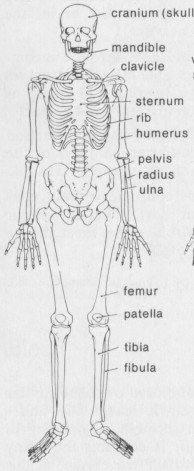 Learn all the bones named in this diagram.
Which joints are ball-and-socket ? How ? Why ?
Which are hinges ? How ? Why ?
Which parts of the limbs allow axial rotation ? How ? Why ?
Cartilage
Cartilage is very flexible, being cells (chondrocytes in lacunae) embedded in a dense network of collagenous and elastic fibers anda matrix of condroitin sulfate.
Cartilage enables bones to slide over each other at the joints, such as the wrist. Initially, in the fetus, the skeleton is entirely cartilage, which is later calcified into bone. At birth, the cartilage allows the head of the human fetus to be considerably re-shaped, allowing it to be squeezed through the mother's pelvis. The head returns to its natural shape before ossification is complete.
Lifting
The mammal body evolved to walk on 4 legs, with the spine horizontal. When humans evolved an upright stance, they took a 4-legged structure and turned it from the horizontal to the upright. Great for running with a spear, but not designed for lifting elephants. The human body is not designed to carry more than one zebra leg back to camp.
The vertebrae are small and light. Between each 2 vertebrae there is a fragile disk of cartilage. This has a small area, so even a small downward force exerts a huge pressure. When lifting with incorrect positioning of the spine, disks can burst, scattering fragments which then press on the nerves, causing a lifetime of crippling pain. Be warned - many people suffer this. Operations are expensive, dangerous and unsatisfactory. There is no cure. Rarely do you get a second chance.
Lift correctly. Lift with a straight spine held as vertically as possible, with back muscles tensed, AND use your thigh muscles to lift, not your back The back should remain at the same angle thruout the lift. Remember, if you straighten your back you are adding the weight of your trunk to the weight of the load - far too much for the fragile human spine.
Furthermore cartilage discs wear and permanently compress with hard use, allowing the vertebrae to press on the nerves, causing damage and lifelong agony.
Your employer should provide the wheel barrows, block-and-tackle, forklifts, cranes and ramps, to avoid heavy lifting. A friend permanently ruined her back with only 6 weeks of carrying concrete blocks up a slope to her house-site. If you cripple yourself at work, your employer will discard you and you are destined for a life of unemployment. It is up to you to refuse to risk lifelong injury.
Bone
Bone is cells embedded in layers of mineral salts such as calcium phosphate, and the protein collagen which makes it flexible. The outer layer of bone, compact bone, is dense for strength, while the inner layer, spongy bone, contains spaces filled with marrow which produces blood cells.
Joints
There are 2 main kinds of joints:
- fused joints:
Fusing locks the bones together, as in the skull
- synovial joints:
Synovial joints are enclosed in a synovial membrane and lubricated with a synovial fluid, with bones coated in cartilage to allow them to slide over each other
as in the hinged elbow joint and the more maneuverable ball-and-socket hip joint.
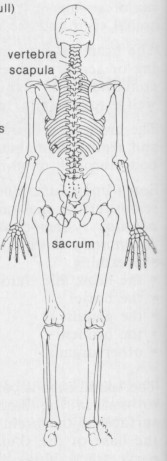
Learn all the bones named in this diagram.
Skeleton groups
The skeleton can be divided into 2 groups:
- axial skeleton:
running from skull to tail but including girdles (pectoral and pelvic) and ribs
- appendicular skeleton:
skeleton of the appendages or limbs.
The skeleton can be seen as a set of bones loosely held together by muscles, tendons and ligaments, making the body very flexible. In the human, these bones are thin and strong, yet able to carry huge amounts of flesh (up to about 0.5 tonne), and external weights in addition. The price we pay is the large percentage of back and knee ailments. Joints and spinal discs wear out with heavy usage.
Axial skeleton
The axial skeleton consists of:
- Skull: the bony case supporting and protecting the brain and some sense organs; and the jaw
- Vertebrae (sing: vertebra): the spinal column consists of vertebrae held together by sets of small muscles, but separated by discs of cartilage which allow the column to twist and bend. The vertebrae have protuberances which enclose and protect the spinal cord while still allowing the spine to twist.
The sequence of vertebrae, with numbers for humans) are:
- neck (7)
- thorax (13)
- abdomen (5)
- sacrum (5)
- coccyx (3)
giving 33 vertebrae for humans. Some snakes have the most with over 400 vertebrae.
Attached to the axial skeleton are:
- Ribs extend from the vertebrae, curving out and around to link to the sternum (humans have 2 pairs of floating ribs, that do not join the sternum). These all protect the lungs and heart, while muscles move them upwards and outwards to draw air into the lungs.
- Pectoral or shoulder girdle consist of the scapula or shoulder blade and the clavicle or collar bone
- Pelvic or hip girdle is the large bone connecting the spine to the legs, and therefore supporting the whole body while running. It thus has to be strong and therefore large, yet have an opening large enough for the newborn to pass through.
Appendicular skeleton
The appendicular skeleton consists of:
- forelimb
- forefoot/hand
- hindlimb
- hindfoot/foot.
Each limb contains:
- attachment:
the limb is attached to the girdle by a ball-and-socket joint
- upper bone:
a single relatively thick bone, with a ball and socket joint at the girdle.
- second joint :
A hinge for the elbow or knee. The knee joint is protected by the patella or knee-cap.
- lower bones:
two lighter bones to give maneuverability of the extremities (hand and foot), allowing rotation of wrist and ankle.
- third joint:
a hinge for wrist or ankle.
- palm or foot:
- fingers or toes:
- tips:
The tips of fingers and toes often end with nails, hooves or claws, made from the structural protein keratin.
| Limb | Girdle | Shoulder/
hip | Upper
bone | Elbow/
knee | Lower
Bones | Wrist/
ankle | Palm | Fingers/toes |
|---|
| forelimb | pectoral | ball | humerus | hinge | radius, ulna | hinge | carpal | meta-phalanges |
| hindlimb | pelvic | ball | femur | hinge | tibia, femur | hinge | tarsal | meta-phalanges |
Bones have holes for blood vessels to enter the spongy layer. Big bones are usually hollow in the middle section, to reduce weight, as in the humerus of the upper arm, and the femur of the thigh..
Red and white blood cells are made inside the bones by bone marrow.
Adaptations
Beaks of birds are 2 very light bony jaws covered by structural protein keratin, and lacking teeth. This sacrifice lightens the head, moving the center of gravity back suitable for flight.
Antlers are solid bone attached to the skull, usually grown each year, and covered with a velvety skin.
Horns are keratin, like our fingernails.