Heart 1

Look down at your heart, beating in your chest.
Your heart is 2 separate pumps:
Each pump has 2 compartments:
Your right heart pumps to your lungs.
Your left heart pumps to everything else.

The direction of blood flow is:
right ventricle —> lung —> left atrium
left ventricle —> brain, muscles, bones, kidneys, liver, alimentary canal —> right atrium

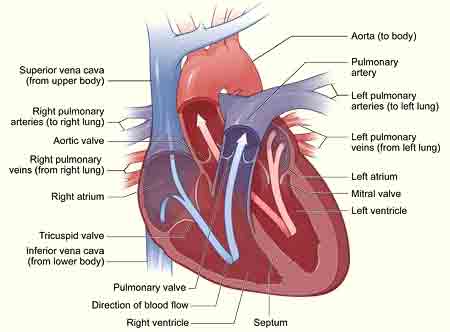
Heart, cross-section, heart_1.jpg not found

Your right heart pumps blood to the lungs only and back to your left heart.
The left side of the heart does exactly the same process but pumps it everywhere except the lungs.

When expelled from the heart, the blood is passed into arteries which branch and re-branch into small arterioles, which keep branching into microscopic capillaries. The muscles of the arteries actively push the blood along under pressure, by peristalsis.

In the capillaries, fluid called plasma (blood minus the red blood cells and platelets) seeps out of the capillaries to become interstitial fluid (ISF) bathing all the cells of the body, providing nutrients and removing waste. The rest of the blood, still inside the capillaries, flows along as the capillaries rejoin into veins returning to the right heart. What is the main purpose of the circulation system ? Clue: what happens at the capillaries ?

The plasma is gathered up by lymph capillaries which channel the plasma, now called lymph, into ducts whichfinally join the bloodstream in the subclavian veins just below the neck, before entering the heart.

Summary
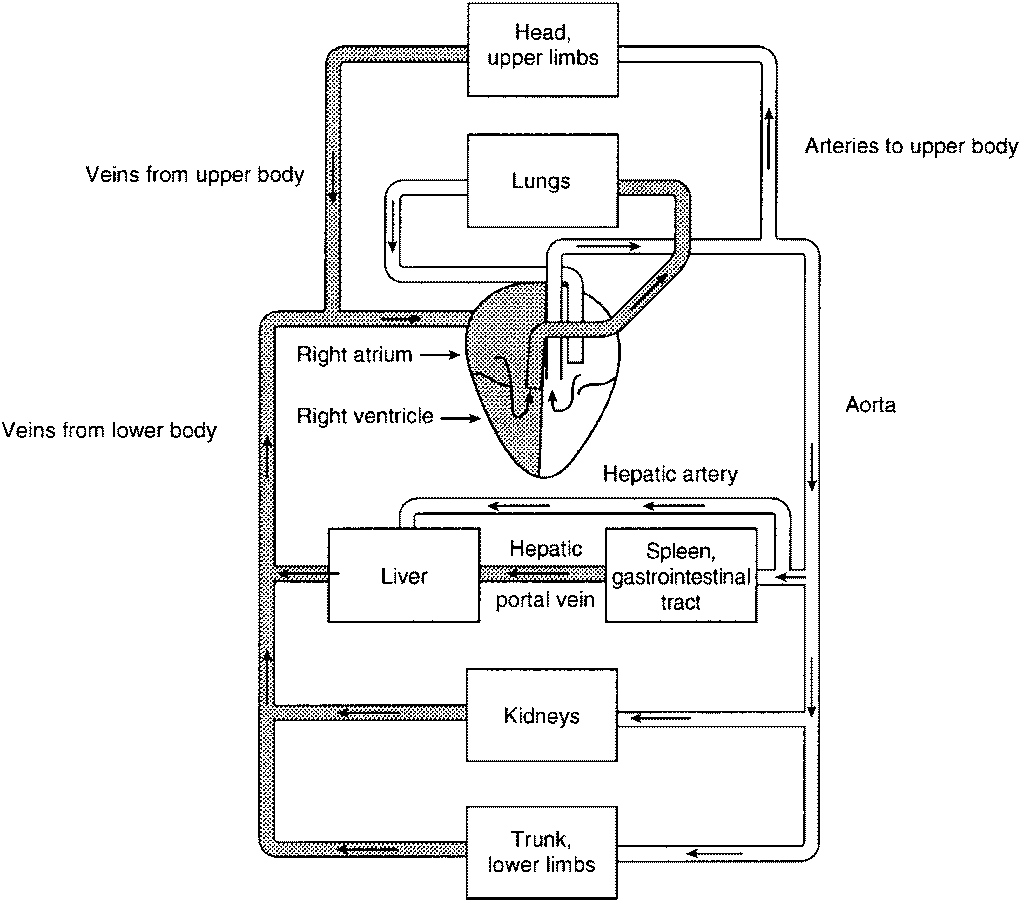
The left side pumps blood all around the body, along arteries under pressure, to capillaries which exude lymph carrying oxygen and nutrients. Having done this job, these capillaries link up to form veins, which return the blood to the heart.

At the capillaries, plasma (blood minus the red blood cells and platelets) seeps out into the interstital fluid surrounding the cells, taking nutrients to the cells and removing wastes from the cells. This plasma is then drawn into the lymph capillaries, which link up to form ducts leading back to the bloodstream in the subclavicle veins near the heart.

Text in this image improves if you enlarge with: hold [Ctrl] and repeatedly click [+/=].

cardiovascular_diagram.gif not found

I found the best way to learn it is to imagine your heart beating inside your chest, and see the blood returning to the top of your right heart, into the right atrium, which pumps it down into the right ventricle which pumps it up a tube up out of the top to the lungs and back to the left atrium.

See your blood entering the top of your right heart, which pumps it down into the right ventricle which pumps it up a tube up out of the top of your heart to everywhere else and back to the left atrium.

Each side of the heart has an atrium at the top and a ventricle at the bottom.
Blood enters into the atrium and leaves from the ventricle.
Each atrium pumps blood down into the ventricle below it.
Each ventricle pumps blood up into a tube passing up thru the atrium, out of the top of the heart.

The main purpose of the circulation system is to carry lymph to every body cell. The lymph carries oxygen, nutrients, hormones etc from the bloodstream in the capillaries, to the cells.

Thus the left-side of the heart pumps to:
The heart is just a pump, giving a non-stop pumping of blood thru the body.
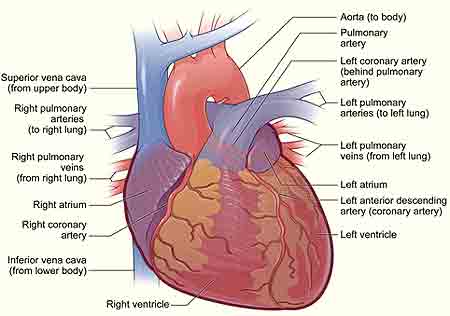
The heart is a hollow, cone-shaped muscle located between the lungs and behind the sternum (breastbone). Two-thirds of the heart is located to the left of the midline of the body and one-third is to the right.

The right heart pumps to the lungs at relatively low pressure (pulmonary circulation). Blood returns from the lungs to the left atrium, enters the left ventricle to be pumped to the rest of the body (systemic circulation) at a much higher pressure, and returns to the right atrium.

And pumps need maintenance because when they clog they fail. Heart disease is the leading cause of death in the United States.

The apex (pointed end) points down and to the left. It is 12 cm by 8-9 cm by 6 cm deep, and is roughly the size of your fist.
The average weight of a female human heart is 0.26kg and a male's heart is 0.3kg, the same as one third of a liter of milk. The heart comprises less than 0.5 percent of the total body weight.

Heart, external view, heart_1.jpg not found

Heart Sounds

When someone listens to your heart with a stethoscope the sound is often described as lub-dub lub-dub:

Heart work

This table shows how hard your heart works for you.

QuantityRatePer minutePer dayPer yearPer lifetime
Pulse 72 beats100,00038 million2.5 billion
Volume70 ml per beat5 liters7,200 liters2,628,000184 million liters

This is what your little fist-sized 0.3kg pump does for you. Your heart deserves and needs to be maintained by a healthy diet.

Pulse Rates

A pulse is the number of heart beats per minute. Each person's pulse slows with age.
Here is a chart of average pulse rates at different ages.

AgePulse
Newborn
3 months
6 months
1 year
2 years
3 years
4 years
6 years
8 years
12 years
adult
130
140
130
120
115
100
100
100
  90
  85
  60 (resting)
- 100 (exercize)

Dehydration

Dehydration (when you are not drinking enough) reduces the volume of your blood, which in turn causes: