Eye 1
Vision requires:
- lens:
to focus the incoming rays of light onto the retina
- retina:
to convert light into nerve impulses
- nerves:
to transmit electrical impulses to the visual area of brain
- visual area of brain:
in the occiptal zone of the brain, converts electrical impulses from the optic nerve into coordinated images for perception, analysis and memorization.
The eye contains the lens and retina.
Eye
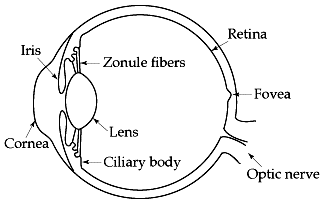 The eyeball, or globe, is spherical in shape and about 1 inch across.
The human eye is comprised of layers and internal structures, each of which performs distinct functions.:
- eyelids, eyelashes and eyebrows:
These protect the eye from dirt and dust that might irritate and injure the eyeball.
- orbital cavity, eyeball:
The orbital cavity, a bony pocket lined with fatty tissue as a cushion, holds and protects the eyeball, and provides attachment to the muscles which move and position the eyeball. The eyeballs usually move as a pair, for binocular vision, which relies on the spacing of the 2 eyes so that their images are slightly different. In the brain these 2 images are reconciled into binocular vision.
- sclera:
A tough, white, protective tissue forming the outside layer of the eye. The sclera helps maintain the shape of the eyeball. Six muscles attach at various points to the sclera and enable the globe to move in many directions inside the orbit.
- choroid:
Under the sclera is the next layer, the choroid, which carries the blood supply necessary to nourish the eye's internal structures.
- cornea:
A transparent structure at the front of the eye allows light to enter unrestricted, but bends it slightly inwards.Behind the cornea is the black pupil, simply a hole, and the colored iris, often brown or blue.
- lens:
Behind the cornea, the lens focuses the incoming light rays onto the retina. another clear, layered structure shaped like a large lentil (about 10 mm in diameter) that is attached to muscles which contract or relax to change the shape of the lens. The changing lens shape helps light to be focused in response to the need for clarity. With age, this focusing ability may diminish, making the eyes long-sighted, and requiring reading glasses.
- aqueous humor:
a watery substance which fills the small chambers between the cornea and the lens
- iris:
The colored 'curtain' around the black hole (pupil), which opens in darkness to provide a hole up to 8mm in diameter, and in dazzling light closes the hole down to about 2mm diameeter, to protect the retina from burns.
- retina:
The lining over the inside of the eye, in which incoming light triggers chemical reactions generating electrical impulses in nerves going to the brain.
There are 2 types of cells registering light:
- rod cells:
The rod cells (numbering about 100 million) are found in the peripheral retina, away from the macula. These cells provide vision in dim light.
- cone cells:
The cone cells (about 7 million in number) are located in greatest concentration in the small, central part of the retina called the macula. This area is responsible for producing sharp, detail vision and color vision.
- afferent pathway to brain:
The optic nerve is the bundle of retinal fibers that exits the back of the eye and transports electrical impulses to the brain where they are interpreted in the primary visual cortex.
- vitreous humor:
A clear, jelly-like substance filling the large space between the lens and retina.
- primary visual cortex:
Receives the nerve impulses and interprets, analyzes and, if required, memorizes.
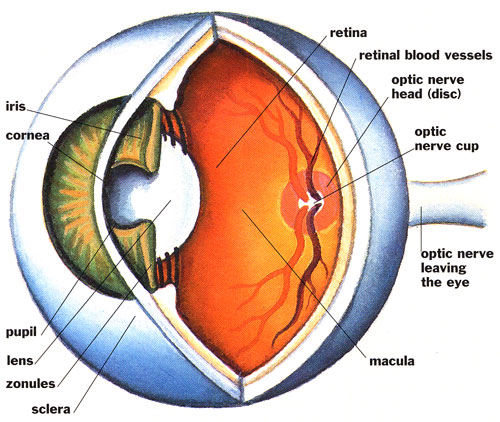
When all parts of the visual system are working, the eyes can move together, can adapt to light and dark, perceive color and accurately evaluate an object's location in space. They are sensitive to differences in contrast, and can also provide detail vision, which is measured as visual acuity.
By convention, we know "normal" visual acuity to be reported as 20/20. As the bottom number of this expression gets higher, it tells us that the vision is poorer than "normal." For example, the start of the range known as "legal blindness" is represented by the visual acuity finding of 20/200. One way to understand the meaning of this finding is that the eye being tested sees at 20 feet what the "normal" eye would see at 200 feet. People whose vision is in the category of "legal blindness" may still be able to use vision to do some of the things they need to do.
All eyes are not the same, nor are they all perfect. Some eyeballs are too long or have too much focusing power, causing the person to be myopic (nearsighted). Others are too short or have too little focusing power, and the result is hyperopia (farsightedness).
Some eyeballs may have uneven curvature, called astigmatism. Options for correcting these "mechanical" problems are standard eyeglasses, contact lenses or refractive surgery.
Other problems may be caused by disease or injury, and are not correctable by conventional means. People whose vision is irreversibly impaired due to diseases such as macular degeneration, glaucoma, cataract, diabetic retinopathy and others can be helped by vision rehabilitation.
Sight
A receptor of light (photoreceptor) registers one point of light, like one pixel or one dot on your computer screen. But one pixel does not make a picture, and one photoreceptor does not give sight. Take 100 million of these photoreceptors sitting on one surface (retina), and you have 100 million points of light. Because some of these points of light are bright, and others are dark, and many are different shades in between, they make a picture, like your computer screen.
Plants, having photoreceptors, detect light and heliotropic plants move to orient themselves towards light just as simple animals do, but plants do not have sight because they do not have a surface of large numbers of photoreceptors coordinated to give a picture.
The retina can contain over 100 million photoreceptors, each sending a signal to the brain. There are two types of receptors, rods for dim light and which cannot register color, and cones for color. The cones use 3 slightly different types of the color pigment rhodopsin, which register either green or red or blue wavelengths.
Light
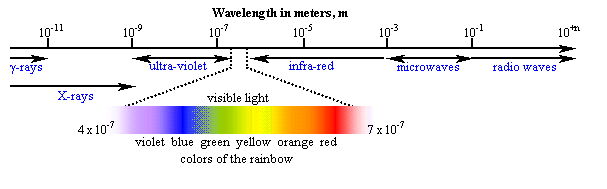 Light is a small band of electromagnetic radiation which is visible to us. This visible band has wavelengths easily remembered as (300 – 700) * 10–9 metres.
(1*10–9 metres = 1 billionth of a metre).
More precisely, the wavelengths of visible light range from 3.8 *10–7 to 7.6 *10–7 metres.
The visible light spectrum has a different color for each wavelength as shown by the band of colors which is often seen in rainbows.
When you see 2 rainbows together, the colors of one are in the reverse order to the colors of the other . Why ?
Radio waves may be kilometres in length. If you cook with electricity, turn on the hotplate. Feel the hotpolate become warm because the hot atoms in the plate are emitting electromagnetic radiation in the infrared range. Eventually you can see a dark and dull red glow because these electromagnetic waves occur with shorter and shorter wavelengths, coming into the right-end of the visible range. The plate becomes a bright red, as the radiation includes orange and then yellow wavelengths. When you turn on the electric light, the metal in the globe is around 6000 degrees Celsius, giving a broad range of wavelengths. All these wavelengths are mixed in together so they look white or yellowish-white.
Why do we see this spectrum and not another, such as radio waves or X-rays ?
Why do raptors see the UV part of the electromagnetic spectrum yet we cannot ?
Why do snakes have heat sensors registering infra-red spectrum, yet we do not ?
With simple sight, an animal responds to the difference between light and dark. In more advanced sight, an animal detects and differentiates the wavelengths and intensities of light.
Arthropods
Most crustaceans and insects have compound eyes which are made of many self-contained compartments or ommatidia, each with a cover or facet, its own conical lens and a single optic nerve fiber. The brain combines all these separate images into a whole picture. Since the eye is greatly curved making each tiny ommatidium view a different section of the surroundings, the compound eye quickly registers the smallest change from light to dark, and therefore of movement in the surroundings - which makes it difficult to catch a fly. Very few birds can catch a dragonfly which combines compound eyes each having 5000 ommatidia, with highly maneuverable flight.
Vertebrates
Vertebrates have simple eyes, each with one lens. The eye is a ball filled with a liquid, aqueous (watery) humor in front of the lens, and vitreous humor behind. At the front is the cornea, the transparent outer surface of the eye. Behind this is the iris. The iris is a circular colored diaphragm which opens and reduces the black circular opening in the center, the pupil, by a reflex action. The size of this hole or pupil, controls the amount of light entering, protecting the retina from being burnt. The light from an object comes through the cornea, then enters through the pupil of the iris, and passes through the lens which focuses the image onto the retina at the back of the eyeball.
Eye positions
Animals differ in which wavelengths they register best. Birds of prey can detect ultraviolet light which enables them to recognize where animals have rubbed against the earth and grass.
Some vertebrates have muscles which move the eye, others do not, and have to move their heads instead.
Side vision and forward vision are adaptations to different necessities; they view the world differently and detect different signals. Eyes at the side of the head give a greater range or angle of vision, ideal for prey keeping watch for predators. Forward vision, with eyes set in the front of the head, but several centimetres apart, give 3-dimensional vision or binocular vision, for accurately knowing how far away an object is. Each eye has a slightly different picture and these two pictures are reconciled by the brain to be seen as one, but with the difference registered as an interpretation of the distance. This is ideal for predators, and for tree-dwellers who leap from branch to branch. When objects are further away than 10 metres the differences in the pictures are too small to be usefully interpreted by the brain.
Some dogs have short snouts or muzzles while others have long ones. A TV documentary stated that long-snouted dogs have better long-range 3-dimensional vision. (Perhaps there are other factors involved. For example, short-snouted dogs tend to be short-legged and more inclined to be house pets, less used to outdoor activities requiring use of long vision. Short-snouted dogs might have eyesight difficulties because of undue shortening of the skull affecting eye-sockets. Remember that dogs have evolved from the long-snouted wolf. How did the experimenters eliminate the effects of such variables ? What do you think ?)
Description
To gauge distance, humans use:
- binocular vision:
Binocular vision uses 2 eyes set apart so that each has a slightly different image. The brain reconciles these 2 images, enabling 3-dimensional perception up to about 10 metres. (Over greater distances, for example a bird flying thru trees or an airplane over a mountain, it can be impossible to judge which is closer.)
- clarity:
Clarity of objects reduces with distance. such as the details of the eyes of another person which are clearly seen for, say, 5m but reduce to shadows at 100m, and eventually not seen at all, depending on the quality of vision of the viewer. You can train yourself in this skill by noting people's facial details over specific distances, such as at the end of a (50m) swimming pool, and a (100m) race track or football field.
- size:
The size of an object appears to decrease with increasing distance.
- color:
The color of an object becomes increasingly bluish with increasing distance. Most noticeably, mountains appear bluer as you move further away. This characteristic varies with season, altitude and latitude.
- mathematics:
mathematics, such as triangulation. It is about 4.65 kilometres to the horizon when standing with the sea lapping your toes, but varies with your height. (The formula is [12756 x h (in metres)] * 0.5 kilometres. What would be the formula when standing on the moon ?)
For each of these, try to develop a formula: apparent height = f (real height, distance).