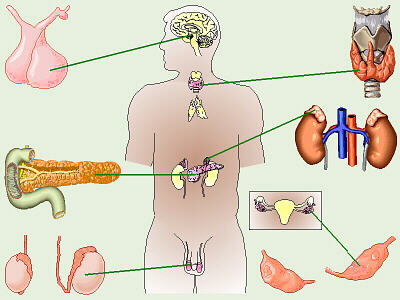
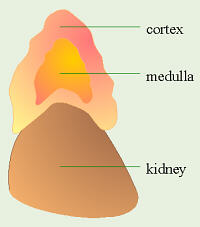
 The adrenal glands are critical to normal body functions, such as maintenance of fluid balance, reaction to stress, and reproduction. There are two adrenal glands, each of which lies above a kidney. The adrenal glands have two distinct parts: the cortex (outer layer), which secretes steroid hormones, and the medulla (inner part), which secretes epinephrine and norepinephrine.
There are more than 30 steroid hormones produced by the adrenal glands. These hormones serve to regulate a wide array of processes throughout the body. Epinephrine and norepinephrine are responsible for the changes in heart rate, blood pressure, and level of usable glucose (a form of sugar) that are necessary to cope with stress.
The pancreas is located in the rear center of the abdominal cavity, behind the stomach. Specialized cells in the pancreas produce two hormones, insulin and glucagon, needed to maintain stable blood sugar levels in the body. Insulin helps body cells use glucose for energy, thereby reducing the amount of sugar in the bloodstream. To balance this action, the hormone glucagon stimulates the liver to release its stored sugar into the blood, thereby raising the blood sugar levels.
The pancreas also functions in digestion. Nonendocrine cells in the pancreas produce special chemicals called enzymes, which are secreted directly into the small intestine through ducts. These enzymes help break down proteins, carbohydrates (sugars and starches), and fats in the small intestine. This dual activity of the pancreas means that it functions as both an endocrine and an exocrine organ.
The pituitary gland is a small organ located just beneath the base of the brain, between the two frontal lobes and directly above a cavity called the sphenoid sinus. It is sometimes called the master gland because all other endocrine glands come under its control. Its job is to receive messages about the need for a particular hormone and to secrete either the hormone or substances that cause the manufacture and release of the hormone.
The anterior (front) lobe of the pituitary gland secretes somatotropin (growth hormone), which affects the body's general growth; thyrotropic hormone (thyroid-stimulating hormone), which acts on the thyroid gland to stimulate production of thyroid hormones; adrenocorticotropic hormone (ACTH), which stimulates the adrenal cortex; follicle-stimulating hormone and luteinizing hormone, which are necessary for maturation and release of egg and sperm cells; and prolactin, a hormone that acts on the mammary glands to promote the secretion of milk.
The posterior lobe of the pituitary gland secretes oxytocin, which stimulates smooth muscle tissue to contract (and is of critical importance during childbirth) and vasopressin, a hormone that regulates by acting on the kidneys.
The primary responsibility for hormone production for the reproductive system lies with the testes (male sex glands) and ovaries (female sex glands).
The testes are two oval organs in the scrotum (the pouch of skin behind the penis). The testes produce sperm and sex hormones that govern the male secondary sex characteristics, including the growth of facial hair.
The two ovaries are located in the pelvis. The ovaries secrete the hormones estrogen and progesterone, which govern ovulation (monthly release of an egg from an ovary) and the female secondary sex characteristics, such as breast development.
The thyroid gland is located at the front of the neck above the top of the breastbone. It consists of two main lobes on either side of the trachea (windpipe) that are connected by a narrow band of tissue called the isthmus. The hormones secreted by the thyroid influence the rate of metabolism (the chemical processes in the body having to do with energy production).
The four parathyroid glands are located on the back and side of each lobe of the thyroid gland. Their secretion, parathyroid hormone, controls calcium levels in the blood.