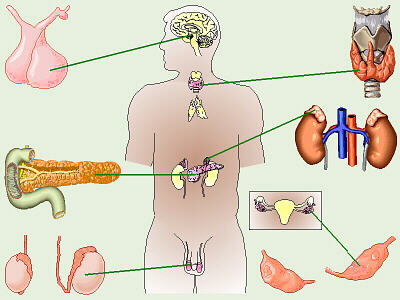
Follicle-stimulating hormone (FSH), leutinizing hormone (LH): The hypothalamus controls the pituitary gland so together, they control many other endocrine functions. They secrete a number of hormones, especially several which are important to the female menstural cycle, pregnancy, birth, and lactation (milk production). These include follicle-stimulating hormone (FSH), which stimulates development and maturation of a follicle in one of a woman’s ovaries, and leutinizing hormone (LH), which causes the bursting of that follicle (= ovulation) and the formation of a corpus luteum from the remains of the follicle.
There are a number of other hypothalamus and pituitary hormones which affect various target organs.
Antidiuretic hormon, ADH: One non-sex hormone secreted by the posterior pituitary is antidiuretic hormone or ADH. This hormone helps prevent excess water excretion by the kidneys. Ethanol (drinking alcohol) inhibits the release of ADH and can, thus, cause excessive water loss. A night of beer and salty peanuts causes dehydration and hangover. Diuretics are chemicals which interfere with the production of or action of ADH so the kidneys secrete more water. Thus diuretics are often prescribed for people with high blood pressure, in an attempt to decrease blood volume.
Endorphins: Another group of non-sex hormones that many people have heard of is the endorphins, which belong to the category of chemicals known as opiates and serve to deaden our pain receptors. Endorphins, which are chemically related to morphine, are produced in response to pain. The natural response to rub an injured area, such as a pinched finger, helps to release endorphins in that area. People who exercise a lot and push their bodies “until it hurts” thereby stimulate the production of endorphins. Those who constantly over-exercise such as marathon runners, might be addicted to the euphoria brought on by endorphins released by severe exercise.
Thyroid hormones regulate metabolism, therefore body temperature and weight. The thyroid hormones contain iodine, which the thyroid needs in order to manufacture these hormones. If a person lacks iodine in his/her diet, the thyroid cannot make the hormones, causing a deficiency. In response to the body’s feedback loops calling for more thyroid hormones, the thyroid gland then enlarges to attempt to compensate (The body’s plan here is if it’s bigger it can make more, but that doesn’t help if there isn’t enough iodine.). This disorder is called goiter. Dietary sources of iodine include any “ocean foods” because ocean-dwelling organisms tend to accumulate iodine from the seawater, and would include foods like ocean fish (tuna) and seaweeds like kelp. Because of this, people who live near the ocean do not have as much of a problem with goiter as people who live inland and don’t have access to these foods. To help alleviate this problem in our country, our government began a program encouraging salt refiners to add iodine to salt, and encouraging people to choose to consume this iodized salt.
This organ has two functions. It serves as a ducted gland, secreting digestive enzymes into the small intestine. The pancreas also serves as a ductless gland in that the islets of Langerhans secrete insulin and glucagon to regulate the blood sugar level. The alpha-islet cells secrete glucagon, which tells the liver to take carbohydrate out of storage to raise a low blood sugar level. The beta-islet cells secrete insulin to tell the liver to take excess glucose out of circulation to lower a blood sugar level that’s too high. If a person’s body does not make enough insulin (and/or there is a reduced response of the target cells in the liver), the blood sugar rises, perhaps out of control, and we say that the person has diabetes mellitus.
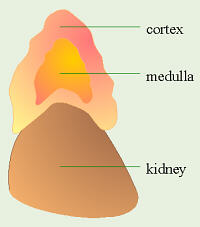 adrenal glands:
These sit on top of the kidneys. They consist of two parts, the outer cortex and the inner medulla. The medulla secretes epinephrine (= adrenaline) and other similar hormones in response to stressors such as fright, anger, caffeine, or low blood sugar. The cortex secretes corticosteroids such as cortisone. Corticosteroids are well-known as being anti-inflammatory, thus are prescribed for a number of conditions. However, these are powerful regulators that should be used with caution. Medicinal doses are typically higher than what your body would produce naturally, thus the person’s normal feedback loops suppress natural secretion, and it is necessary to gradually taper off the dosage to trigger the adrenal glands to begin producing on their own again. Because the corticosteroids suppress the immune system, their use can lead to increased susceptibility to infections, yet physicians typically prescribe them for people whose immune systems are hard at work trying to fight off some pathogen. Corticosteroids raise blood pressure, and in people with high blood-pressure, can cause strokes. It is your responsibility to know the conditions of your body, like blood pressure, diabetes and allergies, so that you can check whether your prescription is appropriate for you. Doctors are busy and can make mistakes. You could be their next mistake. But that would be your fault.
In addition to producing gametes, the female ovaries and male testes (singular = testis) also secrete hormones. Therefore, these hormones are called sex hormones. The secretion of sex hormones by the gonads is controlled by pituitary gland hormones such as FSH and LH. While both sexes make some of each of the hormones, typically male testes secrete primarily androgens including testosterone. Female ovaries make estrogen and progesterone in varying amounts depending on where in her cycle a woman is. In a pregnant woman, the baby’s placenta also secretes hormones to maintain the pregnancy.
This gland is located near the center of the brain in humans, and is stimulated by nerves from the eyes. In some other animals, the pineal gland is closer to the skin and directly stimulated by light (some lizards even have a third eye). The pineal gland secreted melatonin at night when it’s dark, thus secretes more in winter when the nights are longer. Melatonin promotes sleep (makes you feel sleepy). It also affects reproductive functions by depressing the activity of the gonads. Additionally, it affects thyroid and adrenal cortex functions. In some animals, melatonin affects skin pigmentation. Because melatonin production is affected by the amount of light to which a person is exposed, this is tied to circadian rhythm (having an activity cycle of about 24 hours), annual cycles, and biological clock functions. SAD or seasonal affective disorder (syndrome) is a disorder in which too much melatonin is produced, especially during the long nights of winter, causing profound depression, oversleeping, weight gain, tiredness, and sadness. Treatment consists of exposure to bright lights for several hours each day to inhibit melatonin production. It has also been found that melatonin levels drop 75% suddenly just before puberty, suggesting the involvement of melatonin in the regulation of the onset of puberty. Studies have been done on blind girls (with a form of blindness in which no impulses can travel down the optic nerve and reach the brain and pineal gland), which showed that these girls tended to have higher levels of melatonin for a longer time, resulting in a delay in the onset of puberty. While some older people, who don’t make very much melatonin, thus don’t sleep well, might benefit from a melatonin supplement, the recent melatonin craze in the US is probably ill-advised. Should the many people suffering from SAD, take more melatonin, especially since the pineal gland is one of the least-studied, least-understood of the endocrine glands.
Local regulators are hormones with target cells nearby or adjacent to the endocrine gland in question. For example, neurotransmitters are secreted in the synapses of our nervous system and their target cells are in the same synapses.