More
Biology is the study of living entities, called organisms.
A living organism is something that:
- can duplicate itself and its duplication can duplicate itself
- can duplicate itself from within (viruses duplicate from without)
- is sensitive to stimuli
- metabolises
- excretes by-products of metabolism
- grows by adding new material from within.
Since viruses do not do all of these processes, they are excluded by biologists, from the 3 Domains of Life Forms. In the first two diagrams below, viruses are included to show a comparison with bacteria, but are excluded from the other diagram.
Prokaryotic or Eukaryotic
Early cells as found in archaea, eubacteria (including cyanobacteria), do not have a membrane around the nucleus, and are called prokaryotic. Later developments, fungi, plants and animals, have membranes around the nucleus in their cells and are called eukaryotic.
Viruses or living organisms
Viruses do not reproduce within itself, without the use of organisms to replicate its nucleic acids. Therefore biologists do not consider viruses to be living organisms.
How to learn
As always, we choose an accurate, simple frame to learn by rote. Here is one.
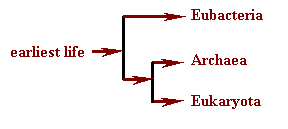
Categories of Life
The 3 domains into which all known life may be divided, are:
Eubacteria: true bacteria.
Archaea: like bacteria but having a different cell membrane.
Eukaryota: "true nucleus" - their cells have the nucleus contained within its own membrane. All the living organisms we can see, people, other animals, plants, algae and fungi, are included here as well as millions we cannot see.
Archaea
Archaea include methanogens, 44% of whose genes resemble those of eubacteria and eukaryotes (plants and animals). Archaea include most, but not all, hyperthermophiles. Many of these Archaea exist along volcanic ridges at the bottom of oceans, where the temperature is about 100oC, the pressure is enormous, and the water is acidic and very salty.
Thus we have 4 groups of Archaea:
- therm-ophiles and hyperthermophiles: high-temperature loving, even around 100oC
- pressure-ophiles: pressure loving, at oceanic depths
- acid-ophiles: acid loving
- salt-ophiles: salt-loving.
Eubacteria cells
Euacteria cells are similar to animal cells but have:
- no nucleus (prokaryotic = before true nucleus); but do have a nucleoid region without a plasma membrane
- no complex cell organelles such as mitochondria and chloroplasts
- a tough non-cellulose cell wall outside the plasma membrane
- a tough capsule outside the cell wall
- pili, threads which stick the cell to its food, including other cells.
Vulcanism
Along rift deep in the ocean floor, where two tectonic plates are quickly separating, has been found different forms of life which suggest how life may have begun on our Earth.
Hot springs in the floor eject jets of high pressure hot water, depositing minerals in columns called chimneys. These chimneys have core temperatures of over 350oC and vents called hydrothermal vents (hydro = water; thermal = hot), also called smokers, which, by their jets, deposit minerals from deep underground veins of ore. Around those vents live over 500 'new' species from giant clams, shrimps, crabs, fish, anemone, tubeworms up to 3 meters long, jellyfish, living in water at 27oC, and more importantly, thermophilic and hyperthermophilic tubeworms, bacteria and archaea living at temperatures previously thought impossible for life.
Alvinella pompejana, a worm 100mm long, encrusted with mineral grains deposited by the hot water from vents as it lies on a Smoker, has its head at 21 but its tail is at 78oC. This temperature gradient moves cooler water through the tube, carrying nutrients. A. pompejana, has a fully developed digestive tract, gills, and a blood circulating system. It incorporates bacteria in a symbiotic relationship, converting toxic substances into nutrients.
Definitions
Thermophilic bacteria can live at temperatures greater than 65oC (about the temperature that proteins denature); hyperthermophilic at greater than 85oC. Psychophiles live near 0oC and acidophiles live in acid environments.
Bacillus infernus, a psychophile, lives on bare rock, 1.5 kilometers underground, replicating at close to 0oC, but no lower, and does so once a year instead of bacteria's usual once per hour.
Pyrolobus fumarii, a hyperthermophilic bacteria, begins replicating at about 88oC but does best at 110oC, which is above the boiling point of water because of the huge ocean pressure. Pyrococcus furiosus likes sulfur, hates oxygen and replicates best at 99oC.
One major problem is that under normal pressure of 1 atmosphere, at 93oC nucleic acids, which are protein building blocks, begin to lose their structure, thus breaking their genetic information.
Life depends on 3 factors
Life depends on 3 factors:
- an energy source (for life's chemical reactions)
- organic molecules that carry genetic information
- water in a liquid state (usually 0oC to 100oC but this can be extended – salt will lower the freezing point to -18oC, while reduced air pressure up in the mountains will reduce the boiling point to where you can happily put your hand into boiling water. High water pressure will raise the boiling point to over 110oC.)
Thermophilic bacteria and archaea use chemosynthesis, not photosynthesis. Chemosynthesis frees sulfur from hydrogen sulfide; combines that free sulfur with carbon dioxide, oxygen and water; then re-attaches the sulfur to oxygen to form sulfate, which liberates energy to make carbohydrates.
Essentially, S2– >> SO42– + energy.
The hydrothermal vents provide a much more stable, if extreme, environment than does the Earth's surface or upper ocean levels. Although the smokers last only a few years as the plates move apart, in that time have occurred many breeding cycles, and new smokers are always being created nearby.
Classification
| Taxonomy | Animal |
|---|
Domain
Kingdom
Class
Order
Family
Genus
Species |
Eukaryota
Chordata
Mammalia
Primates
Pongidae
Pan
paniscus |
Step 1: Because there are so many living creatures, we begin by grouping them into Domains: Archaea, Eubacteria, Eukaryota.
Step 2: Because there are so many Eukaryota (algae, plants, fungi, animals), we begin by grouping them into Kingdoms. We put all the plants into the Plant Kingdom, and all the animals into the Animal Kingdom, and so on. (Over the past 40 years biologists have increased the number of Kingdoms from 2 to 5, and as new information accumulates, we expect this number to increase.)
Step 3: Then we split each Kingdom into Phylae (plural for Phylum). We put all the animals with backbones, into the Backbone Phylum, called Phylum Chordata.
Step 4: Each Phylum, we split into Classes. We put all the hairy animals which suckle their young, into the Mammal Class or Class Mammalia; and all the animals with feathers into the Class Aves (birds).
Step 5: then each Class is split into Orders. Within the Class Mammalia, we put monkeys, gibbons and great apes into the Order Primates.
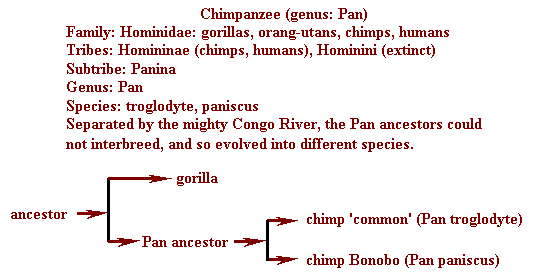
Step 6: then each Order is split into Families: within the class Mammalia, we put all the great apes (orang utan, gorilla, chimpanzee and pygmy chimpanzee) into the Family Pongidae.
Step 7: and finally Genera: we put both chimpanzees into the Genus Pan.
Step 8: All grouping has been completed by now, so we have the species, that is, a name for those animals which breed together such that their offspring are fertile. Cross-breeding species produces infertile offspring. Some species have different varieties within the species, like the human species which has Mongol, African, Caucasian, and American varieties but these can interbreed to give fertile offspring. They are not distinct species. We put the pygmy chimpanzee into the species paniscus and call it Pan paniscus, using both genus and species names to define it. The larger chimpanzee is Pan troglodytes.
Explanations or definitions ?
In science we try to define everything. Dictionaries use explanations, but definitions are very different to explanations. An explanations is vague and imprecise.
For example, one dictionary says:
a cat is a small furry animal with a tail, whiskers, and sharp claws that kills smaller animals such as mice and birds.
If we had a video of a fox, but did not know what it was, we would conclude that a fox is a cat because it fits this explanation perfectly.
A definition has two parts and only two parts:
- inclusive part:
which includes it into an already defined group of similar objects:
The domestic cat is a member of the group Genus Felis. This genus must already have been defined.
- exclusive part:
which excludes every other member of that group
The domestic cat Felis catis, purrs by forcing air through two holes in the roof of its mouth. Since no other member of the genus Felis has these holes, or purrs, no other member of Felis can fit this definition. Since no organism other than cats, fits the definition of Felis, no other organism can fall into this definition of the domestic cat.
Definition: A domestic cat is the species Felis catis.
This tells us that a domestic cat is a member of the genus Felis, and of the species catis, that is, the domestic cat is the only member of Felis which purrs.
The easiest form of a definition is: A …… is …….., which ………
as in: A …cat… is …a member of the genus Felis….., which ……purrs…
Whereas explanations are frequently vague and even ambiguous, definitions, by their construction, are always precise. A good thinker disciplines him or herself to think precisely by using definitions. If a person cannot define something, then they do not know what its essence is, what separates it from everything else (bluff as they may).
Structure
A structure has consistently recognizable boundaries, materials, patterns and systems.
Organism
An organism is a structure which is organized to:
- absorb and manufacture chemicals (from soil, air, other organisms)
- use chemicals to:
- provide energy
- grow and repair
- reproduce
- respond to its environment.
Cell Theory
All organisms, that is, all structures which replicate themselves independently of other organisms, are made of cells. What is a cell? A cell is the smallest structure which contains all those parts needed to absorb or manufacture food, and to provide energy, to grow and repair, and to reproduce itself. The cell is the smallest building block of an organism, that can reproduce itself.
Cell theory states:
- anything that lives is made of cells
- growing and reproducing require cells to produce other cells
- new cells can only come from existing cells.
Categories of our Planet
We can categorize the parts of our Planet like so:
- Non-replicating: Solids, liquids, gases; mountains, rivers, air.
- Self-replicating:
organisms
- Eubacteria: true bacteria
- Archaea: look like bacteria but different membrane.
- Eukaryota: true karyote **
- protista: protists, single-celled organisms.
- chromista: # simple organisms, from microscopic diatoms to colorless mildew to giant brown kelps. Usually brown or golden. Most are photosynthetic.
- algae: usually single-celled, always using photosynthesis.
- plantae: plants, deriving energy from sunlight by using chlorophyll
- fungi: derives energy by absorbing nutrients from other organisms, dead or alive. (Eumycota: mushrooms, sac fungi, yeast, molds, rusts, smuts, etc).
- metazoa: animals deriving energy from plants (as herbivores eating plants or as carnvores eating herbivores).
** Eukaryota:
Each cell of the organism contains a self-enclosed nucleus.
karuan [Gk] = nut, taken to mean 'nucleus'.
karyo = self-contained nucleus.
# When I learn, I take the groups Rhodophyta (red algae), Chromista (brown algae), and others, out of the vague and contradictory Protista. To leave them inside Protista, will leave you very confused. (Let us not wait for biologists to agree amongst themselves.)
Plant cells
Like animal cells, plant cells are contained in a plasma membrane, have a nucleus and organelles like mitochondria, but they also have:
- chloroplasts whose green chlorophyll give plants their color and use the sun's energy to convert carbon dioxide and water into sugar.
- sap-filled vacuoles which absorb water by osmosis, and by water pressure maintain the rigidity (turgidity) of the cell and thus of the plant; lack of this water produces wilting.
- a stiff cell wall made of cellulose, made of layers of tough carbohydrate, which gives the cell its shape and fastens cells together to enable the plant to grow tall.
- cytoskeleton, chemical threads forming a scaffold to keep organelles in position and move them in cell division.
Animal cells
An animal cell has a flexible plasma membrane, which is a double layer of phospholipid molecules, very thin and strong. If torn, it can repair itself. Water and small food molecules such as glucose can pass in, while the products of chemical reactions can pass out.
In the cytoplasm float the nucleus and organelles. Organelles are structures inside plasma membranes, having specific functions:
- a lysosome digests food
- a mitochondrion releases energy
- a smooth endoplasmic reticulum makes lipids and hormones
- a rough endoplasmic reticulum contains ribosomes, granules which make proteins.
- Golgi body
- Some may have small vacuoles.
An animal cell absorbs food since it cannot make its own. Many cells have hundreds of cilia (cilium) to move themselves or other things. The cells in you trachea use cilia to move dust back up to your oesophagus. Some cells have one or two flagella, which act like whips moving from side to side to propel the cell. Mammal sperm cells, euglenoids, and many algae use them.
Food
Food is chemicals which provide energy and the molecular building blocks to grow, repair and reproduce.
How to learn
As always, we choose an accurate, simple frame to learn by rote. Here is one.
The 3 domains into which all known life may be divided:
Eubacteria: true bacteria.
Archaea: like bacteria but having a different cell membrane.
Eukaryota: true nucleus" - their cells have the nucleus contained within its own membrane.
The Archaeans and Eubacterians are often called microbes because they are so small, and used to be grouped as Prokaryotes ("before the karyotes"). The categories under Eubacteria and Archaea are for reference only, and not intended to be learnt.
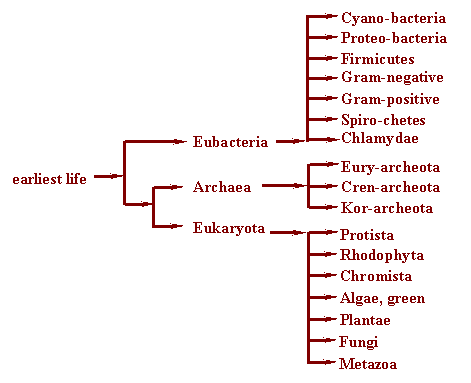
Learn the preceding table well then move to the next table.
Eubacteria
Archaea
Eukaryota
Protista: single-celled, perhaps best divided into simple and complex.
Rhodophyta: Red algae, usually single-celled, photosynthetic, usually mainly red pigment
Chromista: Brown algae, usually single-celled, photosynthetic, from microscopic diatoms to kelps. Usually mainly brown pigment. Unlike plants, the Chromista have chlorophyll c (not a and b), and do not store their energy in the form of starch. Other sources say that all photosynthetic pigments must pass their energy to chlorophyll a.
Algae:Green Algae, usually single-celled, always photosynthetic, using predominantly green chlorophyll a.
Plantae: Green plants are those photosynthetic organisms that use chlorophylls a and b inside the double-membrane-bounded chloroplasts, to utilize sunlight to convert carbon dioxide and water to sugars, and then to polysaccharides (starch and cellulose). Usually the cell walls are cellulose, a giant polysaccharide.
Fungi
Metazoa (Animals)
Non-living self-replicating molecules
Virus
I try to associate a table with a diagram.
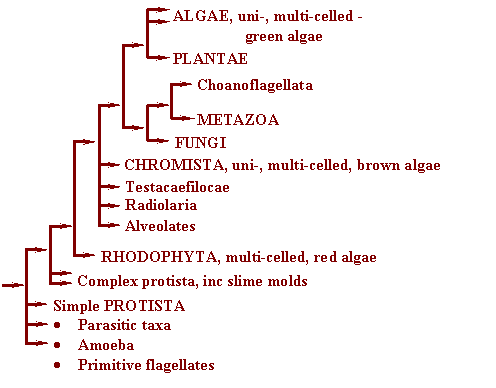
You can see that there are more groups in the diagram than in the table. The diagram, which gives a degree of complexity to the groups, makes the biologists' restriction to 5 Kingdoms seem ludicrous. Why not more ? I think it is because everyone is waiting for enough information to decide how to form the most reliable additional Kingdoms. But I cannot wait. Your choice.
What order do we use ? You can use alphabetic order but that robs us of information.
I compromise between complexity and proximity. Thus in the Eukaryota, Protistas are the simplest, so they go in first place.
Fungi are believed to be close to Metazoa (animals) so I put them together but with the more complex Metazoa after Fungi. Should I put Plantae before Metazoa ?
This is the way I learn. You might learn more quickly by using another method.
I have added viruses to the end since they are self-replicating molecules in that they use the chemicals in their host's cells to make copies of themselves. However, biologists do not consider them to be living because they do not exist in the cell form. Nonetheless, I find it useful to learn them here.
Remember, viruses are not related to cellular organisms.
In contrast, the Archaea, Eubacteria and Eukaryota are likely to have developed from the same cellular organisms which began life nearly 4 billion years ago. Such a long time would have allowed these simple species to adapt to changing environment, such as increasing availability of oxygen, decreasing amounts of methane gas, lowering of temperature, increasing availablity of other organisms for food, and more, much more.
Some would produce chemicals which in turn used the energy of sunlight to combine carbon dioxide gas with water to produce sugar. This sugar could then be broken down later to provide energy for replication of the cell. These would eventually become plants. And so on.
Because the molecules which replicate themselves often make mistakes, (who doesn't), the next generation can be slightly different to its parent. For example, a farmer in the mid-USA, troubled by long-legged sheep which kept jumping over his fences, found that one of his ewes had given birth to a short-legged lamb. He used that lamb to breed a flcok of short-legged sheep which could not jump his fences. This was an unusually marked change brought by one change (mutation) in one molecule. Usually changes are very small, almost unnoticeable, but over 4 billion years, that is a lot of mutations, making for evolution of countless species.
The self-replicating molecules are called genes, and these are usually carried in long strings called DNA and RNA. Our improving technology now enables us to see the structure of genes, of DNA and RNA, collectively called the genotype or genome of a species, so we can compare the genomes of organisms. We can thus see how these minute changes in genotype have slowly produced changes in how the organism looks and acts (its phenotype).
Learn these simplified definitions:
- gene: a self-replicating molecule which determines chemical processes that build the cell.
- DNA: the string of genes stored together in one long helical molecule.
- genome: the sum of its genes, every gene on every DNA.
- genotype: those genes which are different to others within the same species.
- phenotype: the observable looks and behaviour of an organism predetermined by its genotype.
- mutate: when a gene replicates, the replica is not an exact duplicate.
This table, showing groups within groups, is based on the similarity of organisms. The more similar are two organisms, the more closly related.
For example, chimpanzees are different to gorillas by only a few genes.
We can then suggest that chimps and gorillas had a common ancestor, existing in large numbers. As the genes in this tribe mutated over a long time, causing variety in looks and behaviour, some adapted to differing lifestyles, moved apart, and kept on changing. Eventually their differences prevented them interbreeding, and they became separate species. Thus one line evolved into chimps and one other line became gorillas. Some lines may have become extinct.
We can suggest (hypothesize) this, but we need evidence. If this is true, then there should be fossils (bones in the ground) which suggest intermediate specimens showing these transitions. So we look for them. Some have been found, and the search goes on.
This method is essential to science:
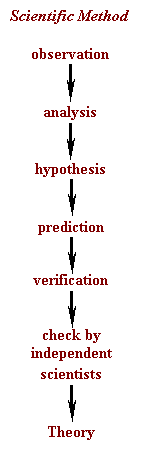
Scientists observe, in this case, the different species, their similarities and differences of their bones, muscles, circulation systems, brains, etc; their behaviour such as social structure and raising of young; and, nowadays with recent technology, their genomes.
These observations are analysed, leading to some unifying theme or generalization (hypothesis) from which several predictions can be made if and only if that hypothesis is true.
Those predictions are then verified by observation of 'nature' or by experiment. If correct then the results are published so that other independent scientists can repeat the observations or experiments to check whether their results are the same. If the general scientific community agrees, then the hypothesis is upgraded to a theory.
Theories are not TRUTH, but merely accepted generalizations. If new technology later brings new observations that contradict the theory, then it is dropped and a new hypothesis is formed, based on the new observations. Thus the cycle is repeated.
If the theory is deemed to be absolute, unchanging, then the theory is said to be a 'law', such as Newton's Law or the 1st law of thermodynamics.
Returning to our chimps ... note that there are two types of chimps, very similar in looks and behaviour, so these shared a common ancestor more recent than the ancestor common to chimps and gorillas.
This study of the relationships between species is called phylogeny.
To understand biological phenomena, most of which have an evolutionary explanation, knowledge of phylogeny is essential.
Chimpanzees and humans differ in only a small number of genes, so it is not surprising that there is marked similarity in appearance and behaviour. In particular, both are the only animals that have such a large number of facial muscles to express emotions. Chimps also have a digitally-opposed thumb, invent and use tools, hunt in packs, deceive, readily walk on two legs, solve intricate problems, and learn to communicate with humans by use of sign language and picture cards. Their brain is developed enough for speech but they lack the vocal chords. While chimps grieve over dead comrades, research suggests that they have no concept of a life-after-death. However we must be careful about assuming we understand the thoughts and emotions of another species. How could we verify such assumptions ?
Let us now return to our frame for living organisms.
This is also called The Tree of Life (ToL) since the earliest organisms produced ever-mutating offspring (genotypes), which led to divergent structures (phenotypes) with corresponding lifestyles. This is like the trunk of a tree growing upwards to branch and rebranch endlessly till it reaches the twigs which are the species and varieties of species.
Each of these, Eubacteria, Archaea and Eukaryota, then branches again.
Learn the preceding table well then move to the next table.
Eubacteria
Proteobacteria
Firmicutes
Gram-negative anaerobes
Gram-positive organisms: excluding Gram-positive rods and cocci.
Spirochetes: corkscrew-shaped
Chlamydiae
Cyanobacteria: blue-green cells, misnamed 'algae'.
Archaea
Euryarcheota: include many methanogens (methane producers) and salt-loving archaeans
Crenarcheota: include both hi-temp species and moderate temperature species
Korarcheota: known only from their DNA sequences (only recently discovered).
Eukaryota
Protista
Rhodophyta (red algae)
Chromista (brown algae)
Algae (green)
Plantae
Spermatophytes (Seed Plants)
Anthophyta (Flowering Plants)
Fungi
Metazoa (Animals)
Ecdysozoa
Arthropoda
Nematoda
Lophotrochozoa
Annelida
Brachiopoda
Mollusca
Deuterostomia
Echinodermata
Chordata (vertebrates)
Chondrichthyes (Cartilage fish, sharks)
Osteochthyes (Bony fish)
Amphibia
Reptilia
Aves (Birds)
Mammalia
Non-living self-replicating molecules
Virus
Viroid
Prion
I have added viruses to the end since they are self-replicating molecules, but biologists do not consider them to be living because they do not exist in the cell form. Nonetheless, I find it useful to learn them here.
Obviously the above table does not include all groups: it has been simplified to facilitate learning. Then, once you know it, add others. This is good learning technique.
Learn the preceding table fairly well then move to the next chapter. Revise the table daily till you know it perfectly. After all, this table forms the key to understanding our living world. The next chapters will show how these organisms influence our lives, our health, our wealth, our happiness.