Language

Part 1 is fundamentally about language; without the language of biology, we cannot discuss it nor think about it, speculate or test hypotheses. This first part of Part 1, introduces words basic to understanding the Frame of biology.

A frame is a word picture or diagram, based on a pattern, used to organise our thinking, making it easier for us to assimilate a large amount of data.

Classification

Classification is an hierarchical top-down parent-child structure in which each child has all the properties of the parent, but is distinguishable from all other children:

Explanations or definitions?

In science we try to define everything. Dictionaries use explanations, but definitions are very different to explanations. An explanations is vague and imprecise. for example, one dictionary says:
a cat is a small furry animal with a tail, whiskers, and sharp claws that kills smaller animals such as mice and birds.
If we had a video of a fox, but did not know what it was, we would conclude that a fox is a cat because it fits this explanation perfectly.

A definition has two parts and only two parts::
Definition: A domestic cat is the species Felis catis.
This tells us that a domestic cat is a member of the genus Felis, and of the species catis, that is, the domestic cat is the only member of Felis which purrs.
The easiest form of a definition is:
A [name] is the member of [name of set], which [characteristic which distinguishes from all other members of that set]
as in: A (domestic) cat is that member of the genus Felis, which purrs.
This obviously requires that the genus Felix has already been defined. So we define in turn: Of all these sets, only a species actually exists. The rest have been created by us to indicate how we think the species are related to other species through evolution.

Whereas explanations are frequently vague and even ambiguous, definitions, by their construction, are always precise. A good thinker disciplines him or herself to think precisely by using definitions. If a person cannot define something, then they do not know what its essence is; what separates it from everything else (bluff as they may).

The principle of osmosis

When sugar dissolves in water, the combination of sugar and water is called a solution, with salt the solvent and water the solute.
A solution is a liquid with a substance dissolved in it.
A solute is the substance dissolved.
A solvent is the liquid dissolving the solute.

not found

For ionic compounds the solvent is usually water; for non-ionic compounds such as organic compounds, the solvent is usually an organic compound such as methyl alcohol or chloroform.

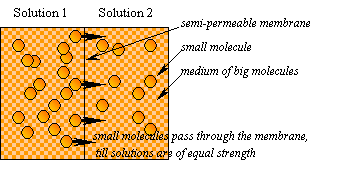
Plasma membranes are differentially permeable or semi-permeable, that is, they have small holes or pores which allow small molecules to pass through but block big molecules. Small molecules pass through plasma membranes till the concentration of small molecules is the same on each side of the membrane, that is, till the ratio of small/total is the same on both sides. (Actually, it relates to vapor pressure but this concept requires more study.)

Osmotic pressure is the pressure needed to stop a solvent from moving through a differentially permeable membrane.

For cells to counteract this flow, they must expend energy by pumping the small molecules into or out of themselves.

Prokaryotic or Eukaryotic

Early cells as found in bacteria and cyanobacteria, do not have a nucleus, and are called prokaryotic. Later developments, fungi, plants and animals, have nuclei in their cells and are called eukaryotic.

Organisms

No virus can reproduce within itself, without the use of organisms to replicate its nucleic acids. Therefore biologists do not consider viruses to be living organisms.

Explanation: A structure has consistently recognizable boundaries, and within it, materials, patterns and systems.

Definition: An organism is a structure which is organized to::
Definition: Food is any chemical which provides energy and the molecular building blocks to grow, repair and reproduce.

All organisms, that is, all structures which replicate themselves independently of other organisms, are made of cells.
What is a cell?
Definition: A cell is the smallest structure of a (living) organism, which contains all those parts needed to absorb or manufacture food, and to provide energy, to grow and repair, and to reproduce itself. The cell is the smallest building block of an organism, that can reproduce itself.

Animal cells

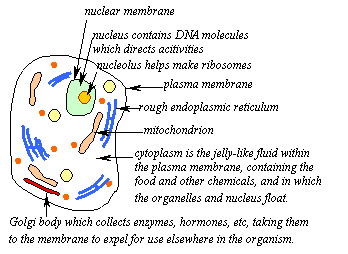
An animal cell has a flexible plasma membrane, which is a double layer of phospholipid molecules, very thin and strong. If torn, it can repair itself. Water and small food molecules such as glucose can pass in, while the products of chemical reactions can pass out.

not found

In the cytoplasm float the nucleus and organelles. Organelles are structures inside plasma membranes, having specific functions::
An animal cell absorbs food since it cannot make its own. Many cells have hundreds of cilia (cilium) to move themselves or other things. The cells in your trachea use cilia to move dust back up to your oesophagus. Some cells have one or two flagella, which act like whips moving from side to side to propel the cell. Mammal sperm cells, euglenoids, and many algae use them.

Bacteria cells

Bacteria cells are similar to animal cells but have::

Plant cells

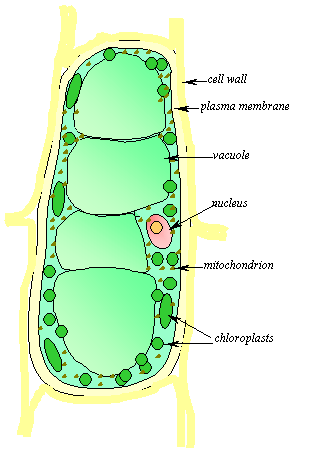
Like animal cells, plant cells are contained in a plasma membrane, have a nucleus and organelles like mitochondria, but they also have: not found

Cell Theory

Cell theory is a corollary of the definition of (living) organisms:

Words for Position

This table gives words for Position.

WordMeaningExample
anterior in front of (ant- = before) A cow's head is anterior to its neck.
posterior behind (post- = behind) A cow's neck is posterior to its head.
ventral the side of the body which has the vent A worm's ventral nerve chord.
dorsal near the The fish has a dorsal fin.
apical at the apex The apical bud will flower.
superior above, on top A flower's ovary, if superior, occurs above where the petals are attached.
inferior below or underneath A flower's ovary, if inferior, occurs below where the petals are attached.
longitudinal running the length of something, along the longest dimension  
transverse running across, athwart, at right angles to the longitudinal axis  
peripheral at or near the edge, around the edge These leaves have peripheral veins.
distal at the furthest point  
proximal close to  
lateral on the side Lateral muscles

Symmetry

Meanings of stems of words

You can often guess the meanings of many words if you learn the meaning of a few stems (roots). Here is a table of some Latin and Greek roots.

RootMeaningExample
anti against, opposed to antibody, antipodes
arthro jointed arthropod, arthritis
auto self autotroph, automatic
bio life biology, biosphere
carn meat or flesh carnivore, carnal
chloro green chlorophyll, chloroplasts
cyano blue cyanobacteria
cyta cell leucocyte
derm skin epidermis
di two or twice diploid, disaccharide
ecto outside ectothermic, ectoderm
endo inside endocrine, endoderm
epi upon, all over epidermis
exo outside exoskeleton
gastro stomach gastropod
gen a cause of something antigen
genesis formation morphogenesis
haemo blood haemoglobin
herb plant herbaceous, herbivore
hetero different heterogeneous, heterozygous
homeo similar homeostasis
homo same, identical homogeneous, homozygous
karyo cell karyotype
macro large macromolecule
meso in the middle mesoderm
micro small microorganism
mono one, single monosaccharide
morpho shape morphogenesis
myco mould, fungus mycologist
omni all omnivorous
peri near, around peripheral
photo light photosynthesis
phyll a leaf mesophyll
phyto a plant tracheophyte, phytochrome
plasm living matter cytoplasm
pod a foot Gastropod: gastro- = stomach; -pod = foot (snail: carries its stomach in its foot).
Arthropod: arthro- = jointed; -pod = foot.
poly many polysaccharide: poly- = many; -saccharine = sugar/sweet; -ide = noun denoting a compound.
troph something that feeds autotroph: auto- = self; -troph = feeder.
vor to eat carnivore: carn- = flesh; -vor = eat.
zoo animal zoology: zoo- = animal(s); -ology = the study of.
tracheo of windpipe relating to trachea (windpipe). Tracheostomy
gameto wife/husband/marriage (gam-ete/-etes/-os respectively) Gametes = sex cells.
sporo spores of plants, micro-organisms or elementary forms of animal life. Sporophyte
chromo   chromosome: chrome- = color; -some = see "some" (relates to the ability to dye chromosomes).
some small body forms a noun denoting small body, especially intra-cellular particle. Chromosome