Virus 1

Virus (L. virus = poison, toxin):

Living or not ?

Viruses are not included in the 3 Domains of Living Organisms.
Opinions differ on whether viruses are a form of life, or organic structures that interact with living organisms.
They have been described as "organisms at the edge of life", since they:
Additionally, viruses:
Accepted forms of life use cell division to reproduce, whereas viruses spontaneously assemble within cells, which is analogous to the autonomous growth of crystals.

Virus self-assembly within host cells has implications for the study of the origin of life, as it lends further credence to the hypothesis that life could have started as self-assembling organic molecules.
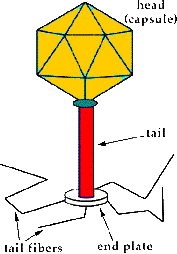
Virus diagram

Immunity

Viruses cause a number of diseases in eukaryotes. In humans, viral diseases include smallpox, the common cold, chickenpox, influenza, shingles, herpes, polio, rabies, Ebola, hanta fever, and AIDS. Some types of cancer have been linked to viruses.

Viral infections in animals usually cause an immune response, which can completely eliminate a virus.
These immune responses can also be produced by vaccines that give lifelong immunity to a viral infection. Microorganisms such as bacteria also have defences against viral infection, such as restriction modification systems.
Antibiotics have no effect on viruses, but are prescribed during viral infection to ward off secondary infection by bacteria during this attack on the immune system. Antiviral drugs have been developed to treat life-threatening infections.

Viruses themselves have no fossil record, but it is quite possible that they have left traces in the history of life.

Effects on the host cell

The range of structural and biochemical effects that viruses have on the hosts cell is extensive. These are called cytopathic effects (cyto = cell; pathos [Gk] = suffering, disease). Most virus infections eventually result in the death of the host cell.
The causes of death include:
Some viruses cause no apparent changes to the infected cell. Cells in which the virus is latent and inactive show few signs of infection and often function normally. This causes persistent infections and the virus is often dormant for many months or years.
latent, inactive. Example: herpes viruses, varicella zoster virus (chicken pox first, then latent, emerging later as shingles).
latent, active, non-malgnant. Causes cells to proliferate. Example: Epstein-Barr virus
latent, active, malignant. Causes cancer. Example: papillomaviruses

The relative ability of viruses to cause disease is described in terms of virulence.

Some viruses can cause life-long or chronic infections, where the viruses continue to replicate in the body despite the hosts' defence mechanisms. This is common in hepatitis B virus and hepatitis C virus infections.
People chronically infected are known as carriers, as they serve as reservoirs of infectious virus.
In populations with a high proportion of carriers, the disease is said to be endemic.

Probably we all carry latent viruses, for many viruses cause flu-like symptoms and so are dismissed by doctors as flu, but they recur occasionally when we are 'run-down', that is, when our immune systems are low.
There may be many viral diseases of unrecognized cause, and even those which are serious but whose symptoms are mistakenly diagnosed as caused by another disease.

Because viruses can transfer genetic material between different species of host, they are extensively used in genetic engineering. Viruses also carry out natural "genetic engineering": a virus may incorporate some genetic material from its host as it is replicating, and transfer this genetic information to a new host, even to a host unrelated to the previous host. This is known as transduction, and in some cases it may serve as a means of evolutionary change, although it is not clear how important an evolutionary mechanism transduction actually is.

Questions

This small section on Viruses contains much information that you can use to care for yourself and your loved ones.
What information can you use ? How can or will you use it ?
How do viruses spread from person to person ?
For all viruses, what are the best ways of avoiding infection ?
For each type of virus, how can you avoid contagion ?
Are you cured of a viral infection when the symptoms disappear ?
Will antibiotics destroy a virus ? Why spend money on antibiotics when trying to cure a viral disease ?

Virus, Virion, Viroid, Prion

Virus (L. virus = poison, toxin) is a self-replicating DNA or RNA molecule, which needs a host cell to replicate but exists outside of cells within a protein shell in a metabolically inert state.
Virion is a single infective viral particle (ie a virus when outside its host).
Viroid is an independent self-replicating molecule of RNA that is not classified as virus because it lacks a protein coat.
Prion is an infectious protein molecule that does not contain DNA or RNA.

Viroids

Viroids are molecules of RNA that are not classified as viruses because they lack a protein coat. However, they have characteristics that are common to several viruses and are often called subviral agents.

Viroids are important pathogens of plants. They do not code for proteins but interact with the host cell and use the host machinery for their replication.

The hepatitis delta virus of humans has an RNA genome similar to viroids but has protein coat derived from hepatitis B virus and cannot produce one of its own. It is therefore a defective virus and cannot replicate without the help of hepatitis B virus. Viruses that are dependent on other virus species are called satellites and may represent evolutionary intermediates of viroids and viruses.

Prions

Prions are infectious protein molecules that do not contain DNA or RNA. They cause an infection in sheep called scrapie and cattle bovine spongiform encephalopathy ("mad cow" disease). In humans they cause kuru and Creutzfeld-Jacob disease. They are able to replicate because some proteins can exist in two different shapes and the prion changes the normal shape of a host protein into the prion shape. This starts a chain reaction where each prion protein converts many host proteins into more prions, and these new prions then go on to convert even more protein into prions. Although they are fundamentally different from viruses and viroids, their discovery gives credence to theory that viruses could have evolved from self-replicating molecules.

However, it seems unlikely that all currently known viruses have a common ancestor. Viruses have probably arisen numerous times in the past by different means.

Virions

When found outside of host cells, viruses exist as a protein coat or capsid, sometimes enclosed within a membrane. The capsid encloses either DNA or RNA which codes for the virus elements. While in this form outside the cell, the virus is metabolically inert. Viruses depend on the host cells that they infect to reproduce.
When a virion comes into contact with a host cell, it can insert its genetic material into its host, literally taking over the host's functions. An infected cell then produces viral protein and genetic material instead of its usual products.
There can be 2 stages:
More than 5,000 types of virus have been described. The study of viruses is known as virology, a branch of microbiology.

Virus classification

The International Committee on Taxonomy of Viruses (ICTV) developed the current classification system and wrote guidelines that put a greater weight on certain virus properties to maintain family uniformity.
The general taxonomic structure is as follows:
Order (-virales) 5
Family (-viridae) 82
Subfamily (-virinae) 11
Genus (-virus) 307
Species (-virus) 2083

+ 3000 types unclassified.
We should not be surprized if these numbers increase as research progresses.

In the current (2008) ICTV taxonomy, five orders have been established:
The committee does not formally distinguish between subspecies, strains, and isolates.

Baltimore classification system
This ICTV classification system is used in conjunction with the Baltimore classification system, based on the mechanism of (messenger) mRNA production.
Viruses must generate mRNAs from their genomes to produce proteins and replicate themselves, but different mechanisms are used to achieve this in each virus family.
Viral genomes may be:
This classification places viruses into seven groups:

I
II
III
IV
V
VI

VII
dsDNA
ssDNA
dsRNA
(+)ssRNA
(−)ssRNA
ssRNA-RT

dsDNA-RT
ds = double stranded DNA
ss = single stranded
ds = double stranded RNA
+ = sense
– = antisense
(+)sense RNA with DNA intermediate in life-cycle
RT = uses reverse transcriptase
Herpesviruses, Poxviruses
Parvoviruses
Reoviruses
Picornaviruses, Togaviruses
Orthomyxoviruses, Rhabdoviruses
Retroviruses

Hepadnaviruses

As an example of viral classification varicella zoster (VZV), the chicken pox virus, belongs to the
Order Herpesvirales
Family Herpesviridae
Subfamily Alphaherpesvirinae
Genus Varicellovirus
Species varicella zoster (VZV).
Baltimore Classification Group I
because it is a double-stranded DNA virus that does not use reverse transcriptase.

Properties of viruses

Properties:

Life Cycle

Life Cycle:

Immunity

Viral infections in animals usually cause an immune response, which can completely eliminate a virus.
These immune responses can also be produced by vaccines that give lifelong immunity to a viral infection. Microorganisms such as bacteria also have defences against viral infection, such as restriction modification systems.
Antibiotics have no effect on viruses, but are prescribed during viral infection to ward off secondary infection by bacteria during this attack on the immune system. Antiviral drugs have been developed to treat life-threatening infections.

Effects on the host cell

The range of structural and biochemical effects that viruses have on the hosts cell is extensive. These are called cytopathic effects (cyto = cell; pathos [Gk] = suffering, disease). Most virus infections eventually result in the death of the host cell.
The causes of death include:
Some viruses cause no apparent changes to the infected cell. Cells in which the virus is latent and inactive show few signs of infection and often function normally. This causes persistent infections and the virus is often dormant for many months or years.
latent, inactive. Example: herpes viruses, varicella zoster virus (chicken pox first, then latent, emerging later as shingles).
latent, active, non-malgnant. Causes cells to proliferate. Example: Epstein-Barr virus
latent, active, malignant. Causes cancer. Example: papillomaviruses

The relative ability of viruses to cause disease is described in terms of virulence.

Some viruses can cause life-long or chronic infections, where the viruses continue to replicate in the body despite the hosts' defence mechanisms. This is common in hepatitis B and C virus infections.
People chronically infected are known as carriers, as they serve as reservoirs of infectious virus.
In populations with a high proportion of carriers, the disease is said to be endemic.

Probably we all carry latent viruses, for many viruses cause flu-like symptoms and so are dismissed by doctors as flu, but they recur occasionally when we are 'run-down', that is, when our immune systems are low.
There may be many viral diseases of unrecognized cause, and even those which are serious but whose symptoms are mistakenly diagnosed as caused by another disease.