Eubacteria 1
Eu- = true; bakterion = staff, cane (referring to the shape of the first bacteria examined under a microsope).
This chapter will enable you to learn a framework for bacteria.
A knowledge of bacteria is fundamental to maintaining a healthy lifestyle and long life.
Rote-learning of this framework is recommended. Then ponder how you will change your habits to protect yourself and your family from disease.
Ponder its significance in how you view your place in the cosmos.
Morphology
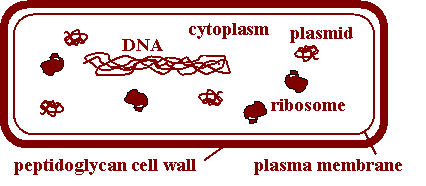
Diagram explained:
- Cytoplasm: the fluid which contains the water, proteins, enzymes, sugars, minerals, etc to maintain the required chemical reactions.
- DNA: forms a tangle known as a nucleoid.
- Plasma membrane: membrane for containing the cytoplasm.
- Plasmid: small loops of DNA.
- Peptidoglycan: carbohydrate polymers cross-linked by proteins.
- Ribosome: granules rich in ribonucleic acid; the sites where proteins are made.
The cell of any bacterium is much simpler than a eukaryotic cell.
In this diagram, the bacterium has a fairly thick cell wall made of peptidoglycan; such bacteria retain a purple color when stained with a dye known as crystal violet, and are known as Gram-positive (after the Danish bacteriologist who developed this staining procedure).
Other bacteria have double cell walls, with a thin inner wall of peptidoglycan and an outer wall of carbohydrates, proteins, and lipids. Such bacteria do not stain purple with crystal violet and are known as Gram-negative.
In the diagram, note that the bacterium:
- lacks the membrane-bound nuclei of eukaryotes
- its DNA forms a tangle known as a nucleoid, but there is no membrane around the nucleoid
- its DNA is not bound to proteins as it is in eukaryotes - whereas eukaryote DNA is organized into linear pieces, the chromosomes, bacterial DNA forms loops
- it does not contain membrane-bound organelles such as mitochondria or chloroplasts, as eukaryotes do. However, photosynthetic bacteria, such as cyanobacteria, may be filled with tightly packed folds of their outer membrane. The effect of these membranes is to increase the potential surface area on which photosynthesis can take place.
- it contains plasmids, or small loops of DNA, that can be transmitted from one cell to another, either in the course of sex or by viruses. This ability to trade genes with all comers makes bacteria amazingly adaptible; beneficial genes, like those for antibiotic resistance, may be spread very rapidly through bacterial populations. It also makes bacteria favorites of molecular biologists and genetic engineers; new genes can be inserted into bacteria with ease.
- its cell membrane is surrounded by a cell wall, as in all bacteria except one group, the Mollicutes, which includes pathogens such as the mycoplasmas. The composition of the cell wall varies among species and is an important character for identifying and classifying bacteria. It is chemically distinct from that of all archaea.
Shapes
Bacteria differ in shapes:
- rod-shaped: Bacillus, which may occur in chains; some have flagella
- bent rod with flagellum: Vibrio
- spirally coiled cell with tuft of flagella: Spirillum
- tightly-coiled: long slender tightly-coiled Spirochetes, usually only a fraction of a micron in diameter but 5 to 250 microns long. Members of this group are also unusual among bacteria for the arrangement of axial filaments, which are otherwise similar to bacterial flagella. These filaments run along the outside of the protoplasm, but inside an outer sheath; they enable the bacterium to move by rotating in place.
- spherical:
- spherical: Coccus
- pair of spherical cells: Diploccus
- chain of spherical cells: Streptococcus
- clumps of spherical cells: Staphylococcus
Properties of bacteria
- Prokaryotic (no membrane-enclosed nucleus)
- No mitochondria or chloroplasts
- A single chromosome:
- a closed circle of double-stranded DNA
- with no associated histones
- If flagella are present, they are made of a single filament of the protein flagellin; there are none of the "9+2" tubulin-containing microtubules of the eukaryotes.
- Ribosomes differ in their structure from those of eukaryotes
- Have a rigid cell wall made of peptidoglycan
- The plasma membrane is a phospholipid bilayer but contains no cholesterol or other steroids.
- No mitosis
- Mostly asexual reproduction
- Any sexual reproduction very different from that of eukaryotes; no meiosis
- Many bacteria form a single spore when their food supply runs low. Most of the water is removed from the spore and metabolism ceases. Spores are so resistant to adverse conditions of dryness and temperature that they may remain viable even after 50 years of dormancy.
Bacteria differ in:
- shapes: see above
- spores: ability to form spores
- method of energy production:
- glycolysis: for anaerobes which cannot tolerate gaseous oxygen, such as those bacteria which live in deep underwater sediments, or those which cause bacterial food poisoning.
- cellular respiration: for aerobes which thrive in oxygen
- both: for facultative anaerobes, which prefer growing in the presence of oxygen, but can continue to grow without it.
- varied nutrition:
Have various methods of nutrition:
- autotrophic:
- chemoautotrophy: by chemosynthesis (chemoautotrophs are uncommon)
- photosynthesis: by pigment enzymes
- heterotrophic: by absorption
- reproduction::
- asexual: by binary fission
- sexual: by simple conjugation
- reaction to the Gram stain::
- gram-positive: encased in a plasma membrane covered with a thick wall of peptidoglycan.
- Gram-negative: encased in a triple-layer. The outermost layer contains lipopolysaccharide (LPS).
Genome sequencing, especially of their 16S ribosomal RNA (rRNA), is now used to determine the evolutionary relationships among the bacteria.
Bacteria 1st-level categories:
- Proteobacteria:
- Firmicutes:
- Gram-negative anaerobes:
- Gram-positive (organisms ?): excluding Gram-positive rods and cocci.
- Spirochetes: corkscrew-shaped
- Chlamydiae:
- Cyanobacteria: blue-green cells, misnamed 'algae'. The Red Sea gets its name from occasional blooms of a reddish species of Oscillatoria, and African flamingos get their pink color from eating Spirulina.
Roles of bacteria in the global ecosystem:
- Recycling of nutrients:
The cycling of nutrients such as carbon, nitrogen, and sulfur depends upon bacteria.
- Decomposition of dead organisms:
Decomposition of dead organisms is the breakdown of their chemical compounds, which act releases nutrients into the soil and air for other organisms to use. Without bacteria to decompose, the carbon (as carbon dioxide in the air), nitrogen and sulfur in soluble compounds in the soil, and other nutrients would remain stored in the tissues of dead organisms, locked away from re-use.
- Nitrogen:
The cycling of nitrogen is another important activity of bacteria.
Plants rely on nitrogen from the soil for their health and growth, but cannot acquire it from the gaseous nitrogen in the atmosphere. The primary way in which nitrogen becomes available to them is through nitrogen fixation by bacteria such as Rhizobium, and by cyanobacteria such as Anabaena, Nostoc, and Spirulina. These bacteria convert gaseous nitrogen into nitrates or nitrites as part of their metabolism, and the resulting products are released into the environment. Some plants, such as liverworts, cycads, and legumes have taken special advantage of this process by modifying their structure to house the basteria in their own tissues.
Other denitrifying bacteria metabolize in the reverse direction, turning nitrates into nitrogen gas or nitrous oxide. When colonies of these bacteria occur on croplands, they may deplete the soil nutrients, and make it difficult for crops to grow.
- Digestion of cellulose:
Spirochetes A small group with only six genera (sing: genus) spirochetes range from deadly disease to crucial aids in digestion of coarse cellulose (polysaccharides) in termites and cows. Some species of Treponema live in the rumen of a cow's stomach, where they break down cellulose and other difficult to digest plant polysaccharides for their host. Treponema is the only genus to lack the outer sheath.
Spirochetes are long slender tightly-coiled bacteria, usually only a fraction of a micron in diameter but 5 to 250 microns long. Members of this group are also unusual among bacteria for the arrangement of axial filaments, which are otherwise similar to bacterial flagella. These filaments run along the outside of the protoplasm, but inside an outer sheath; they enable the bacterium to move by rotating in place. Treponema is the only genus to lack the outer sheath. Some species of Treponema live in the rumen of a cow's stomach, where they break down cellulose and other difficult-to-digest plant polysaccharides for their host.
The ecological roles of spirochetes are varied; the group includes both aerobic and anaerobic species, and both free-living and parasitic forms. One species, in the genus Cristispira, has been found growing only on the crystalline style in the digestive tract of certain bivalve mollusks.
Perhaps the best-known spirochetes are those which cause disease, particularly syphilis (an STD) and Lyme disease (carried by deer ticks)
Fossils
Altho bacteria are minute and fragile, the cyanobacteria or "blue-green algae," have left a fossil record that extends far back into the Precambrian, nearly 3.5 billion years old, among the oldest fossils currently known.
Cyanobacteria are larger than most bacteria, and may secrete a thick cell wall. More importantly, cyanobacteria may form large layered structures, called stromatolites (if more or less dome-shaped) or oncolites (if round). These structures form as a mat of cyanobacteria grows in an aquatic environment, trapping sediment and sometimes secreting calcium carbonate. When sectioned very thinly, fossil stromatolites may be found to contain exquisitely preserved fossil cyanobacteria and algae. Stromalites still exist in Exmouth Gulf of Western Australia - that is 3.5 billion years of history !
Memorize:
- Unicellular:
Unicellular, but may be grouped in clumps or chains.
- Varied nutrition:
Have various methods of nutrition:
- autotrophic:
- chemoautotrophy: by chemosynthesis (chemoautotrophs are uncommon)
- photosynthesis: by pigment enzymes
- heterotrophic: by absorption
- Reproduction:
- asexual: by binary fission
- sexual: by simple conjugation
- Roles:
- digest cellulose: cows, termites, even humans, rely on bacteria to digest large molecules in our gut
- decomposition of the dead: breakdown chemical compounds, freeing their parts for others
- nitrogen: takes nitrogen from the air, converting it into soluble form available to plants
- Fossils:
Cyanobacteria or "blue-green algae," extends back to Precambrian, nearly 3.5 billion years old.
Cyanobacteria with algae form dome-shaped stromatolites and round oncolites. Stromalites exist today in the tidal areas of Exmouth Gulf, Western Australia.