Eubacteria 2
This chapter is aimed at enabling you to learn a framework for bacteria.
A knowledge of bacteria is fundamental to maintaining a healthy lifestyle and long life.
Rote-learning of this framework is recommended. Then ponder how you will change your habits to protect yourself and your family from disease.
Ponder its significance in how you view your place in the cosmos.
Bacteria are microscopic organisms whose single cells have neither a membrane-bounded nucleus nor other membrane-bounded organelles like mitochondria and chloroplasts.
Another group of microbes, the archaea, meet these criteria but are so different from the bacteria in other ways that they must have had a long, independent evolutionary history since close to the dawn of life. In fact, there is considerable evidence that you are more closely related to the archaea than they are to the bacteria!
Bacteria-like organisms are the oldest fossils known, from nearly 3.5 billion years ago.
Properties
Properties of bacteria:
- Prokaryotic (no membrane-enclosed nucleus)
- No mitochondria or chloroplasts
- A single chromosome:
- a closed circle of double-stranded DNA
- with no associated histones
- If flagella are present, they are made of a single filament of the protein flagellin; there are none of the "9+2" tubulin-containing microtubules of the eukaryotes.
- Ribosomes differ in their structure from those of eukaryotes
- Have a rigid cell wall made of peptidoglycan
- The plasma membrane is a phospholipid bilayer but contains no cholesterol or other steroids.
- No mitosis
- Mostly asexual reproduction
- Any sexual reproduction very different from that of eukaryotes; no meiosis
- Many bacteria form a single spore when their food supply runs low. Most of the water is removed from the spore and metabolism ceases. Spores are so resistant to adverse conditions of dryness and temperature that they may remain viable even after 50 years of dormancy.
Bacteria differ in:
- shape:
- spherical: Coccus
- pair of spherical cells: Diploccus
- chain of spherical cells: Streptococcus
- clumps of sherical cells: Staphylococcus
- rod-shaped: Bacillus may occur in chains, some have flagella
- Bent rod with flagellum: Vibrio
- Spirally coiled cell with tuft of flagella: Spirillum
- spores: ability to form spores
- method of energy production:
- glycolysis: for anaerobes which cannot tolerate gaseous oxygen, such as those bacteria which live in deep underwater sediments, or those which cause bacterial food poisoning.
- cellular respiration: for aerobes which thrive in oxygen
- both: for facultative anaerobes, which prefer growing in the presence of oxygen, but can continue to grow without it.
- nutritional requirements:
- heterotrophs: Heterotrophs derive energy from breaking down complex organic compounds that they must take in from the environment. This includes saprobic bacteria found in decaying material, as well as those that rely on fermentation or respiration.
- autotrophs: Autotrophs fix carbon dioxide to make their own food source; this may be fueled by light energy (photoautotrophic), or by oxidation of nitrogen, sulfur, or other elements (chemoautotrophic). While chemoautotrophs are uncommon, photoautotrophs are common and quite diverse. They include the cyanobacteria, green sulfur bacteria, purple sulfur bacteria, and purple nonsulfur bacteria. The sulfur bacteria are particularly interesting, since they use hydrogen sulfide as hydrogen donor, instead of water like most other photosynthetic organisms, including cyanobacteria.
- reaction to the Gram stain::
- Gram-positive: encased in a plasma membrane covered with a thick wall of peptidoglycan.
- Gram-negative: encased in a triple-layer. The outermost layer contains lipopolysaccharide (LPS).
Genome sequencing, especially of their 16S ribosomal RNA (rRNA), is now used to determine the evolutionary relationships among the bacteria.
Roles of bacteria
Bacteria play important roles in the global ecosystem.
The ecosystem, both on land and in the water, depends heavily upon the activity of bacteria. The cycling of nutrients such as carbon, nitrogen, and sulfur depends upon bacteria.
Decomposition of dead organisms is the breakdown of their chemical compounds, which act releases nutrients into the soil and air for other organisms to use. Without bacteria to decompose, the carbon (as carbon dioxide in the air), nitrogen and sulfur in soluble compounds in the soil, and other nutrients would remain stored in the tissues of dead organisms, locked away from re-use.
The cycling of nitrogen is another important activity of bacteria. Plants rely on nitrogen from the soil for their health and growth, and cannot acquire it from the gaseous nitrogen in the atmosphere. The primary way in which nitrogen becomes available to them is through nitrogen fixation by bacteria such as Rhizobium, and by cyanobacteria such as Anabaena, Nostoc, and Spirulina, shown at right. These bacteria convert gaseous nitrogen into nitrates or nitrites as part of their metabolism, and the resulting products are released into the environment. Some plants, such as liverworts, cycads, and legumes have taken special advantage of this process by modifying their structure to house the basteria in their own tissues. Other denitrifying bacteria metabolize in the reverse direction, turning nitrates into nitrogen gas or nitrous oxide. When colonies of these bacteria occur on croplands, they may deplete the soil nutrients, and make it difficult for crops to grow.
Spirochetes A small group with only six genera (sing: genus) spirochetes range from deadly disease to crucial aids in digestion of coarse cellulose (polysaccharides) in termites and cows.
Spirochetes are long slender tightly-coiled bacteria, usually only a fraction of a micron in diameter but 5 to 250 microns long. Members of this group are also unusual among bacteria for the arrangement of axial filaments, which are otherwise similar to bacterial flagella. These filaments run along the outside of the protoplasm, but inside an outer sheath; they enable the bacterium to move by rotating in place. Treponema is the only genus to lack the outer sheath. Some species of Treponema live in the rumen of a cow's stomach, where they break down cellulose and other difficult to digest plant polysaccharides for their host.
The ecological roles of spirochetes are varied; the group includes both aerobic and anaerobic species, and both free-living and parasitic forms. One species, in the genus Cristispira, has been found growing only on the crystalline style in the digestive tract of certain bivalve mollusks.
Perhaps the best-known spirochetes are those which cause disease, particularly syphilis (an STD) and Lyme disease (carried by deer ticks)
Morphology
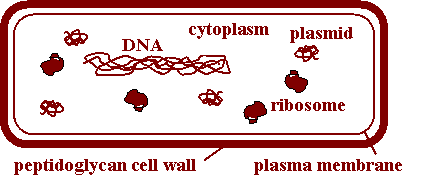
A more or less typical bacterium, shown here, is comparatively much simpler than a typical eukaryotic cell. View the transmission electron micrograph of a typical bacterium, E. coli, below and compare it with the diagram above.
Bacteria lack the membrane-bound nuclei of eukaryotes; their DNA forms a tangle known as a nucleoid, but there is no membrane around the nucleoid, and the DNA is not bound to proteins as it is in eukaryotes. Whereas eukaryote DNA is organized into linear pieces, the chromosomes, bacterial DNA forms loops. Bacteria contain plasmids, or small loops of DNA, that can be transmitted from one cell to another, either in the course of sex (yes, bacteria have sex) or by viruses. This ability to trade genes with all comers makes bacteria amazingly adaptible; beneficial genes, like those for antibiotic resistance, may be spread very rapidly through bacterial populations. It also makes bacteria favorites of molecular biologists and genetic engineers; new genes can be inserted into bacteria with ease.
Bacteria do not contain membrane-bound organelles such as mitochondria or chloroplasts, as eukaryotes do. However, photosynthetic bacteria, such as cyanobacteria, may be filled with tightly packed folds of their outer membrane. The effect of these membranes is to increase the potential surface area on which photosynthesis can take place.
The cell membrane is surrounded by a cell wall in all bacteria except one group, the Mollicutes, which includes pathogens such as the mycoplasmas. The composition of the cell wall varies among species and is an important character for identifying and classifying bacteria. In this diagram, the bacterium has a fairly thick cell wall made of peptidoglycan (carbohydrate polymers cross-linked by proteins); such bacteria retain a purple color when stained with a dye known as crystal violet, and are known as Gram-positive (after the Danish bacteriologist who developed this staining procedure). Other bacteria have double cell walls, with a thin inner wall of peptidoglycan and an outer wall of carbohydrates, proteins, and lipids. Such bacteria do not stain purple with crystal violet and are known as Gram-negative.
Fossils
Altho bacteria are minute and fragile, the cyanobacteria or "blue-green algae," have left a fossil record that extends far back into the Precambrian, nearly 3.5 billion years old, among the oldest fossils currently known. Cyanobacteria are larger than most bacteria, and may secrete a thick cell wall. More importantly, cyanobacteria may form large layered structures, called stromatolites (if more or less dome-shaped) or oncolites (if round). These structures form as a mat of cyanobacteria grows in an aquatic environment, trapping sediment and sometimes secreting calcium carbonate. When sectioned very thinly, fossil stromatolites may be found to contain exquisitely preserved fossil cyanobacteria and algae. Stromalites still exist in Exmouth Gulf of Western Australia.
Bacteria-like organisms are the oldest fossils known, from nearly 3.5 billion years ago.
Mitochondria and Chloroplasts
Did these eukaryotic organelles, mitochondria and chloroplasts, evolve from once free-living bacteria ?
There is much evidence that:
- mitochondria evolved from alpha-proteobacteria like the rickettsias
- chloroplasts evolved from cyanobacteria.
Bacteria similar to alpha-proteobacteria and cyanobacteria, may have taken up an endosymbiotic way of life within the ancestors of the eukaryotes, and eventually become incorporated into their cells. The current programs for genetically modifying bacteria, plants and animals, shows that DNA chains of one organism can become incorporated into the chromosomes of another.
For example, a virus may incorporate some genetic material from its host as it is replicating, and transfer this genetic information to a new host, even to a host unrelated to the previous host. This is known as transduction.