Eukaryota 1

Eukaryotes are organisms whose cells have true nuclei, that is, nuclei contained within their own membranes. Bacteria and Archaea are cellular organisms without true nuclei.
Eukaryote fossils begin to appear at about 1.8 billion years ago.

Domain Eukaryota is split into the kingdoms:
Each of these Kingdoms can then be expanded into:
Every organism can be placed into a species within a genus, within a Family within an Order, .... all the way up. Any living organism can be identified by 2 words, the first word is its genus and the second its species. For example, Canis familiaris identifies an organism as the domestic dog, of which "Canis familiaris Alsatian" is one variety.

Eukaryota 1

Eukaryotic Kingdoms:

Eukaryota characteristics:


Almost all eukaryotes contain other complex organelles:
Chloroplasts and mitochondria contain their own DNA and replicate independently. These organelles are probably descendants of symbiotic bacteria living inside the eukaryote host, but have become so dependent on their host that they can no longer live outside. This may also be the case with MTOCs, although the evidence is less clear in this case.

It would seem then that Eukaryotes, including humans, are colonies rather than individual organisms, incorporating useful organisms both within our gut and within our cells.

Life Cycle

The eukaryotes are so diverse that it isn't easy to generalize about their life histories and ecological roles. However, a particular method of cell division is found in most eukaryotes: this is mitosis. The pictures below show the stages of mitosis in the cells of an onion root tip.

Eukaryote DNA is divided into linear pieces called chromosomes (unlike bacterial DNA, which forms loops).

In the non-dividing phase of a eukaryotic cell's life cycle, known as interphase, the chromosomes are uncoiled.

When a eukaryotic cell prepares to divide:

Morphology

What makes a eukaryote a eukaryote? The name means "true nut" or "true kernel" in Greek; the "nut" is in fact the nucleus of the eukaryotic cell, a membrane sac that contains the cell's DNA. Unlike bacteria and archaea, eukaryotes have their DNA in linear pieces that are bound up with special proteins (histones) to make chromosomes (normally visible only in dividing cells).

The cytoskeleton is another feature unique to the eukaryotes. It is a network of protein filaments, mostly actin and tubulin, which are anchored to the cell membrane, and criss-cross the periphery of the cell. The network provides a structural framework which gives the cell its shape, and stabilizes the membrane systems. It also permits the cell to selectively exert tension on the membrane, making movement of the cell possible. The contractibility of these protein filaments are also responsible for muscle function, and the operation of the spindle apparatus, which separates the chromosomes during mitosis.

Both eukaryotes and bacteria may move with "flagella" - long threadlike structures that propel the organism through liquid. However, the eukaryote flagellum is completely different in structure from that of a bacterium; some scientists prefer to use the word "undulipodium" for a eukaryotic flagellum, to emphasize this difference. An undulipodium is a bundle of nine pairs of microtubules surrounding a central pair (the so-called 9+2 structure). At the base of a eukaryotic flagellum is a microtubule organizing center, or MTOC. In animals, MTOCs also function in creating the arrays of microtubules that pull the chromosomes apart during cell division.

The endoplasmic reticulum, or ER for short, is a complex network of membranes that provides a transport system within the cell. There are two types of endoplasmic reticulum, rough and smooth. Smooth endoplasmic reticulum is the site of lipid (fat and oil) formation, and is also the site where cells detoxify poisons; your liver cells are rich in smooth ER. Rough ER is the site of protein formation and transport; it is called "rough" because it is studded with ribosomes, which are small organelles that synthesize protein.

Golgi bodies, which are most common in secretory cells, package cell products, such as enzymes, into vacuoles for transport to the outside.

Almost all eukaryotes contain other complex organelles.

Mitochondria, shown here, are the cell's "powerhouses," the sites where aerobic respiration breaks down food in the presence of oxygen into water and carbon dioxide, generating energy. Plants and many protists also contain plastids, where photosynthesis takes place, allowing these organisms to manufacture their own food from carbon dioxide and water.

Chloroplasts and mitochondria are curious organelles indeed; they contain their own DNA and replicate independently. In fact, these organelles are descendants of symbiotic bacteria living inside the eukaryote host. They have become so dependent on their host that they can no longer live outside. This may also be the case with MTOCs, although the evidence is less clear in this case. Eukaryotes - including humans - are, in a very real sense, not individual organisms but colonies, and living proof that evolution frequently does not proceed according to the violent stereotypes of continuous struggle, of "nature red in tooth and claw." Sometimes the winning strategy is cooperation.

Compare the diagram above with this transmission electron micrograph of rat liver cells (212 K). Two cells are shown, with both nuclei visible, as well as the thin junction between the cells. Many mitochondria are present, along with abundant endoplasmic reticulum.

Systematics

Nothing is as confusing as a group of biologists. Each is so sure about his field that not only does he disagree with every other biologist, but he keeps changing his mind. When I began studying biology there were no more than 2 Kingdoms, plants and animals, botanists and zoologists. At University students studied either botany or zoology, rarely both. Now, to understand the basics, we must study 3 Domains and 5 Kingdoms. In the future, as reseach increases our understanding, there will be a need for more Kingdoms.

No Kingdom has been defined to include all its desired members, while excluding all members of every other Kingdom. But that is to be expected. Kingdoms are a human construct into which we hope to artificially compartmentalize nature. So please do not despair.
Remember:
In recent years, eukaryotes have been broken down into five kingdoms: animals, fungi, plants, green algae and protists.

AI_eukaryota systematics

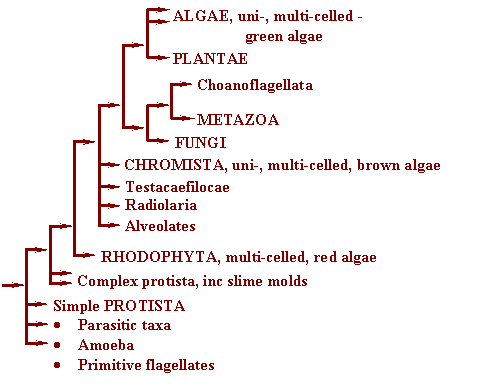
Study this systematic chart carefully, for it contains many concepts:
EukaryotaMetazoa
I memorized the Eukaryota as:
  • simple Protista
  • advanced Protista (slime molds, etc)
  • Rhodophyta (red algae)
  • Alveolates:
    • Ciliata
    • Foraminifera
    • Dinoflagellata
    • Apicomplexa
  • Chromista (brown algae)
  • Algae (green algae)
  • Plants
  • Fungi
  • Choanoflagellata
  • Metazoa ==>
I memorized the Metazoa as:
  • Porifera
  • Cnidaria
  • Proto-stomes:
    • Lopho-tropho-zoans:
      • Platyhelminthes
      • Others
      • Annelids
      • molluscs
    • Ecdyso-zoans:
      • Others
      • Nematoda
      • Arthropoda
  • Deutero-stomes:
    • Echinodermata
    • Chordata:
      • Amphioxus
      • Tunicata
      • Craniata (hagfish)
      • Vertebrata:
        • Cartilage fish
        • Bony fish
        • Amphibians
        • Reptiles
        • Aves (birds)
        • Mammals


Unfortunately I have been compiling this book on Biology across 4 years, unable to separate the conflicting versions by 'experts' into some order and sequence. Because of this, different chapters use different taxonomies. Ignore these differences; stick to the version you have chosen. That is your memory aid. Only when you become a superstar in Biology, will such differences become important.

Fossils

Probable eukaryote fossils begin to appear at about 1.8 billion years ago. These are spherical fossils of likely algal protists, called acritarchs.

DNA

Despite what you may have seen in some textbooks, DNA is not built like a twisted ladder. The helix, or spiral, is an inherent feature of the DNA molecule. Notice, for instance, that in the picture below, that the groove on the left side of the picture is much larger than the right side. This is because the paired bases in the center meet each other at an angle.

DNA is a very large molecule; the image here shows only a tiny fraction of the typical molecule. If an entire molecule of DNA from the virus "bacteriophage lambda" were shown at this scale, the image would be 970 meters high. For the bacterium Escherichia coli, the image would be 80 kilometers long. And for a typical piece of DNA from a eukaryote cell, the image would stretch for 1600 kilometers. Such a large molecule is not fully stretched out inside the cell, but is wound around proteins called histones which protect the DNA.

You might also notice in the image that the two halves do not quite come in contact. In fact they are held together by hydrogen bonds, an electrical attraction between partially negative atoms on the base of one side with the partially positive atoms on the other. Both sides have positive and negative charges. A single such pairing would not hold the molecule together well, but several million such bonds are quite effective. This also has the advantage that little effort is required to pull the two halves apart for replication, when the DNA is copied, and for transcription, when the DNA message is read. The message of DNA is the information from which the cell and its components are built.