Protista

[Protista is the plural of Protistos = "very first".
Previously called Protozoa, Proto- = first; -zoa = animal.
Protozoa = first animals.
Since the term 'Protozoa' suggests 'animals' the term 'Protista' is now being used instead.]

Many biologists still use Protista to include all this:
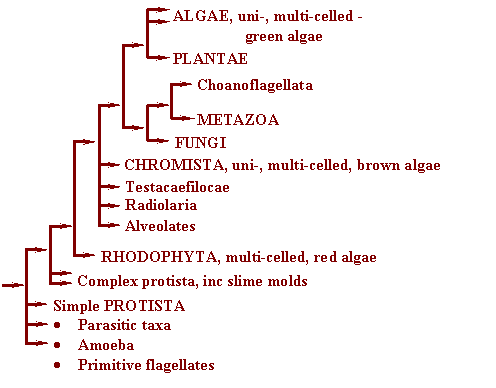
This odd assortment contains organisms which are more closely related to members of other kingdoms than they are to other protists. The next diagram, showing the evolutionary paths, demonstrates why.
Biologists admit that they probably should be classified in several kingdom-level taxa. They just havent got around to it.
Instead of learning the grouping as a simple list, why not learn the grouping as an evolutionary diagram ?

Until biologists agree on the new Kingdoms, learn the divisions as:
Better still, learn the divisions as a diagram, so you learn the evolutionary paths at the same time. You might like to rearrange the diagram to put Metazoa on the top but I arranged it here to emphasize the path of the algae.

AI_eukaryota_systematics.gif not found
Unfortunately many biologists use the term Protista to include all unicellular Eukaryota from amoeba up to Alviolates and Radiolaria.

Let us study this Eukaryota systematics chart.

1st level – Simple Protista, unicellular.
2nd level – Complex Protista, includes slime molds.
3nd level – Red Rhodophyta, mostly multicellular.
4th level – Brown Chromista (from unicellular diatoms to multicellular giant kelps)
Still 4th level – unicellular Alveolata.
5th level – Green Algae, uni- & multi-cellular.

Let us memorize this.

Protista categorizes phyla by complexity and locomotion:
Since this chart is our frame, as you learn the facts, associate these facts with positions and names on the chart.

Caution If you are at the introductory stage, you need only a broad grasp of this chapter. Do not be overwhelmed by new words. Do learn the Memorize section at the bottom.

Advanced discussion

This section is for advanced students (university level) and students doing specialized projects. The language is specialized and complex.

Mastigophora (Flagellates)

This phylum consists of flagellate protozoa (few produce pseudopodia in addition to flagella) many of which are plant-like (dinoflagellates, euglenoids and some other algal forms) and others animal-like (zooflagellates).

Generally regarded as the most primitive of all protozoa, these zooflagellates still extant are mostly free-living and phagotrophic, and generally resemble colourless flagellate algal protists.

Free-living zooflagellates undoubtedly gave rise to many symbiotic forms. They are highly specialized and adapted to specific hosts.

Examples:

Rhizopoda (Amoebas)

These protists, also called Sarcodina, have an amoeboid locomotion generally by pseudopodia, although some may possess flagella.

It is considered that their likely ancestors probably include free-living zooflagellates and algal groups such as Chrysophyta and Dinophyceae.

Since these protozoans generally move by pseudopodia ("false legs"), their body contour is ever-changing in movement. Most of the rhizopods are free-living whereas some are parasitic. Amoeba is a typical representative of this class.

Entamoeba histolytica, causing amoebic dysentry in man, is an example of parasitic rhizopod.

Some rhizopods develop a protective covering, called 'shell', composed of calcium carbonate. Many deposits of 'chalk' in nature are said to be due to the deposition of these shells. Arcella, Foraminiferans are other examples.

Sporozoa (Spore-forming Protozoa)

This class includes parasitic Protozoan protists, which are generally immotile, develop spores, and reproduce by multiple fission. Plasmodium is undoubtedly the most familiar sporozoan genus.

Four species of Plasmodium, namely, P. vivax, P. malariae, P. falciparum, and P. ovate, cause human malaria (P. falciparum causes the deadly cerebral malaria); with the female Anopheles mosquito, as vector. Another example is Leishmania that causes disease in humans.

Structure

The protozoan cell is devoid of cell wall (except for the spores of slime molds). The cell membrane, plasmalemma, is permeable to smallish molecules altho the cell may have to consume energy for reverse osmosis. The cell membrane is aware of mechanical and chemical interaction with its environment, as well as making contact with other cells.

Sometimes, the protozoan cell is surrounded by a non rigid cuticle composed of chitin or chitin-like substances.

Various protozoa produce an exoskeleton in the form of shells, which are made up of siliceous, calcareous, or proteinaceous material. A characteristic type of covering called cyst occurs commonly in various protozoa.

The cyst protects the protozoan cell from environmental factors, such as high light intensity, high temperature, dessication, food exudation, and anaerobiosis.
Cysts protecting parasitic protista helps them survive till they reach a victim.

Like other eukaryotic cells, the cytoplasm of a protozoan cell is more or less homogenous matrix containing the structures endoplasmic reticulum, Golgi bodies, mitochondria, ribosomes, blepharoplasts, food vacuoles, contractile vacuoles, and nucleus.

Protozoa possess a more or less continuous network or canals and lacunae that give rise to endoplasmic reticulum.

Their nucleus is eukaryotic ("true nut, ie has a membrane of its own) and may be either one (in most of the protozoa) or more than one (almost in all cilliates) in each cell.

Ciliates possess two dissimilar nuclei, a macronucleus (polyploid) and a micronucleus (diploid). The macronucleus controls the metabolic activities and regeneration, whereas the micronucleus is concerned with reproductive activity.

Memorize

The first level of the Eukaryota systematics chart contains simple protozoans.
The 2nd level, Complex Protista, includes Ciliophora (or Ciliates) and Slime Molds.
This is listed here:
The protozoan cell is devoid of cell wall (except for the spores of slime molds). The cell membrane, plasmalemma, is permeable to smallish molecules.

Various protozoa produce an exoskeleton in the form of shells, which are made up of siliceous, calcareous, or proteinaceous material. A characteristic type of covering called cyst occurs commonly in various protozoa.

The cyst protects the protozoan cell from environmental factors, such as high light intensity, high temperature, dessication, food exudation, and anaerobiosis.

Their nucleus is eukaryotic ("true nut, ie has a membrane of its own) and may be either one (in most of the protozoa) or more than one (almost in all cilliates) in each cell.

Ciliates possess two dissimilar nuclei, a macronucleus (polyploid) and a micronucleus (diploid). The macronucleus controls the metabolic activities and regeneration, whereas the micronucleus is concerned with reproductive activity.

Questions

What properties of Protista are shared with more differentiated Eukaryota ?
Does this suggest that they might have evolved from common ancestors ?

Primitive eukaryotes

A number of eukaryote lineages that branched very early in eukaryote evolution are still extant today. Most of them have no fossil record at all. However, studying these protists is important for what it can tell us about the earliest steps in eukaryote evolution.

These primitive eukaryotes are also important in medicine and veterinary science: some cause human and animal diseases such as giardia (hikers' diarrhea) and trypanosomiasis (African sleeping sickness). Yet others live in symbiotic relationships with other organisms: the flagellate Streblomastix shown above lives in the intestines of termites, and it and several other protists assist in the digestion of wood.

The relationships among these protists were not clear until the advent of techniques such as electron microscopy and DNA sequencing. A picture of the "family tree" of the early eukaryote lineages is just beginning to arise.

Basal protists

Some of the important groups of basal protists are:
Introduction to the "Slime Molds" Long classified together in the Myxomycophyta as part of the Fungi, slime "molds" are now known to be quite unrelated to the fungi. There are three main groups of slime molds, which do not form a clade:
What these three groups have in common is a life cycle that superficially resembles that of the fungi. When conditions become unfavorable, these slime molds form sporangia - clusters of spores, often on the tips of stalks such as in the sporangium of a Physarum. Spores from the sporangia are dispersed to new habitats, "germinate" into small amoebae, and the life cycle begins again. Similarities in the life cycle do not, however, imply close relationship, especially when one considers that certain bacteria (the myxobacteria) and even an unusual ciliate have very similar life cycles, aggregating to form spores on a sporangium.

Slime molds have almost no fossil record, which is not surprising. Not only do slime molds produce few resistant structures (except for spores, which are often overlooked or unidentifiable), but they live in moist terrestrial habitats, such as on decaying wood or fresh cow dung, where their potential for preservation is low. A few fossil slime molds have been found in amber.

PhylumAssigned to:Characteristics
1. Percolozoa subkingdom Adictyozoa lacks Golgi dictyosomes
2. Parabasalia subkingdom Dictyozoa
branch Parabasalia
has Golgi dictyosomes
lacks mitochondria
3. Euglenozoa subkingdom Dictyozoa
branch Bikonta
infrakingdom Euglenozoa
has Golgi dictyosomes
mostly with mitochondria
with trans-splicing of miniexons
4. Opalozoa (flagellates) subkingdom Dictyozoa
branch Bikonta
infrakingdom Neozoa
parvkingdom Ciliomyxa
has Golgi dictyosomes
tubular mitochondrial cristae
with cis-spliced introns
predominantly ciliated
no cortical alveoli
5. Mycetozoa (slime molds) subkingdom Dictyozoa
branch Bikonta
infrakingdom Neozoaparv
kingdom Ciliomyxa
has Golgi dictyosomes
tubular mitochondrial cristae
with cis-spliced introns
predominantly ciliated
no cortical alveoli
6. Choanozoa (choanoflagellates) subkingdom Dictyozoa
branch Bikonta
infrakingdom Neozoa
parvkingdom Ciliomyxa
has Golgi dictyosomes
flattened mitochondrial cristae
with cis-spliced introns
predominantly ciliated
no cortical alveoli
7. Dinozoa (Dinoflagellata and Protalveolata) subkingdom Dictyozoa
branch Bikonta
infrakingdom Neozoaparv
kingdom Alveolata
has Golgi dictyosomes
tubular mitochondrial cristae
with cis-spliced introns
with cortical alveoli
Reassigned to Miozoa in Alveolata.
8. Apicomplexa subkingdom Dictyozoa
branch Bikonta
infrakingdom Neozoaparv
kingdom Alveolata
has Golgi dictyosomes
tubular mitochondrial cristaewith cis-spliced intronswith cortical alveoli
Reassigned to Miozoa in Alveolata.
9. Ciliophora subkingdom Dictyozoa
branch Bikonta
infrakingdom Neozoaparv
kingdom Alveolata
has Golgi dictyosomes
tubular mitochondrial cristae
with cis-spliced introns
with cortical alveoli
Reassigned to Alveolata.
10. Rhizopoda (lobose and filose amoebae) subkingdom Dictyozoa
branch Bikonta
infrakingdom Neozoaparv
kingdom Neosarcodina
has Golgi dictyosomes
usually with tubular cristae
with cis-spliced introns
11. Reticulosa (foraminifera; reticulopodial amoebae) subkingdom Dictyozoa
branch Bikonta
infrakingdom Neozoaparv
kingdom Neosarcodina
has Golgi dictyosomes
usually with tubular cristae
with cis-spliced introns
12. Heliozoa subkingdom Dictyozoa branch Bikontainfrakingdom Neozoaparvkingdom Actinopoda has Golgi dictyosomes
mostly with mitochondria
with cis-spliced introns
has axopodia
13. Radiozoa subkingdom Dictyozoa branch Bikontainfrakingdom Neozoaparvkingdom Actinopoda has Golgi dictyosomes
mostly with mitochondria
with cis-spliced introns
has axopodia;
13. Entamoebia subkingdom Dictyozoa branch Bikontainfrakingdom Neozoaparvkingdom Entamoebia has Golgi dictyosomes
with cis-spliced introns
no mitochondria, peroxisomes, hydrogenosomes or cilia
transient intranuclear centrosomes
14. Myxosporidia subkingdom Dictyozo
branch Bikonta
infrakingdom Neozoaparv
kingdom Myxozoa
has Golgi dictyosomes
with cis-spliced introns
endoparasitic, multicellular spores, mitochondria,
and no cilia
15. Haplosporidia subkingdom Dictyozoa
branch Bikonta
infrakingdom Neozoaparv
kingdom Myxozoa
has Golgi dictyosomes
with cis-spliced introns
endoparasitic, multicellular spores, mitochondria,
and no cilia
Reclassified as animals in 1998.
16. Paramyxia subkingdom Dictyozoa
branch Bikonta
infrakingdom Neozoaparv
kingdom Myxozoa
has Golgi dictyosomes
with cis-spliced introns
endoparasitic, multicellular spores, mitochondria,
and no cilia
Reclassified as animals in 1998.
17. Mesozoa subkingdom Dictyozoa
branch Bikonta
infrakingdom Neozoaparv
kingdom Mesozoa
has Golgi dictyosomes
with cis-spliced introns
tubular mitochondrial cristae multicellular
with no collagenous connective tissue
Reclassified as animals in 1998.

The phylum Opalozoa was established by Cavalier-Smith as late as 1991.