Rhodophyta
The high vitamin and protein content of this food makes it useful in food and gels, as does the relative simplicity of cultivation, which began in Japan more than 300 years ago. As sheets of red algae, rhodophyta are eaten dried as nori or toasted to wrap sushi.
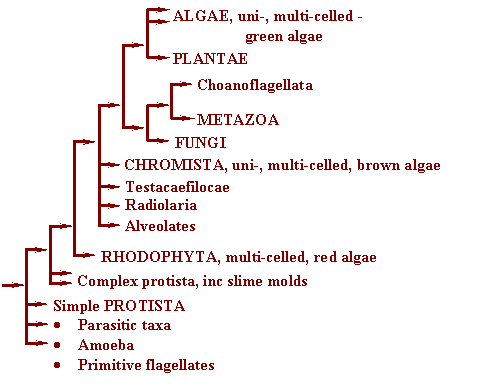
Some members of Rhodophyta are unicellular and microscopic. Some biologists group them as protista, and some group as "red algae". Here we group them in-between. (Do not worry about these differences in opinions - classification is not some law of nature, but an artificial aid to our memory.)
Rhodophyta are useful for medical purposes such as bone tissue engineering: and for the study of metabolic pathways, cell biological processes, and genetics, particularly Galdieria sulphuraria because of its metabolic versatility.
Red algae are red because of the presence of the pigment phycoerythrin; this pigment reflects red light and absorbs blue light. Because blue light penetrates water to a greater depth than light of longer wavelengths, these pigments allow red algae to photosynthesize and live at greater depths than most other "algae". Some rhodophytes have very little phycoerythrin, and may appear green or bluish from the chlorophyll and other pigments present in them.
Some rhodophytes have, for millions of years, been important in the formation of tropical reefs; in some Pacific atolls, red algae have contributed far more to reef structure than other organisms, including corals. These reef-building rhodophytes are called coralline algae, because they secrete a hard shell of carbonate around themselves, like corals do.
Properties
Properties of Rhodophyta include:
- autotrophic (self-feeding, makes its own food)
- possess chlorophyll a, d, β-carotene and xanthophylls; pigmented with phycoerythrin, phycocyanin and allophycocyanins. These pigments are found in phycobilisomes.
- make floridian starch from photosynthesis for a food reserve
- a few are unicellular or colonial, but most are multicellular
- do not have any flagella or centrioles
- do not have chloroplast endoplasmic reticulum.
- have unstacked thylakoids in plastids.
Early development
Possibly Rhodophyta were among the first multicellular organisms.
(You can omit this advanced paragraph.)
Rhodophyta is a diverse classification, having between 2,500 and 6,000 species, having different genome structures (so we should expect them to be further classified as research increases our understandingof their evolution).
They are an ancient group of organisms; fossil records place them in the mid-proterozoic. It is believed that Rhodophyta were among the first multicellular organisms. There is evidence that Toxoplasma gondii shares ancestry with red algae, possibly by ingesting it as an endosymbiont. Evidence suggests that the two organisms evolved from cells with similar UDP-glucose-based metabolisms.
Lifestyle
There are more than 5200 species of rhodophytes, and although some rhodophytes do inhabit fresh water, and temperate and cold seas, red algae are most common in tropical marine environments.
Rhodophyta tend to live at greater depths of water than Charophyta and Chlorophyta, because Rhodophyta pigments absorb blue light, which penetrates water to a greater depth than other wavelengths.
Rhodophyta are primary producers. By forming reefs they provide habitats for other aquatic organisms. Pink encrusting material found in the south Pacific on the outsides of shells is often "coralline" alga, usually members of the order Corallinales, in the Rhodophyta, altho there are calcifying algae in other rhodophyte orders, and even a few cyanobacteria, green "algae", and one kelp which also form coralline structures. [You might like to ponder the evolutionary implications of this.] Corallines, in some reefs, are the major structural component, even outnumbering the corals.
Rhodophyta respond to their immediate environment; for example, in terms of wave action, Mastocarpus papillatus groups react to whether their sites are exposed or protected.
Reproduction
Rhodophyta tend to reproduce sexually.
(You can omit this advanced paragraph.)
Life cycles tend to be diplo-haplontic (alternate diploid and haploid stages). However, this is not the case with all species. Porphyra nereocystis, for example, has a heteromorphic alternation of generations. Sexual reproduction is oogamous; it involves non-motile spermatia and closed mitosis. Tetraspores are produced in the tetrasporangia during meiosis.
If asexual reproduction occurs, it does so through aplanospores.
The various red algae have a complicated life history, often involving three stages of independent organisms to complete their life cycle. When the edible nori stage of Porphyra begins to release gametes, these fuse together upon the female to produce a stage which then releases spores.
The dispersed spores germinate into a smaller alga. This conchocelis phase burrows into the shells of marine animals, where it grows and matures, eventually dispersing conchospores which germinate into the edible phase of the life cycle. This discovery revolutionized the nori industry.
Systematics
Rhodophytes are just about the only eukaryotes to possess phycobilins, a class of water-soluble pigments; the only other eukaryotes to have them are the Cryptomonads. This and their lack of accessory chlorophylls, such as those found in most other photosynthetic eukaryotes, suggest that the plastids of rhodophytes were gained independently from these other groups. Rhodophytes also lack the eukaryotic flagella, or undulipodia which characterize most other eukaryotes.
More morphology
While some rhodophytes are unicellular, most species grow as filaments, such as those shown below at right, or membranous sheets of cells. Some of these multicellular forms are coralline, depositing skeletons composed of calcium carbonate crystals within and around their cell walls. These calcified reds can be difficult to distinguish from corals without the assistance of a microscope or a trained eye, as you can see from the picture below at left.
Rhodophytes store their energy surplus from photosynthesis in the form of floridean starch, a carbohydrate assembled from approximately 15 glucose units. This carbohydrate, like the pigments of the red algae, are unique to this group. The cells of rhodophytes are commonly covered by a slimy outer sheath. Additional colloidal compounds may be found in the cell wall, such compounds as agars and carageenan.
The red "algae" lack flagella at all stages in their life history, and cells may be multinucleate.