Ciliata
[L. cilium = eyelash]
Ciliata, or Ciliophora or ciliates some or all of the surface of a ciliate is covered with cilia, relatively short, dense hairlike structures which beat to propel the ciliate through the water and/or to draw in food particles.
The Ciliata are the most advanced and structurally complex protozoan protists. This large class of 7000 known species consists of aquatic phagotrophic protozoans that are characterized by the presence of short hair-like structures called cilia, the organs of locomotion.
All ciliates are also uniquely characterized by the possession of two kinds of nuclei, a small 'micronucleus' for sexual reproduction, and a large 'macronucleus' for all other processes.
In the diagram below, Paramecium is a typical representative of this class. The freshwater Stentor is up to 2mm long.
Ciliates are abundant in almost every watery medium: oceans, marine sediments, lakes, ponds, and rivers, and even soils. Because individual ciliate species vary greatly in their tolerance of pollution, by listing and counting the ciliate species in a sample of water, it is possible to estimate quickly how much organic material, which could include pollution, is present.
Ciliata: Morphology
The ciliates are probably the most complex of all unicellular organisms. Unlike multicellular organisms, which have cells specialized for performing the various body functions, single-celled organisms must perform all these functions with a single cell:
- movement
- sensitivity to the environment
- water balance
- food capture.
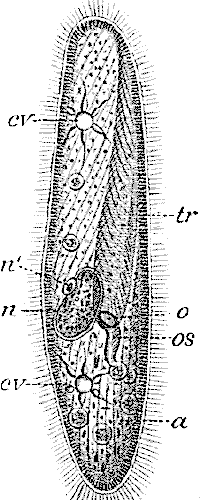 The ciliate has many parts:
- cilia:
Used for locomotion and to draw food within reach. The cilia originate from kinetosomes which are components of a complex system of intracellular conductile fibrils.
- nuclei:
Unlike other eukaryotes, ciliates have two kinds of nuclei:
- micronucleus n':
The micronucleus contains chromosomes, with two copies of each chromosome; hence this nucleus is diploid, as is common in eukaryotes. A ciliate may have one or several micronuclei. At cell division the micronuclei divide through mitosis.
- macronucleus n:
In the much larger macronucleus, the genetic material is in the form of short pieces of DNA, each of which may exist in tens of thousands of copies. At cell division in most ciliates, the macronucleus simply pinches apart into two.
- digestive vacuoles:
Several vacuoles, or round membranous structures that enclose food, waste, or various structures. In the diagram, follow the oral groove down to the cytosome, into the gullet to the digestive vacuole which forms at the end of the gullet as food particles are ingested. The digestive vacuole then circulates through the cell. Waste remaining in the vacuole is discharged through a particular point in the cell membrane known as the cytoproct.
- contractile vacuole cv:
The star-shaped contractile vacuole gathers excess water through microtubule-lined channels (the "rays" of the star) and periodically pumps it out through another special pore.
- cortex:
The outer layer, or cortex, is a complicated structure, separated from the interior of the cell by a layer of microfilaments. Each hair-like cilium is associated with a set of tubules and structural protein molecules that make up a kinetosome. In turn, kinetosomes are arranged in rows known as kineties. The cilia beat in waves to propel the organism forward and also move food into the cytostome, the ciliate's "mouth" (o).
- kinities:
The kineties around the cytostome are often arranged in a specialized way to generate water currents that funnel food particles into the cell.
- cytosome o:
The ciliate's mouth, sometimes set back in an oral groove (tr).
- oral groove tr:
Shown as a long wide groove running from the top-right down to the cytosome.
- extrusomes:
Extrusomes are part of the cortex, organelles that can rapidly eject short threadlike structures. These extrusomes function in predation, defense, and in forming cysts in various ciliates.
- cytoproct:
A particular point in the cell membrane thru which waste is eliminated from the digestive vacuoles.
Ciliata: Life story and ecology
Most ciliates are free-living forms. Relatively few are parasitic, and only one species, Balantidium coli, is known to cause human disease. Some other ciliates cause diseases in fish, causing problems in aquaculture. Others are parasites or commensals on various invertebrates. Still others live in great numbers in the digestive tracts of many hoofed mammals, where they serve to stabilize the large populations of symbiotic bacteria that break down cellulose in the animals' food.
Free-living ciliates may feed on bacteria, algae, or even other ciliates. Some ciliates harbor symbiotic bacteria or algae.
Ciliates in soils tend to be small forms that can form resistant cysts in order to survive long periods of drying. Tintinnids abound in the marine plankton, where they and other ciliates may consume up to 90% of the production of planktonic bacteria and algae. Large ciliates are common in freshwater environments, in particular those that have been organically enriched (such as by sewage).
Ciliates reproduce:
- asexually by division:
The micronucleus undergoes mitosis, while in most ciliates the macronucleus simply pinches apart into two.
- sexually:
Through a process known as conjugation. Conjugation is often induced by lack of food. Two ciliates of opposite mating types come close together and form a cytoplasmic bridge between the two cells; the micromuclei divide by meiosis, the macronuclei disintegrate, and the conjugating cells exchange haploid micronuclei over the cytoplasmic connection. They then separate, reform new macronuclei from their micronuclei, and divide. The essence of sexual reproduction is forming a new organism from the combined genetic material of parents. After conjugation, each ciliate partner has acquired new genetic material, and divides to give rise to progeny with a new combination of genes. Most ciliates eventually die out if prohibited from conjugating.
Ciliata: Systematics
In the most recent classification of ciliates, the group is divided into eight classes, listed here with common genera:
- Prostomatea:
Benthic (tidal); mostly marine forms.
- Litostomatea:
Includes Balantidium and Didinium
- Karyorelictida:
Benthic (tidal); mostly marine forms.
- Spirotrichea:
Includes Stentor, Stylonychia, and tintinnids.
- Phyllopharyngea:
Includes suctorians.
- Nassophorea:
Includes Paramecium and Euplotes.
- Oligohymenophorea:
Includes Tetrahymena, Vorticella, and Colpidium.
- Colpodea:
Includes Colpoda.