Testaceafilocea
[Test-acea-filocea having a test often made of silica plates, and filamentous pseudopodia.]
Testate amoebae
There are a number of protists that are amoeboid; that is, they are more or less shapeless and move by means of extensions known as pseudopodia ("false feet"). This has been achieved many times in various eukaryote lineages; amoebas are a highly polyphyletic group. A number of amoebas are referred to as testate: they are partially enclosed in a shell, or test, that may be made of organic material, agglutinated particles, calcium carbonate, or silica. The testate amoebae probably make up a polyphyletic group, but one group of testate amoebae, the Testaceafilocea, is probably monophyletic, united by the synapomorphies of having long, thread-like pseudopodia and a test that is often made of silica plates.
Trinema is very common in the water films on mosses, in leaf litter, in moist soils, and on aquatic vegetation. The amoeboid cell would partially fill the hollow test and extend pseudopodia from the aperture.
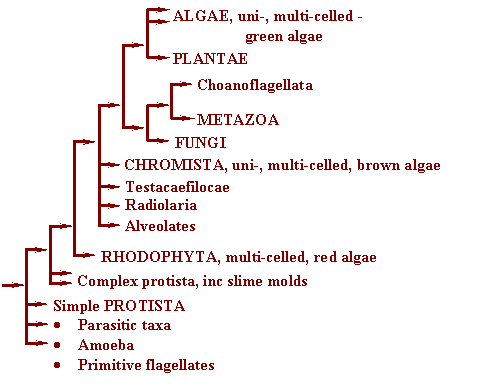
Although these testate amoebae are non-photosynthetic and lack flagellated stages, their coating of siliceous scales is similar to that seen in some chromists. For this reason, some have placed the Testaceafilocea near the Chromista.
The oldest filose testacean fossils may be late Precambrian, but because tests rapidly disintegrate into individual scales after the death of the amoeba, fossil Testaceafilocea are not well-known. However, tests of these and other amoebae may be common in Cenozoic and Quaternary lake deposits and peats, where they may provide information on paleoclimate and paleoecology.