Chromista 2
[Chromista from GK khroma = colored]
The great kingdom-level Chromista includes organisms from microscopic diatoms, with their delicate silica skeletons only forty millionths of a meter long, thru downy mildew to the giant kelps, which may grow as long as fifty meters.
Although some chromists, like mildews, are colorless, most are photosynthetic. Even though they are photosynthetic, chromists are not at all closely related to plants, or even to other algae. Unlike plants, the Chromista have chlorophyll c, and do not store their energy in the form of starch. Also, photosynthetic chromists often carry various pigments in addition to chlorophyll, which are not found in plants. It is these pigments which give them their characteristic brown or golden color.
 Photosynthetic chromists are some of the most important organisms in aquatic ecosystems. The cool and temperate coasts of continents are lined with kelp forests, where many commercially important fish and shellfish feed and reproduce, and diatoms are frequently the primary source of food for both marine and fresh-water organisms.
In additional to their roles as producers for marine animals, chromists provide many products for industry. Alginates are viscous chemicals extracted from kelp; these are used in paper production, toothpaste, and in ice cream, where the alginate helps to improve texture and ensure uniform freezing and melting. Ancient chromists, like coccolithophorids, are responsible for deposits of limestone and other rock formations. The skeletons of dead chromists accumulate on the floor of lakes and oceans, where they may become thick deposits of silica or calcium carbonate. These deposits are useful for interpreting ancient climate, and in searching for oil.
Life Cycle
Members of the Chromista are almost all aquatic organisms. These may occur, however, in both freshwater and marine environments. The Phaeophyta, for example, are primarily known for their large marine kelps, but the group also includes microscopic freshwater species. Likewise the free-floating surface diatoms have many marine and freshwater groups, providing food at the bottom of the food-chain.
The large kelps are attached to the bottom of coastal waters but may reach to the surface, forming kelp forests.
Morphology
Most chromists, at some stage of their life cycles, have two eukaryote-type flagella, or undulipodia, one of which is covered with tubular hairs branching from it, and a second flagellum without these hairs. Both flagella are attached to one side of the cell, rather than to the "front" or "back" end of the cell. Even multicellular chromists, like brown algae and water molds, produce flagellated zoospores of this type.
Many chromists are photosynthetic; those that are have a particular form of chlorophyll, chlorophyll c, which is not found in most other photosynthetic organisms. Most also contain carotenoid pigments, such as the brown pigment fucoxanthin, that give the cells a yellow, orange, or brown color. Food manufactured by these organisms may be stored for reserve energy in the form of the oil leucosin or the polysaccharide laminarin; chromists do not manufacture starch as plants do. The chroroplast and nucleus are typically surrounded by a common membrane; the chloroplast contains a light- sensitive "eyespot" of pigment granules, the stigma.
A third character that a number of chromists have in common is the manufacture of silica or calcium carbonate skeletons of various shapes from their Golgi apparatus, although not all chromists can do this. Those that can form silica skeletons, such as the diatoms and silicoflagellates, or skeletons of calcium carbonate, such as the coccolithophorids, may be extremely abundant in the fossil record. Many of the chromists which do not deposit skeletons surround their cells with a wall of cellulosic compounds, which gives the organism strucutre and rigidity, while remaining flexible.
Chromistans have evolved multicellularity independently of plants and animals. Basal chromists are primarily single-celled throughout their life history. Several groups, including diatoms and chrysophytes, have species that live colonially; several cells live together, but each function an a separate entity. Many oomycetes live as filamentous networks of cells, giving them a fungal-like appearance. The most complex anatomy among chromists, however, is that of the large kelps. Many kelps have specilized tissue regions that differentiate from surrounding cells, even producing a kind of conductive tissue in a few species.
For more detailed information on the morphology of one chromist in particular, the chrysomonad Poterioochromonas, click to visit the Protist Image Database at the University of Montreal.
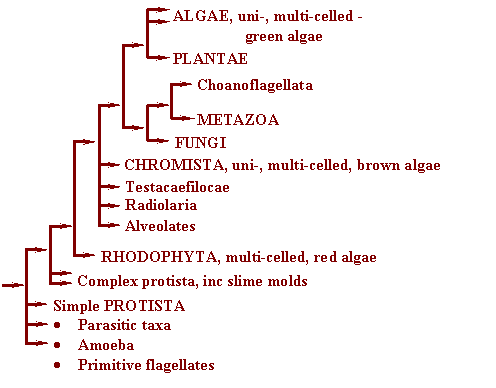
For many years, photosynthetic chromists were classified as plants, while non-photosynthetic chromists were classified with the fungi or animals. The close relationship among chromists was not fully appreciated until the rise of ultrastructural and molecular studies. For instance, it is now known that chlorophyll "c" and a number of other pigments found in the Chromista are not found in any plant group, but occur in a number of photosynthetic chromist taxa. There are also peculiarities of the flagella, plastids, and genetic arrangement which are not found in any other group.
The Chromista appear to represent an independent evolutionary line that diverged from the same common ancestor as plants, fungi, and animals. It was for this reason that the new kingdom Chromista was proposed. The precise relationship of the chromists to the other eukaryotes is not yet known, but they appear to be part of the so-called "crown eukaryotes", which includes not only plants, animals, and fungi, but also Alveolates and posiibly the red algae. There is some evidence that the Haptophyta may not belong to the Chromista. They lack several of the morphological and molecular characters common to this group, but we have included them here since no alternative relationships have been suggested.
There is still not full agreement as to how the chromist taxa are interrelated. The cladogram shown here is a composite of the results of molecular and morphological studies (see list of sources below). Our phylogeny is something of an oversimplification: we have excluded a number of taxa that have no fossil record and are not diverse, common, or well studied. We have also retained the Chrysophyta as a group, even though it is now generally believed that it is a paraphyletic, or possibly polyphyletic, group.
There is also considerable variation in the application of names to this group and the vaious subgroups in the literature. The group, which we here call the Chromista, is sometimes called Stramenopiles, Heterokonta, and Chromobionta, among others. Each of these terms has at times been used for a more restricted group however, so we follow Cavalier-Smith (1997) in using the term Chromista.
Chromist systematics is an area of intense and active research. It is quite likely that new research will greatly add to, or even modify, the relationships depicted in the cladogram above.
Kelps and brown "algae"
The largest of the chromists are the Phaeophyta, the brown algae -- the largest brown algae may reach over 30 meters in length. The rockweed shown at left, Fucus distichous, visible at low tide at the Berkeley Marina in California, is somewhat smaller. Almost all phaeophytes are marine.
Phaeophytes, like most photosynthetic protists, have traditionally been classified as plants. However, phaeophytes are not closely related to land plants; their cells contain different pigments, such as chlorophyll c and fucoxanthin. They also lack the plasmodesmata and starch production of land plants and their relatives.
Like plants and many protists, brown algae undergo a complex life cycle involving alternation of generations. In this picture, you can see a diploid kelp with flat photosynthetic structures, the blades, branching from the stipe, or stalk. The "puffy" regions attached to the blades are receptacles, structures in whic
Phaeophyta: Life Cycle
Though there are a few rare freshwater species, the brown algae dwell almost exclusively in marine (or coastal) environments. Members of the group dominate many benthic marine biotas, sometimes reaching from the ocean floor to its surface. In general, they are not free-floating organisms, but are attached to rock, coral, or other firm surfaces.
The group is found primarily in colder waters of the northern hemisphere, with the largest forms occurring in cooler waters, rather than in the tropics. Many familiar species, such as rockweed, are intertidal, and are exposed to the air at low tide.
The Sargasso Sea
The Sargasso Sea is a free-floating (pelagic) kelp-dominated ecosystem in the western North Atlantic. It is bounded by the Gulf Stream, the Canaries Current, and other currents which together produce an ever circulating boundary. The local pattern of distribution appears to also be affected by both wind and thermal fronts, and more broadly may be affected by the action of storms. Attempts to quantify the amount and distribution of Sargassum in the Atlantic have met with many difficulties, including changes with seasonality and regional patchiness.
Two species constitute the majority of the algae here, primarily Sargassum natans, and most of the rest is Sargassum fluitans. These two species apparently evolved from other anchored species of Sargassum, providing the basis of this bizarre ecosystem. Sargassum stays afloat by producing gas-filled bladders which act like buoys. Life here is precarious for animals who are poor swimmers -- they must maintain a firm grip on floating mats of kelp, or be lost to the ocean depths.
Such a floating ecosystem of course will have difficulties in acquiring nutrients, and will therefore be severely limited by access to such nutrients. Many of the organisms which live here survive by being generalists, not limiting themselves to a single food source but making use of whatever is available. The most common crab is a generalist carnivore, eating many different kinds of prey. It is also interesting that this ecosystem has no animals which are strict herbivores, but rather they are omnivores, switching between diets of eating algae and animals. This may in part be due to the rubbery, chemical-laden nature of Sargassum.
The accumulated mats of Sargassum support a wide variety of animal life, some of which depend on the kelp for only a part of their life. Other organisms spend their whole life among the algae, and this diversity of life has been called a "floating jungle". Some of the more unusual forms include fish and crabs which are camouflagued to look like Sargassum. Perhaps the best known of these is the pipefish Syngnathus pelagicus, a relative of the seahorse. This fish is brownish-green, and is covered by flaps of skin which resemble the kelp blades. There are more than 50 fish species whose lives are linked to Sargassum, and a myriad of invertebrates, including gastropods, polychaetes, bryozoans, anemones, and sea-spiders. The most numerous inhabitants are hydroids and copepods.
Fucoid communities
Fucus, or rockweed, a picture of which appears on the introduction to the Phaeophyta page, is the organism which gives these communities their name. Communities dominated by members of the order Fucales are mostly subtidal and intertidal. In these regions, the stress of wave action makes life difficult for free-floaters; most organisms who live here attach themselves to the rocks. And it is not just the peaceful waves that must be withstood, but the powerful force of waves generated by storms as well. Those organisms not securely fastened to the rocks will likely be torn free and washed ashore or carried into the open ocean.
Algae and plants which live here must also contend with many herbivores which live in these near-shore communities. Heavy grazing may damage and weaken the holdfasts which anchor the algae. Exposure at low tide also means that these organisms risk dessication, which is reduced by the presence of gelatinous compounds such as algin.
Phaeophyte life cycle
Most brown algae have a sexual alternation of generations between two different multicellular stages. The differences in life cycle define a number of orders, some with a dominant diploid phase, and some with isomorphic phases, that is, they are quite similar in appearance to each other. Some, such as the Fucales, have no free-living gametophyte stage at all.
The largest kelps are diploid, and release flagellated swimming sperm into the water to find egg cells. It has been shown that chemical signals called pheromones aid the sperm in their quest in at least some phaeophytes.
Phaeophyta: Systematics
The brown "algae" are members of the kingdom-level taxon Chromista, which also includes diatoms, water molds, and coccolithophorids. This may seem surprising, since most chromists are microscopic, and are usually unicellular, but phaeophytes share many unique features with these other organisms. Like other chromists, they have two dissimilar flagella, when they have flagella at all, and they have the same pigments and photosynthates.
All photosynthetic organisms use some sort of pigment to capture the energy of light, usually some form of chlorophyll. The standard kind of chlorophyll is called chlorophyll a, and is essential for the transfer of captured light energy to molecules which will make use of that energy. Most organisms with chlorophyll have additional pigments to capture more of the light energy that they receive. In each case, however, the captured energy must be transferred to a molecule of chlorophyll a before it can be used.
Brown "algae" and other chromists make use of several such secondary pigments, including a modified chlorophyll called chlorophyll c. This form of chlorophyll does not have the long "tail" that would be present in plant chlorophylls. In addition, phaeophytes have large amounts of carotenoids in their plastids, and it is these brown and golden pigments which give the chromists their characteristic color. The most important carotenoid in the phaeophytes is fucoxanthin, which was named after the rockweed, Fucus.
The carbon-containing products of photosynthesis are called photosynthates. In plants, these would be glucose and starch, a polymer of glucose. However, starch is not made by any chromist, but rather glucose and mannitol are polymerized together as laminarin. Mannitol is a six-carbon sugar-alcohol; it is linked together with glucose in a beta-1,3 linkage.
This biochemistry demonstrates that the chemical makeup of each of the various chromist groups is quite similar to the others, and that they are all quite different from the green algae and plants. The enzymes and biochemical reactions are different, as are the underlying genetic codes that give rise to them. Not all photosynthetic organisms are closely related. For a fuller understanding, take a look at this cladogram of the eukaryotes -- note especially where the red algae (Rhodophyta), green algae, and plants are with respect to the Chromista. You may notice that the animals are more closely related to the plants than the chromists are.
While their placement within the Chromista is well established, the relationship of the brown "algae" to other chromists is not well worked out. It is believed that they are most closely related to the yellow-green algae and the golden algae, but intensive work on solving this question is still being done. Neither are the relationships within the Phaeophyta agreed upon. Many genera are in need of detailed study, as there is not even agreement among experts on the number of kelp species in even the most common genera. What is agreed upon is that the "original" phaeophytes were either unicellular, or were small and composed of filaments, like the living genus Ectocarpus, and probably had a similar life cycle.
Currently, there is no general agreement as to the number of orders, but life history and morphological features are used to delimit the groups by most workers.
Morphology
Phaeophytes are the largest of the chromists, and are among the largest photosynthetic organisms on earth. The largest kelps may grow to more than 60 meters in length, forming dense underwater forests. Though the giant forms receive more notice, there are also many microscopic brown algae. These may grow as epiphytes on underwater vegetation, forming networks of branched filaments, or broad encrustations.
Among all this variation, there are no unicellular or colonial phaeophytes -- all are multicellular, and have a large surface area. They depend on this to acquire dissolved nutrients from the surrounding water, in much the same way that animals use the large surface area of their gills in order to obtain oxygen.
New tissues are added by a variety of processes, each involving cell division within a relatively localized part of the body. Some have parenchymatous growth, in which divisions of cells may occur in multiple directions. This kind of growth produces broad sheets of tissues, or thick regions. Most kelps renew their damaged tissues through intercalary growth, in which the cell divisions occur in the middle of a set of tissues, usually near the base of the stalk. This is in contrast to the apical growth in plants, which among phaeophytes is found only in a few dreived forms of Fucales and Dictyotales.
The flat photosynthetic structures, the lamina, or blades, branch from the stipe, or stalk. At the base of the stalk is the holdfast, which cements the alga to the rock and prevents it from being washed away. This has allowed kelps to grow in the turbulent surf zone and intertidal regions. A close-up of such a holfast is shown below.
Many large kelps use gas-filled floatation bladders to keep their large blades near the surface, and therefore in the light. The bladders are filled with respired gases, some of which would be considered toxic by humans. A very few large kelps have pitted walls, that is, there are are openings between neighboring cells which will allow dissolved substances to pass freely between thses cells. This is structurally quite similar to the phloem found in vascular plants, but is likely a product of convergent evolution. Kelps have no definite fossil record before the Miocene, and the trait has been found in only three genera of the single family Lessoniaceae.
Phaeophytes have a number of compounds which help them to retain water. This might seem unneccessary for an alga, since it is immersed in water, but many brown algae live in the intertidal zone, where they may become exposed to the air at low tide. Alginic acid, along with cellulose, is a component of phaeophyte cell walls. This polysaccharide is a viscous gel which absorbs and retains water. Consider how slowly gelatin evaporates and you get a feel for how alginic acid works.
Fossils
Possible fossil phaeophytes have been found in North American and Asian rocks as old as the Vendian, although some experts are sceptical about their identity. More likely fossil phaeophytes have been found in Ordovician and later rocks. One of these, Winnipegia, was described by W.L.Fry from shallow marine deposits near Lake Winnipeg, where thousands of these plants had apparently been deposited in place. Even these algae are placed among the Phaeophyta with some doubt.
The oldest fossils which defintely belong to the Phaeophyta are fossil kelps from the Tertiary. Miocene deposits have yielded taxa assignable to the extant orders Dictyotales, Laminariales, and Fucales. Julescraneia is a dichotomizing fossil blade attached to a floatation bladder, not unlike that in Nereocystis. Several species of another Miocene phaeophyte, Paleohalidrys, are known from California. Some produced a flattened nearly half-meter long thallus, and have been compared to members of the Cytoseiraceae, such as Cytoseira, pictured below at right. All these fossils come from the Monterey Formation of Southern California.
The fossil record of phaeophytes is rather sparse, as these organisms do not produce hard parts, such as certain calcified red and green algae, nor do they produce resistant spores. Also, in the absence of pigments, fossil brown algae may be almost impossible to distinguish from these other algae, since there are many morphologically convergent forms among the three groups. These difficulties are compounded by the lack of trained paleobiologists who specialize on algae, or of phycologists who examine fossils.
The lack of recognizable brown algal fossils from the latter Paleozoic or from the Mesozoic has troubled many biologists who feel that the divergence must have occurred in the Precambrian. Others have proposed that the larger, recognizable forms, such as the kelps, may not have radiated until the Miocene, the time when animals associated with kelp-dominated communities first appear in the fossil record. In any case, the relatives of brown algae all first appear as fossils in the Jurassic or Cretaceous, suggesting that phaeophytes may have originated at that time as well.