Algae 1
 Definitions
Rhodon: [Gk] = rose as in Rhodophyta (red algae).
Glauco: [Gk] = bluish-green as in Glaucophyta (green algae).
Cyano: [Gk] = blue as in cyanobacteria.
Endosymbiotic: endo = within; symbiosis = mutually beneficial. Thus an endosymbiont (endosymbiotic organism) lives inside another organism, with both endosymbiont and host benefiting from this arrangement. Some bacteria are endosymbiotic, living inside our intestines, breaking up larger molecules into smaller ones which we can digest. Originally mitochondria were probably endosymbiotic cyanobacteria that chose to live in eukaryotic cells, but through evolution have become an integral part of those cells.
Algae are a large and diverse group of simple, typically autotrophic organisms, ranging from unicellular to multicellular forms. The largest and most complex marine forms are called seaweeds. They are photosynthetic, like plants, and "simple" because they lack the many distinct organs found in land plants. For that reason they are currently excluded from being considered plants.
The term Algae is now restricted to eukaryotic organisms.
'Algae' no longer includes the prokaryotic Cyanobacteria, previously called 'blue-green algae', because of large differences from true algae.
Cyanobacteria differs in its:
- organelles: the lack of membrane-bound organelles
- chromosome: single circular chromosome
- cell walls: the presence of peptidoglycan in the cell walls
- ribosomes: ribosomes different in size and content from those of the Eukaryotes
- thylakoid membranes: instead of using chloroplasts, cyanobacteria conduct photosynthesis on specialized infolded cytoplasmic membranes called thylakoid membranes.
Therefore, they differ significantly from the Algae despite occupying similar ecological niches.
All true algae:
- have a nucleus enclosed within a membrane
- have chloroplasts bound in one or more membranes.
- but do not include all the descendants of the last universal ancestor
- and do not all have one common algal ancestor, although their chloroplasts seem to have a single origin.
- lack the various structures that characterize land plants, such as phyllids and rhizoids in nonvascular plants, or leaves, roots, and other organs that are found in tracheophytes.
- Many are photoautotrophic, although some groups contain members that are mixotrophic, deriving energy both from photosynthesis and uptake of organic carbon either by osmotrophy, myzotrophy, or phagotrophy.
- Some unicellular species rely entirely on external energy sources and have limited or no photosynthetic apparatus.
- The chloroplasts of green plants are surrounded by two membranes, suggesting they originated directly from endosymbiotic cyanobacteria. Thus, like cyanobacteria, they produce oxygen by photosynthesis. (Other photosynthetic bacteria such as purple and green sulfur bacteria do not produce oxygen.)
Characteristics of Algae:
- Eukaryotes
- Conduct photosynthesis within membrane-bound organelles called chloroplasts. But many of these groups contain some members that are no longer photosynthetic. Some retain plastids, but not chloroplasts, while others have lost plastids entirely.
- Chloroplasts contain circular DNA and are similar in structure to Cyanobacteria, presumably representing reduced cyanobacterial endosymbionts. The exact nature of the chloroplasts is different among the different lines of Algae, reflecting different endosymbiotic cyanobacteria or adaptation.
- With a few exceptions among the green algae, all such forms have:
- cell walls containing cellulose
- have chloroplasts containing chlorophylls a and b,
- store food in the form of starch
- undergo closed mitosis without centrioles
- typically have mitochondria with flat cristae.
The chloroplasts of green plants are surrounded by two membranes, suggesting they originated directly from endosymbiotic cyanobacteria. The same is true of two additional groups of algae: the Rhodophyta (red algae; rhodon = rose) and Glaucophyta (glauco = bluish-green).
All three groups, Algae, Rhodophyta and Glaucophyta, together are generally believed to have a common origin, and so are classified together in the taxon Archaeplastida.
In contrast, most other algae (e.g. heterokonts, haptophytes, dinoflagellates, and euglenids) have chloroplasts with three or four surrounding membranes. They are not close relatives of the green plants, presumably acquiring chloroplasts separately from ingested or symbiotic green and red algae.
When plant cells divide, they must form a new cell wall between them, and this is accomplished by the formation of a phragmoplast, a system of microtubules oriented along the axis of cell division which helps to guide the deposition of cellulose.
In contrast, "green algae" produce a phycoplast during mitosis, in which the microtubules lie perpendicular to the axis of division. Only plants and charophytes divide their cells with the aid of a phragmoplast.
Advanced studies
Classification
The asterisked species are frequently mentioned; ignore the others.
Algae
Domain: Eukaryota
Included groups:
- Axodines
- Bolidomonas
- Brown algae *
- Charophyta
- Cryptomonads
- Diatoms *
- Dinoflagellates *
- Euglenids *
- Eustigmatophytes
- Glaucophytes
- Golden algae
- Green algae *
- Heterokonts
- Pelagophyceae
- Phaetothamniophyceae
- Pinguiophyceae
- Prymnesiophyta
- Raphidophytes
- Red algae *
- Synurids
- Yellow-green algae *
- more ??
Excluded groups:
- Cyanobacteria *
- Plantae *
Chloroplasts
These 3 Algae have primary chloroplasts, that is, the chloroplasts with two membranes.
Primary chloroplasts:
- Chlorophyta
- Rhodophyta
- Glaucophyta:
The chloroplasts of Red Algae have chlorophylls 'a' and 'd' (often), and phycobilins, while those of Green Algae have chloroplasts with chlorophylls 'a' and 'b'.
Higher plants are pigmented similarly to Green Algae and probably developed from them, and thus Chlorophyta is a sister taxon to the plants; sometimes they are grouped as Viridiplantae.
Chlorophylls a and b
These Algae have green chloroplasts containing chlorophylls a and b.
Having chloroplasts with 3/4 membranes:
- Chlorarachniophytes: 4 membranes; belong to the phylum Cercozoa, contain a small nucleomorph, a relict of the algae's nucleus.
- Euglenids: 3 membranes; belong to the phylum Euglenozoa, live primarily in freshwater
Their 3-4 membranes were probably retained from ingested Green Algae.
Chlorophylls a and c
These groups have chloroplasts containing chlorophylls a and c, and phycobilins:
- Heterokonts:
- Haptophyta:
- Cryptomonads:
- Dinoflagellates:
The latter chlorophyll type is not known from any prokaryotes or primary chloroplasts, but genetic similarities with the Red Algae suggest a relationship there.
In the first three of these groups (Chromista), the chloroplast has four membranes, retaining a nucleomorph in Cryptomonads, and they likely share a common pigmented ancestor, although other evidence casts doubt on whether the Heterokonts, Haptophyta, and Cryptomonads are in fact more closely related to each other than to other groups.
The typical dinoflagellate chloroplast has three membranes, but there is considerable diversity in chloroplasts within the group, suggesting that the endosymbionts were different.
The Apicomplexa, a group of closely related parasites, also have plastids called apicoplasts. Apicoplasts are not photosynthetic but appear to have a common origin with Dinoflagellate chloroplasts.
Relationship to higher plants
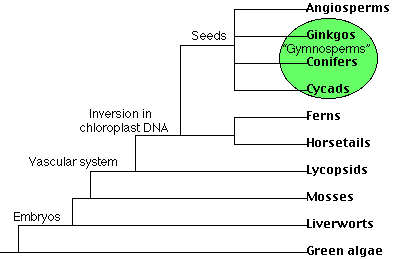
The first plants on earth evolved from shallow freshwater algae much like Chara some 400 million years ago. These probably had an isomorphic alternation of generations and were probably filamentous. Fossils of isolated land plant spores suggest land plants may have been around as long as 475 million years ago
A range of algal morphologies are exhibited, and convergence of features in unrelated groups is common. The only groups to exhibit three dimensional multicellular thalli are the reds and browns, and some chlorophytes.
Apical growth is constrained to subsets of these groups:
- florideophyte reds
- various browns
- charophytes.
The form of charophytes is quite different to those of reds and browns, because they have distinct nodes, separated by internode 'stems'; whorls of branches reminiscent of the horsetails occur at the nodes. Conceptacles are another polyphyletic trait; they appear in the coralline algae and the Hildenbrandiales, as well as the browns.
Most of the simpler algae are unicellular flagellates or amoeboids, but colonial and non-motile forms have developed independently among several of the groups. There several levels of organization.
Common organizational levels include:
- Colonial: small, regular groups of motile cells
- Capsoid: individual non-motile cells embedded in mucilage
- Coccoid: individual non-motile cells with cell walls
- Palmelloid: non-motile cells embedded in mucilage
- Filamentous: a string of non-motile cells connected together, sometimes branching
- Parenchymatous: cells forming a thallus with partial differentiation of tissues.
More than one of these organizational levels may occur in the life cycle of the same species.
In three lines even higher levels of organization have been reached, with full tissue differentiation. These are the brown algae,—some of which may reach 50 m in length (kelps)—the red algae, and the green algae. The most complex forms are found among the green algae (see Charales and Charophyta), some of which evolved into the land plants.
The point where algae stop and non-algal plants begin, is usually taken to be reproductive organs with protective cell layers in non-algal plants.
Symbiotic Algae
Some species of Algae form symbiotic relationships with other organisms. In these symbioses, the algae supply photosynthates (organic substances) to the host organism providing protection to the algal cells. The host organism derives some or all of its energy requirements from the algae. Examples are as follows.
Lichen
Lichens are defined by the International Association for Lichenology to be "an association of a fungus and a photosynthetic symbiont resulting in a stable vegetative body having a specific structure."
The fungi, or mycobionts, are from the Ascomycota with a few from the Basidiomycota. They are not found alone in nature but when they began to associate is not known.
One mycobiont associates with the same phycobiont species, rarely two, from the Green Algae, except that alternatively the mycobiont may associate with the same species of Cyanobacteria (hence "photobiont" is the more accurate term).
A photobiont may be associated with many specific mycobionts or live independently; accordingly, lichens are named and classified as fungal species. The association is termed a morpho-genesis (morpho = shape or form; genesis [Gk] = beginning or creation) because the lichen has a form and capabilities not possessed by the symbiont species alone (they can be experimentally isolated). It is possible that the photobiont triggers otherwise latent genes in the mycobiont.
Coral reef
Coral reefs are accumulated from the calcareous exoskeletons of marine invertebrates of the Scleractinia order; i.e., the Stony Corals. [Gk skleroun = to harden] As animals they metabolize sugar and oxygen to obtain energy for their cell-building processes, including secretion of the exoskeleton, with water and carbon dioxide as byproducts. As the reef is the result of a favorable equilibrium between construction by the corals and destruction by marine erosion, the rate at which metabolism can proceed determines the growth or deterioration of the reef.
Algae of the Dinoflagellate phylum are often endosymbionts in the cells of marine invertebrates, where they accelerate host-cell metabolism by generating immediately available sugar and oxygen through photosynthesis using incident light and the carbon dioxide produced in the host.
Endosymbiont algae in the Stony Corals are described by the term zooxanthellae, with the host Stony Corals thus called hermatypic corals. The algae-Stony Coral partnership is not quite a taxon even though the coral, in order to be healthy, needs the symbiont. Its absence causes coral bleaching, leading to the deterioration and loss of the reef.
Almost all of these zooxanthellae belong to the genus Symbiodinium (= symbiotic + dinium).
Sea sponges
Green Algae live close to the surface of some sponges, for example, breadcrumb sponge (Halichondria panicea). The alga is thus protected from predators; the sponge is provided with oxygen and sugars which can account for 50 to 80% of sponge growth in some species.
Life-cycle
Rhodophyta, Chlorophyta and Heterokontophyta, the three main algal Phyla, have life-cycles which show tremendous variation with considerable complexity. In general there is:
- an asexual phase where the seaweed's cells are diploid.
Asexual reproduction is advantageous in that it permits efficient population increases, but less variation is possible.
- a sexual phase where the cells are haploid
Sexual reproduction allows more variation but is more costly because of the waste of gametes that fail to mate, among other things.
- followed by fusion of the male and female gametes.
Often there is no strict alternation between the sporophyte and gametophyte phases. The asexual phase can include the fragmentation of the thallus.
Distribution
Algae spread mainly by the dispersal of spores analogously to the dispersal of Plantae by seeds and spores. Spores are everywhere in all parts of the Earth: the waters fresh and marine, the atmosphere, free-floating and in precipitation or mixed with dust, the humus and in other organisms, such as humans. Whether a spore is to grow into an organism depends on the combination of the species and the environmental conditions.
The spores of fresh-water Algae are dispersed mainly by running water and wind, as well as by living carriers. The bodies of water into which they are transported are chemically selective. Marine spores are spread by currents. Oceans have temperature zones, and these temperatures determine the propagation or failure of algae. Currents can move those temperature zones and their algae over large distances; and are themselves affected by the presence of continents, underwater shelves, other currents, temperature (cold currents 'dive' under warm currents). Further, these currents may or may not carry nutrients beneficial to algal growth. (Warm equatorial currents tend to be deficient while cold antarctic currents are rich.)
It is therefore possible to identify species occuring by locality, such as "Pacific Algae" or "North Sea Algae". When they occur out of their localities, it is usually possible to hypothesize a transport mechanism, such as the hulls of ships. For example, Ulva reticulata and Ulva fasciata travelled from the mainland to Hawaii in this manner.
Mapping is possible but little work has been done because of cost, difficulty and inability to patent the results of research in order to extract profits.
Ecology
Algae are prominent in bodies of water, common in terrestrial environments and are found in unusual environments, such as on snow and on ice. Seaweeds grow mostly in shallow marine waters, under 100 metres (330 ft); however some have been recorded to a depth of 360 metres (1,200 ft)
The various sorts of algae play significant roles in aquatic ecology. Microscopic forms that live suspended in the water column (phytoplankton) provide the food base for most marine food chains. In very high densities (algal blooms) these algae may discolor the water and outcompete, poison, or asphyxiate other life forms.
Algae are variously sensitive to different factors, which has made them useful as biological indicators in the Ballantine Scale and its modifications.
Uses:
- Agar: an Algae derivative, has a number of commercial uses.
- Alginates: Between 100,000 and 170,000 wet tons of Macrocystis are harvested annually in California for alginate extraction and abalone feed.
- Energy source: Algae are processed to make various chemical fuels.
- Fertilizer: Seaweed is used as a fertilizer.
Today Algae are used by humans in many ways; for example, as fertilizers, soil conditioners and livestock feed. Aquatic and microscopic species are cultured in clear tanks or ponds and are either harvested or used to treat effluents pumped through the ponds. Algaculture on a large scale is an important type of aquaculture in some places. Maerl is commonly used as a soil conditioner.
- Nutrition: Naturally growing seaweeds are an important source of food, especially in Asia. They provide many vitamins including: A, B1, B2, B6, niacin and C, and are rich in iodine, potassium, iron, magnesium and calcium.
In addition commercially cultivated microalgae, including both Algae and Cyanobacteria, are marketed as nutritional supplements, such as Spirulina, Chlorella and the Vitamin-C supplement, Dunaliella, high in beta-carotene.
Algae are national foods of many nations: China consumes more than 70 species, including fat choy, a cyanobacterium considered a vegetable; Japan, over 20 species;
Ireland, dulse; Chile, cochayuyo.
Laver is used to make "laver bread" in the British Isles; in Korea, gim; in Japan, nori and aonori. It is also used along the west coast of North America from California to British Columbia, in Hawaii and by the Maoris of New Zealand. Sea lettuce and badderlocks are a salad ingredient in Scotland, Ireland, Greenland and Iceland.
- Dulse, a food: The oils from some Algae have high levels of unsaturated fatty acids. For example, Arachidonic acid is very high in Parietochloris incisa, where it reaches up to 47% of the triglyceride pool.[53] Some varieties of Algae favored by vegetarianism and veganism contain the long-chain, essential omega-3 fatty acids, Docosahexaenoic acid (DHA) and Eicosapentaenoic acid (EPA), in addition to vitamin B12. Fish oil contains the omega-3 fatty acids, but the original source is algae, which are eaten by marine life such as copepods and are passed up the food chain.
- Pollution control:
- Sewage can be treated with algae, reducing the need for greater amounts of toxic chemicals than are already used.
- Algae can be used to capture fertilizers in runoff from farms. When subsequently harvested, the enriched algae itself can be used as fertilizer.
- Algae Bioreactors are used by some powerplants to reduce CO2 emissions.
- Pigments: The natural pigments produced by algae can be used as an alternative to chemical dyes and coloring agents.
- Stabilizing substances: Carrageenan, from the red alga Chondrus crispus, is used as a stabiliser in milk products.