Algae "Green Algae"
Algae are single-celled acquatic organisms using photosynthesis to generate energy. While they have several pigments to absorb the sun's energy, they must all pass this energy to green chlorophyll a which manufacturs the sugars. Thus all have the green chlorophyll a, but the other pigments may be sufficeintly concentrated to give the organism a different color, such as blue, red or brown.
This list shows the 4 Algal Divisions:
- Chlorophyta (Green Algae) DIVISION:
- Bryopsidaceae:
- Cladophoraceae:
- Ulvaceae:
- Phaeophyta (Brown Algae) DIVISION / Chromista:
- Sargassaceae:>
- Laminariales:
- Alariaceae:
- Laminariaceae:
- Lessoniaceae:
- Rhodophyta (Red Algae) DIVISION:
- Corallinales: Corallinaceae
- Gigartinales: Endocladiaceae
- Cyanobacteria (Blue Algae): Domain Eubacteria
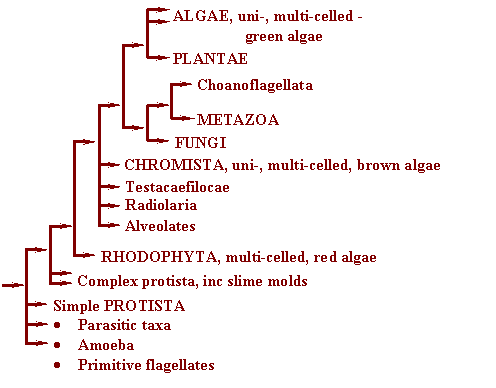
The "green algae" is the most diverse group of algae, with more than 7000 species growing in a variety of habitats. The "green algae" is a paraphyletic group because it excludes the Plantae. Like the plants, the green algae contain two forms of chlorophyll, which they use to capture light energy to fuel the manufacture of sugars, but unlike plants they are primarily aquatic. Because they are aquatic and manufacture their own food, these organisms are called "algae," along with certain members of the Chromista, the Rhodophyta, and photosynthetic bacteria, even though they do not share a close relationship with any of these groups.
Biologists, the 'experts', classify in many ways, showing that they have yet to make up their minds. Perhaps they are not so expert ? We hope that this debate will end when the complete genotypes have been found and compared.
Algae "Green Algae"
Microalgae, the unicellular algal protists, generally occur in many algal divisions.
The algae include:
- Chlorophyta
- Euglenophyta
- Chrysophyta
- Pyrrophyta
- Rhodophyta
Microalgae
The microalgae, the algae that come into the domain of microbiology, occur in great abundance in oceans, seas, lakes, ponds and streams.
They are also found in damp soil, rocks and in plants and animals.
Photosynthetic forms make up a large part of free-floating microscopic life in water (plankton).
Some grow on the snow and ice of polar regions, others in hot springs at temperatures as high as 90oC.
Some microscopic algae can create problems in water supplies (e.g., brown flagellate alga namely Synura) by producing undesirable tastes and odours.
Some grow endophytically in protozoa, hydra, sponges and corals.
Chlorophyta
Microalgae of this large and diverse group of algal protistans are called green algae and are also mainly represented by fresh water species. They are also found in sea water and soil. All members contain chlorophylls a, b, β-carotene and exanthophylls.
The majority of these micro-organisms contain one chloroplast per cell; the chloroplast often contains centre of starch formation called ‘pyrenoid’. Reserve food material is starch. They reproduce by zoospores, fission and other asexual methods or by misogamous and heterogamous sexual methods.
Euglenophyta
This group consists of unicellular flagellate algal protists which are both fresh-water and marine forms. They are actively motile by means of flagella and reproduce by longitudinal binary fission. All members contain chlorophylls a. b, β-carotene and xanthophylls.
There is no cell wall and the reserve food material is paramylon and oil. Euglena is the most interesting genus which is representative of a group designated as animals by some zoologists but as plants by many botanists.
Chrysophyta
The group consists of diverse, non-flagellate, unicellular, colonial or multicellular algal protists. Some have calcium-containing hard cell-walls while others, the diatoms, have a typical organic cell-wall impregnated with silica. These possess chlorophylls a, c, p-carotene and xanthophylls. Reserve food material is chrysolaminarin, a complex carbohydrate. Important genera are: Vaucheria. Pinllularia. Navicula etc.
Pyrrophyta
This group is represented by the dinoflagellates which are primarily marine in their habitat. The motile cell of a dinoflagellate possesses two flagella which differ in structure and arrangement.
One is located in the transverse groove around the equator of the cell and the other extends away from the cell in the posterior direction. Dinoflagellates are generally unicellular and contain chlorophylls a, c, p-carotene and xanthophylls. Asexual reproduction is commonly by longitudinal binary fission and the reserve food material is starch and oil. Some dinoflagellates are luminiscent. Important genera are: Ceratium, Gymnodinium and Gonyaulax; the Gonyaulax produces toxin blooms known as 'red tides' which kill some marine organisms.
Microbiologically Important Micro-Algae
Desmids
Desmids are non-flagellate algal protists belonging to green algal group, the Chlorophyta. Their cells are generally large and flattened with bilateral symmetry. Desmids are usually fresh water forms and are recognised by their delicate symmetrical cells.
They lack flagella but move slowly over the substratum; their motility mechanism is still not known. Asexual reproduction involves the synthesis of two new half cells in the equatorial plane. This is followed by cleavage of the cells to produce two daughter cells, each consisting of a parental and a newly synthesized half.
Desmids are characteristic microorganisms of many oligotrophic waters. For this reason, they are used as a tool in the assessment of the low level of organic pollution in a water body.
Chlorella
Chlorella is one of the microbiologically most important green algal protist. It has tremendous practical application and is rightly called the 'guinea pig' of many scientific investigations. It is probably used more extensively in studies of photosynthesis than any other organism.
Calvin and his coworkers (1946) proposed the pathway of CO2 reduction, the calvin cycle, while working on Chlorella pyrenoidosa. This algal protist was considered to be used in photosynthesis studies because of its following important features:
- it grows luxuriantly in different environmental conditions and avoids contamination
- the entire vegetative body behaves like a single chloroplast
- it divides very rapidly
- its culture is easy to maintain
- it contains chlorophyll pigments similar to higher plants and, therefore, the end products of photosynthesis are also similar, and if) the young cultures are rich in protein and while approaching to maturity the fat and carbohydrate contents increase.
Besides, Chlorella is of increasing interest for its use as food for humans and domestic animals because its protein contains all the amino acids essential for growth.
Methods for mass cultivation of Chlorella, using waste products and sewage for their nutrition, have been developed.
This is to use Chlorella in the recycling of sewage waste and for generating thermal energy.
By this method complex organic substances of sewage can be degraded into simple inorganic components making them readily available for other microorganisms thus generating pollution-free energy.
An antibiotic called 'chlorellin' has also been synthesized from Chlorella.
Diatoms
Diatoms, the members of division Chrysophyta, are the most plentiful form of phytoplankton in the Arctic. The thousands of species of diatoms provide an ever present and abundant food supply for aquatic organisms.
They are morphologically diverse, non-flagellate, unicellular algal protists. The diatom cell has a prominent, single nucleus and massive ribbon-like, or smaller lens-like, plastids.
They produce shells (cell walls) impregnated with silica. The shells of Diatoms are called 'frustules'. Deposits of these shells resulting from centuries of growth are called 'Diatomite' or diatomaceous earth which has enormous industrial
significance as it is used in insulating materials as a filter for clarifying water, fruit juices, cane sugar and beverages; for cosmetic bases; and for polishing material.
Memorize
Microalgae, the unicellular algal protists, generally occur in many algal divisions.
Examples:
- Chlorophyta
- Euglenophyta
- Chrysophyta
- Pyrrophyta
- Rhodophyta