Plantae 3

Embryophytes

Plantae, or land plants, are also called embryophytes. [embryo Gk = to swell or grow; fyton Gk = plant; which refers to the way they begin very small as spores or seeds, and grow massively in proportion.]
Embryophytes are primarily adapted for life on land, although some are secondarily aquatic.
Accordingly, they are often called land plants or terrestrial plants.

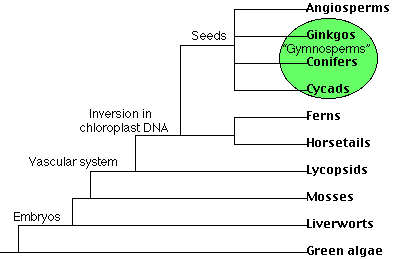
plantae_tree.png not found The embryophytes include: There are over 250,000 species but many remain to be discovered.

All are complex multicellular eukaryotes with specialized reproductive organs. With very few exceptions, embryophytes obtain their energy through photosynthesis (photo = light; synthesis = to make) converting carbon dioxide from the air into sugar. These sugars are then combined end-on-end to form large chains, called starches, and starches are combined to form huge chains called cellulose.

The juice of sugar cane is mainly sugar (sucrose); flour, white rice and potatoes are mainly starch, and trees are mainly cellulose. Grasses stand erect because their cell walls are cellulose. The straw left standing after the harvesting of grain, is mainly cellulose.

Embryophyta may be distinguished from chlorophyll-using multi-cellular algae by having sterile tissue within the reproductive organs - which does not help you and me. But algae are aquatic, including seaweeds, kelp, and that layer of tiny bright-green round 'leaves' which clump on the surfaces of still ponds.

Plant evolution

This evolution tree for plants is the easiest, and must be known perfectly so you can use it without thinking or hesitating. Then search them out to draw over and over, so you can recognize them intuitively, again without thinking. It is on this frame that you will build a magnificent picture of our living planet - and that makes disciplined learning an excellent investment of your time. This is also a basic step towards spirituality.

Plant evolution 'tree': Bryophyte from bruon Gk = "kind of seaweed; tree-moss, oyster-green" + fyton = "plant".
Embryophyte from bruon, bruo Gk = "to swell, to grow" + fyton = "plant".
Extant: still existing.
Ovule: 'egg'
Photo-auto-trophic: they use light to make their own food.
Photosynthesis: is the process whereby the energy absorbed from sunlight is used to combine molecules of carbon dioxide from the air with water, turning them into sugar. This is usually done by a chlorophyll, particularly 'chlorophyll a' usually located in a chloroplast within the cells in the leaf.
-phyte: fyton = "plant"
Spermatophytes: seed-bearers.
Sets of chromosomes:
Chromosomes are strings of genes, which determine an individual's species, and their variation within that species. Chromosomes in the nucleus of an individual's cell, except for bryophytes, usually exist in pairs, that is, two chromosomes affect the same aspects of an individual, such as eye and hair color, the shape of the ears, gender. However, sex cells, those of sperm and ovule, usually have only one chromosomes from each pair. This brings us to haploid and diploid sets of chromosomes.
haplous [Gk] = single or one from each pair; haploid set => gametophytes;
diplous [Gk] = double or two of each pair; diploid set => sporophytes.
Bryophytes (mosses, liverworts, hornworts) have only a single set of chromosomes (haploid, i.e. each chromosome exists in a unique copy within the cell). Thus mosses have a gametophyte-dominant life cycle, i.e. the plant's cells are haploid for most of its life cycle. They do have a full, double set of paired chromosomes but only during the sporophyte stage. Sporophytes (i.e. the diploid body) are short-lived and dependent on the gametophyte.
Trakheia [Gk] = rough artery, as found in Tracheophyta such as club mosses, ferns, whisk ferns, and horsetails, which transport water up from the ground and sugars down to the roots, through vessels (like arteries). This enables them to grow much taller. This is advantageous when seeking sunlight in a forest.
'Vascular' comes from vas [L] = vessel or duct, found in the vascular tissues of Tracheophyta.

Structure

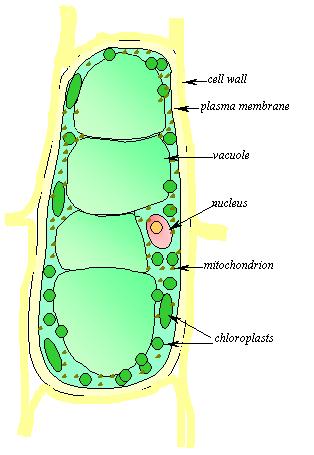
Plant cells have:

When plant cells divide, they must form a new cell wall between them, and this is accomplished by the formation of a phragmoplast, a system of microtubules oriented along the axis of cell division which helps to guide the deposition of cellulose.
In contrast, "green algae" produce a phycoplast during mitosis, in which the microtubules lie perpendicular to the axis of division. Only plants and charophytes divide their cells with the aid of a phragmoplast.

Chloroplast genes

Chloroplasts (as well as mitochondria) have their own genome. As an example, the genome of the liverwort Marchantia polymorpha contains 121,024 base pairs encoding 128 genes.

Plasmodesmata

Plasmodesmata are 'tubes' or 'pores' connecting cells through cell walls, for the transfer of nutrients, water, and some other diffusible materials.
Their advantage is that they bypass the need for osmosis to pass them across membranes. Osmosis requires an imbalance of chemical concentrations across semi-permeable membranes, which requires special conditions and extra energy.
Their disadvantage is that they quickly transmit disease through the tissues.

Vacuole

At maturity, most plant cells are filled with a single large vacuole, pushing the nucleus, plastids, and other organelles outwards, towards the cell membrane. The vacuole is a membrane-bound bag of fluid, containing ions, stored nutrients, and waste materials. The storage of waste materials is a very important function of the vacuole, since plants cannot excrete their wastes the way animals do. The vacuole also assists the cell in maintaining turgor pressure.
The high concentration of materials in the vacuole causes water to diffuse into the cell, increasing its volume. Because of the cell wall, however, the amount of space into which the cell can expand is limited. The cell thus exerts outward pressure on its cell wall, and when all cells are maintaining this pressure, the plant increases its rigidity.
You will have noticed that old vegetables, such as capsicum and egg-plant, as they dry out and so lose rigidity, become wrinkled and soft. Broccholi and celery just soften.

Plastids

Plastids manufacture food through photosynthesis
The plastid is an organelle which contains chlorophyll. The chlorophyll is a chemical that captures the energy of sunlight, by converting low-energy carbon dioxide and water into sugars and oxygen, which have higher energy.
This energy is later released by reversing the process, using oxygen to convert the sugars to carbon dioxide and water. Since more sugars are stored than are 'burnt' for energy, there is a net input of carbon dioxide and a net output of oxygen. We breathe in that net output of oxygen to burning our sugars to give us energy.

The sugars are often linked together for easy storage into a complex carbohydrate called starch. Without these sugars and starch, life on land as we know it would be impossible, for there would be practically no food -- no grains, no fruits, no vegetables.

Another useful by-product of photosynthesis is oxygen, although most of our oxygen comes from phytoplankton in the oceans, which use a similar process. As this phytoplankton is destroyed by our pollution running into the oceans, and increasing oil-spills from tankers, what will we do for oxygen ?

Evolution

Embryophytes evolved from complex green algae (Chlorophyta) during the Paleozoic era. The Charales or stoneworts appear to be the best living illustration of that developmental step. These algae-like plants undergo an alternation between haploid and diploid generations

Chromosomes come in pairs.
Humans have 46 chromosomes but only 23 types of chromosomes because they are in pairs. To form a sperm or an egg, one chromosome from each of the 23 pairs is extracted to form a set of 23. This haploid set makes a gametophyte, the plant equivalent of our sperm and egg.
At fertilization, when the sperm and egg are united, we regain the diploid set of 46 again.
The sperm and the unfertilized egg, with their haploid sets of chromosomes, are the equivalent of the gametophyte.
The fertilized egg's diploid set is the equivalent of the fern's sporophyte.
haplous [Gk] = single or one from each pair; haploid set => gametophytes;
diplous [Gk] = double or two of each pair; diploid set => sporophytes.

'Bryophytes': In the first embryophytes, however, the sporophytes became very different in structure and function, remaining small and dependent on the parent for their entire brief life. Such plants are informally called 'bryophytes'.
They include three surviving groups:
All of the above 'bryophytes' are relatively small and are usually confined to moist environments, relying on water to disperse their spores. Other plants, better adapted to terrestrial conditions, appeared during the Silurian period.

Tracheophyta: During the Devonian period, the 'bryophytes' diversified and spread to many different land environments, some evolving into the vascular plants, tracheophytes. Tracheophyta have vascular tissues or tracheids (trakheia [Gk] = rough artery), which transport water throughout the body, and an outer layer or cuticle that resists drying out. In most vascular plants, the sporophyte is the dominant individual, and develops true leaves, stems, and roots, while the gametophyte remains very small.

Many vascular plants, however, still disperse using spores. They include two extant groups:
Spermatophytes or seed-bearers: Other groups, which first appeared towards the end of the Paleozoic era, produce seeds, which are just desiccation-resistant capsules often able to remain viable in extremely arid conditions for years and even centuries.
Their gametophytes are completely reduced to single-celled pollen and ova held within the seed, where they combine to form the sporophyte. Being already enclosed within the protection of that seed, gives the sporophyte maximun chance of survival. This major advantage over their water-dependent precursors, such as the 'bryophytes', enabled them to spread across the planet, from swamps to arid zones, from tropics to tundra.

The seed plants include the following extant groups:

Spermatophyte classification

Spermatophytes:
Angiosperms were the last major group of plants to appear, developing from gymnosperms during the Jurassic period, and then spreading rapidly during the Cretaceous. They are the predominant group of plants in most terrestrial biomes today. Why ?

Biologists, the 'experts', have yet to make up their minds about classifications within the spermatophytes, so you should decide on one classification and stick to it. As long as your frames work for you.

On a microscopic level, embryophyte cells remain very similar to those of green algae:

Earliest life

In the early stage of the planet, the atmosphere contained large amounts of methane, carbon dioxide and water vapor, with virtually no free oxygen, and therefore impossible for today's plants and animals. Life began in the seas.

The Archaea and Eubacteria used methane and carbon dioxide (and water) to produce energy and other chemicals, releasing oxygen in the process. Thus the balance of gases in the atmosphere changed. Of the countless new organisms which were inevitably evolving, some were suited to this change, and eventually evolved into algae.

The algae kept evolving and eventually produced species which could survive the intertidal regions of the seas, with long exposure to the dry conditions. And some of these eventually evolved into permanently land-based organisms and then plants.

[And that is 2 billion years of Earth's history in 3 paragraphs.]

Plants first appeared in the Ordovician, but did not begin to resemble modern plants until the Late Silurian. By the close of the Devonian, about 360 million years ago, there were a wide variety of shapes and sizes of plants around, including gingkos and cycads (gymnosperms) but no flowering plants.

While using the sun's energy to combine carbon dioxide with water to make sugar plus oxygen, and then accumulating carbon as sugars, starch and cellulose, plants reduced the carbon dioxide levels in the air while increasing the oxygen. They also provided food for the saprophitic fungi and herbivorous metazoa (animals), both of which cannot manufacture their own food.
Thus plants and algae changed the environment to conditions which proved ideal for the evolution of fungi and metazoa.

The only places on earth without plants are the arctic wastelands, very arid deserts, and the deep ocean (where there is no light for photsynthesis). Everywhere else, from the tundra to the rainforest to the desert, is populated by plants.

ProblemPlantsAnimals
Mobility
Protection
Heat response
Water needs
sedentary
toxins, sticky sap, spines
evaporation
dessication tolerance
mobile *
escape
seek shade
move to water

* Some animals are sedentary, such as barnacles and sponges.

Water

Water, or loss of it, can be a serious problem as well, and land plants have developed two basic strategies for coping with water needs:

Photosynthesis

Sunlight provides the energy for plants to manufacture sugars. These sugars can be broken down to release energy to drive the chemical reactions upon which all living organisms depend. Or these sugars can be chained together to form starches, used as an efficient means of storing sugars.
Raw potato and raw rice are mainly starch.
Starches can be combined to form cellulose which provides the structural cell walls to hold the plant erect.

Pigments

The sunlight is absorbed by pigments (colored chemicals), usually chlorophylls. Plants use chlorophylls a and b. (The 'green algae' use a, b or c, p- or beta-carotene, and xanthophylls.) There are several pigments of different colors such as the green we see in grass and leaves. In autumn the green chlorophyll in deciduous trees disappears, exposing the yellow, red and brown pigments which are usually overwhelmed by the intensity of the green.

Chlorophyll is by far the most important pigment, particularly 'chlorophyll a', which uses the energy absorbed from light to combine molecules of carbon dioxide from the air with water, turning them into sugar. Plants are photo-auto-trophic because they use light to make their own food.

Plantae: Systematics

Plants have chlorophyll and an alternation of generations. They differ from the "green algae" in that the young sporophyte -- or diploid plant – begins its development within the tissues of its parent gametophyte – or haploid plant. They also differ in that the sporophyte and gametophyte are heteromorphic, that is the two generations look and develop differently from each other.

The plant groups shown in this cladogram, except for the "seed plants", all have a free-living independent gametophyte which nurtures the young sporophyte. In the "bryophytes" (Hepaticophyta, Anthocerotophyta, and Bryophyta), the sporophyte plant remains small and dependent on the parent gametophyte for its entire life. In the "pteridophytes" (the remaining groups, except the "seed plants"), the sporophyte eventually becomes a large free-living and independent organism. In the spermatophytes ("seed plants"), the situation is reversed, and the gametophyte is the smaller and dependent generation.

Systematics within the Plantae is based on a number of features in addition to life-cycle characteristics. The presence of stomata in all plants but the Hepaticophyta suggests that they were the earliest group to diverge. Vascular tissue is found in all "seed plants" and "pteridophytes", with the exception of some early "rhyniophytes", and so these plants are often referred to as the tracheophytes ("vascular plants"). Relationships among the various groups of pteridophytes are poorly understood, though much research is being concentrated on this group.

We will now summarize some points on the similarities and differences of the less complex plants.

Early plants

There are more than 400,000 species in the Plant Kingdom or Kingdom Plantae.

The earliest plants were non-seeding, non-flowering plants, reproducing by spores; and being non-vascular (without vessels or veins) were restricted to water or damp places.

The early multi-celled algae were followed by the Bryophytes.

Algae

All algae or seaweed, are non-poisonous and cellulose-free, facilitating digestion and absorption of minerals (unlike land-grown vegetables), and have the advantage of being free. However, like mussels, oysters and fish, do not harvest in polluted zones, such as near sewer or factory outlets. Algae beds promote marine life and need protection from pollution.
These are the green algae, colored by the green chlorophyll which enables photosynthesis. Species number about 6000.

Rhodophyta

These are the red algae, mostly sea-dwellers, colored by phycobilins which hide the green of their chlorophyll. Species number about 4000.

Phaeophyta

These are the sea-dwelling dark green or brown algae, including kelp, colored by fucoxanthin which hides the green of the chlorophyll. Species number about 1500. Some grow to 100 meters. They include the brown kelp growing on rocks, whose iodine, potassium and phosphorus make excellent fertilizer. Bull kelp is collected after storms wash it up onto beaches, for extracting alginates such as are used for ice-cream.

Bryophyta

Simple non-vascular land plants in damp places, growing without proper stems, leaves or roots. Instead of roots, bryophyts are anchored to the ground by root-like cells called rhizoids. liverwort, moss, hornwort

Simple plants like liverworts and mosses, use two forms of reproduction in alternate generations:
In liverworts and mosses, the gametophyte stage is larger than the sporophyte stage. In other plants, like ferns, horsetails and clubmosses, it is usually the reverse.

Liverwort

Broad-leafed, squat ground-hugger, with root-like cells (rhizoids) and broad flat leaf-like scales; scattered over surface are gemma cups, cointaining clusters of cells used in asexual reproduction. Anchored to the ground by root-liks cells called rhizoids. Species number about 6000.

Moss

Often in tight clumps, usually in damp places although some can survive for long periods with little water, they produce spores in a capsule on a long stalk. Species number about 10,000.

Hornwort

The life of a hornwort starts from a haploid spore. The first rhizoid grows as an extension of the original germ cell.
The tip continues to divide new cells, which produces a thalloid protonema, which is a transitory stage in the life of a hornwort.
From the protonema grows the adult gametophyte, which is the persistent and independent stage in the life cycle. This stage usually grows as a thin rosette or ribbon-like thallus between one and five centimeters in diameter, and several layers of cells in thickness. It is green or yellow-green from the chlorophyll in its cells, or bluish-green when colonies of cyanobacteria grow inside the plant.
When the gametophyte has grown to its adult size, it produces the sex organs of the hornwort. The biflagellate sperm must swim from the antheridia, or else be splashed to the archegonia. When this happens, the sperm and egg cell fuse to form a zygote, the cell from which the sporophyte stage of the life cycle will develop. Unlike all other bryophytes, the first cell division of the zygote is longitudinal. Further divisions produce three basic regions of the sporophyte.

Part of the sporophyte is a foot receiving nutrients from the parent gametophyte, on which the sporophyte will spend its entire existence. Just above the foot is a meristem producing new cells for the third region which becomes the capsule, and this releases the haploid spores.
Simple vascular plants Tracheophytes or vascular plants
Tracheophytes or vascular plants, have cells acting as pipes to carry water and nutrients from the soil up to the leaves, and sugars and oxygen from the leaves down the plant to provide energy wherever activities occur. They introduce leaves.
Simple vascular plants such as clubmosses, ferns and horsetails, like the simple plants liverworts and mosses, use two forms of reproduction in alternate generations:
In liverworts and mosses, the gametophyte stage is larger than the sporophyte stage. In other plants, like ferns, horsetails and clubmosses, it is usually the reverse.

Pteridophyta - Ferns
Most ferns have fronds divided into many leaflets; form spores under the leaves in sporangia, which may be clustered into a sorus; live usually in damp shady places. Water ferns grow in water or on waterlogged ground; may have rounded fronds and be covered in water-repellent hairs. Tree ferns have 'trunks' formed from the stalks of dead fronds, and have new fronds uncoiling from the top end. Species nmber about 11,000.

Sphenophyta - Horsetails
These are brush-like plants with side-branches arranged in rings; propagating by both spores and rhizomes There are two types of stem: Species number 5.

Lycopodophyta - Clubmosses
Clubmosses usually have small leaves spiralling around the stem; and creeping stems bearing upright branches. Spores occur on sporophylls, special leaves along the branches or grouped at the tips. Species number about 1000.