Properties of classification of plants
Your task
Kingdom Plantae: = Plant Kingdom, the set of all plants, and excluding all non-plants such as green algae, mushrooms and other fungi.
Clade: a diagram showing evolutionary paths rising from a common ancestor.
Plants share one clade, that is, all plants evolved from a common ancestor. [This is an hypothesis, yet to be proved.]
Always test yourself:
It is not necessary to be certain of your answer or for your answer to be irrefutably correct - the task is to exercise your mind, and by doing so, understand the subject, remember the information and increase your intelligence.
For each plant you should answer these questions:
- What has this plant evolved since the simpler one before it ?
- What advantages do these evolved differences offer them in their struggle to survive ?
- What are the main difficulties remaining ?
- What evolutionary changes would solve these difficulties ?
- As the climate in your area changes over the next 100 years:
- which plants will become extinct ? Why ?
- which plants will survive ? Why ?
- Choose a species that might become extinct. Within that specie, some variations might become extinct because of inability to survive the new climatic changes. Explain why. Find, if you can, some variations which will survive because their variations will enable them to adapt.
Explain and justify your choice.
Examples include:
- Some mosses have adapted to urban conditions and are found only in cities.
- In a low part of my little forest there are manferns becoming established. If global warming increases the rainfall in my area, this patch will beome continually under water, thus drowning the plants and leading to their 'extinction'. One solution is for the spores to be windblown to higher ground, and be able to propagate there in the drier soil. Unfortunately the strong winds blow the opposite direction, and spores have difficulty becoming established in dry soil. Those manferns which develop some means of sending their spores up to high ground and which can also propagate there, are the ones which will survive as a new specie.
- The lichen symbiotic association of alga and fungus extends the ecological range of both and is obligatory for their growth and reproduction in natural environments.
- Many lichens break up into fragments when they dry, dispersing themselves by wind action, to resume growth when moisture is found.
- Although lichens typically grow in naturally harsh environments, most lichens, especially epiphytic fruticose species and those containing cyanobacteria, are sensitive to manufactured pollutants. Hence, they have been widely used as pollution indicator organisms. Will they adapt ?
- The drying out of the climate during the latest Carboniferous was catastrophic for the lycopods, which require moist conditions to reproduce. All the giant "pole trees" like Lepidodendron died out, leaving only a number of small herbaceous types.
Plantae overview
Contents:
- (Green Algae, previously of Plantae, Division Chlorophyta, but now evicted)
- Mosses, hornworts & liverworts
- Lycopsids (Division Lycopsida)
- Classification significance of chloroplast genes
- Horsetails (Division Equisetopsida)
- Ferns (Division Filicopsida)
- Seed Plants (Division Spermatopsida):
- Gymnosperms: Conifers
- Angiosperms: fully encased seeds; flowering plants (Magnoliaphyta)
For quick identification:
- Green Alga - mostly green, aquatic, from unicellular thin green soup to simple multicellular sea lettuce.
- Liverworts and Mosses - land plants but need water to reproduce. Ground-hugging, without stems.
- Lycopsids
- Chloroplast Genes
- Horsetails - whorls or rings of branchlets arising from an above-ground shoot. The shoot develops each season from an underground stem (rhizome).
- Ferns - carry spores under leaves; perennial and have both stems, called rhizomes, and roots underground. Their fronds grow up from the rhizome each spring.
- Seed Plants:
- Gymnosperms: Conifers - pines, spruces, firs; have male pollen and female cones, but do not flower.
- Angiosperms: angiosperms flower, with or without petals.
- Monocots - monocots flower but do not have wood.
- Dicots - dicots flower; have true leaves recognized by networked veins.
Definition
Plants are assigned to a single clade, in the belief that they have all evolved from a common ancestor.
This follows characteristics held in common:
- photosynthetic pigments chlorophyll a and chlorophyll b
- similarities in the nucleotide sequences of both their small subunit (18S) and large subunit (28S) ribosomal RNA (rRNA) genes
- cellulose cell walls.
This is not a definition. Why not ? Please convert to a definition.
Green Algae
Green algae are not plants. The purpose of this section is a brief comparison of algae and plants. There are 2 chapters on algae for a full study.
Previously assigned to the Division Chlorophyta, green algae have been evicted from the Kingdom Plantae and grouped into their own set: Kingdom Algae/Chromista.
Define both kingdoms and then explain why the members of the Kingdom Algae/Chromista do not belong in the Kingdom Plantae.
The ancestors of Green Algae were probably the ancestors of all the plants. [Draw the clade incorporating 3 of the algae, Algae, Rhodophyta and Glaucophyta, as well as Plantae. Refer to algae chapters.]
There are some 7000 algal species living today.
They include:
- microscopic, unicellular forms like Chlorella and Chlamydomonas
- colonial forms like the filamentous Spirogyra
- multicellular forms like Ulva, the sea lettuce.
Although some of the multicellular forms are large, they never develop more than a few differentiated types of cells and their fertilized eggs do not develop into an embryo.
Green algae are an important source of food for many aquatic animals. When lakes and ponds are "fertilized" with phosphates and nitrates (e.g., from sewage and the runoff from fertilized fields and lawns), green algae often form extensive algal "blooms" which absorb all the light and the water's little oxygen, killing other aquatic life.
Liverworts and Mosses
These are fairly simple plants that do produce a number of differentiated cell types and whose fertilized egg develops into a distinct embryo. This shows a major evolutionary advance in complexity above green algae.
However, liverworts and mosses cannot grow tall because they have neither:
- vascular tissue: (xylem and phloem)
- woody tissue.
Some 16,000 living species are known. Most grow in moist places. Why do they prefer moist places ? What have they evolved since the ancestor they have in common with algae ? What advantages do these evolved differences offer them in their struggle to survive ?
Lycopsids
Called "club mosses" and "ground pines", these are neither mosses nor pines, but vascular plants with xylem and phloem running through their roots, stems, and leaves. The leaves are quite simple and small with their vascular tissue in a single, unbranched vein.
The "club" of their name comes from the appearance of their spore-forming structures called strobili.
All the surviving 1000 species of lycopsids are small, but in the Carboniferous era, lycopsids reached 30 metres and their remains formed our coal of today.
Classification significance of chloroplast genes
Chloroplasts (as well as mitochondria) have their own genome.
The genome of the liverwort Marchantia polymorpha contains 121,024 base pairs encoding 128 genes.
The order of the genes within one section is also found in the lycopsids. But in all other vascular plants, this region is inverted and the order of the genes is precisely reversed.
This provides further evidence that the other vascular plants:
- horsetails
- ferns
- gymnosperms
- angiosperms
belong to a separate clade, yet they all shared a common ancestor and a common clade beginning further back in time.
Horsetails (Division Equisetopsida)
(Many botanists prefer the older term Sphenopsida.)
The common name comes from the characteristic pattern of branching: whorls or rings of branchlets arising from an above-ground shoot. The shoot develops each season from an underground stem (rhizome).
Horsetails often grow in sandy places and incorporate silica in their stems. This gives them an abrasive quality which caused them to once be used for cleaning pots and pans, which gave rise to another common name: scouring rush.
Only one genus, Equisetum, containing about 25 species, survives today. However, many other, much larger, species were dominant features of the Carboniferous and, like the early lycopsids, contributed to the formation of coal.
Ferns (Division Filicopsida)
(Many botanists prefer the older term Pteridopsida.)
Over 10,000 species of ferns live on earth today. Many of these are found in the tropics where "tree ferns" may grow to heights of 13 metres or more. The tree-ferns or "manferns" of temperate regions are smaller, growing up to 4m.
The leaves, called fronds, may grow up to 3m long, shooting out of the top of the 'trunk' with ends curled, then unfurling, as they grow in length. All ferns prefer damp, shady locations found in understorey.
All ferns are perennial and have both stems, called rhizomes, and roots underground. Their fronds grow up from the rhizome each spring.
Gymnosperms
Fossils from the Devonian period reveal fernlike plants that were heterosporous; that is, producing two kinds of spores:
- male microspores
- female megaspores
The megaspores were not released from the parent sporophyte. Fertilization took place within the tissue of the parent sporophyte thus freed from dependence on surface water.
However, the necessity for the microspores to be carried from one plant to another in order to reach the female gametophyte robbed them of their value as agents of dispersal. This function was taken over by seeds — dormant, protected, embryo sporophytes.
The seed ferns, as these plants are called, were among the earliest gymnosperms. Although seed ferns are now extinct, some of their living descendants, the cycads, resemble them closely. After the Cycad microspore reaches the ovule, it liberates a ciliated sperm which, swimming in moisture supplied by the parent sporophyte, reaches the egg.
The gymnosperm Ginkgo also uses motile sperm.
Conifers
These gymnosperms get their name from their cones:
- male cones in which microspores develop
- female cones in which megaspores develop.
The microspores develop into pollen grains that are carried by the wind to the female cones. Here each germinates into a pollen tube which grows into the tissues of the female cone until it reaches the vicinity of the egg. (In pines, this may take a year.) Then the tube ruptures and a sperm nucleus fuses with the egg to form the zygote.
After fertilization, the zygote develops into a tiny embryo sporophyte plant.
There are approximately 550 species of living conifers.
They include:
Conifers include the largest and the oldest of all living organisms. One redwood (genus Sequoia) growing in California is almost 400 feet high. Bristlecone pines growing in the mountains of eastern California are more than 4000 years old.
While conifers once dominated, they are now mainly concentrated north of the temperate belt of deciduous trees, which are in turn north of the belt of subtropical and tropical evergreens. In the southern hemisphere, apart from the large area of white junipers in Australia's state of New South Wales (which is not new, not south and not wales), the southern hemisphere has mainly evergreen hardwoods, that is, evergreen angiosperms (flowering trees). Deciduous beech is found in remnant pockets in Tasmaia, and covering the cold extreme of southern South America.
Although most conifers are evergreen, their leaves are modified as "needles", and, in the far-northern winters, these resist freezing, reduce transpiration when all water is inaccessibly frozen, and reduce snow load which would otherwise break branches. But by retaining their needles during the winter, conifers are ready to begin photosynthesis immediately upon the return of spring.
Coniferous forests are of great economic importance producing lumber for building and pulp for paper making.
Angiosperms
Angiosperms are flowering plants.
The names of Angiosperm Orders end in -ales, e.g., Arabidopsis is in the Order Brassicales.
The names of Angiosperm Families end in -aceae, such as Arabidopsis is in the Family Brassicaceae.
Order Brassicales
Family Brassicaceae
Genus Arabidopsis
Species thaliana.
Remember that each Order, each Family, each Genus is a clade within a clade within a clade. The node in each clade represents some common ancestor.
Although angiosperms appear in the fossil record in Jurassic deposits, it was not until the end of the Mesozoic era that angiosperms became the dominant plants of the landscape. There are over 240,000 species of living angiosperms while the rest of the plant kingdom includes only some 34,000 species.
Monocots and Dicots
The angiosperms are classified in some:
- 2 clades:
- monocots: a single clade of 80 families, called monocots because their seeds have only a single cotyledon
- dicots: whose seeds have two cotyledons.
- 54 orders
- over 400 families (1-12 families per Order).
Monocot traits:
- a single cotyledon in their seed
- parallel venation in their leaves
- petals and sepals in 3s or some multiple thereof
- vascular bundles scattered randomly throughout the stem.
Monocots include:
- palms (Arecaceae)
- orchids (Orchidaceae)
- yams, sweet potatoes (Dioscoreaceae)
- lilies, onion, asparagus (Liliaceae)
- bananas (Musaceae)
- all grasses (Poaceae), including:
- corn (maize)
- wheat
- rice
- (all cereal grains)
- sugar cane
- bamboo
If monocots don't have wood, then what supports palm trees?
Palms rely on overlapping leaf bases, thickened enlarged cells, and prop roots to stay up. This strategy is also used by cycads and tree ferns.
Dicot traits:
- two cotyledons in their seeds
- netted venation in their leaves
- petals and sepals in 4s, 5s, or some multiple thereof
- vascular bundles in the stem arranged in a radial pattern like spokes of a wheel.
Here is a selection of dicots, with families in alphabetical order.
| Family | Examples |
|---|
Anacardiaceae
Asteraceae
Brassicaceae
Cactaceae
Cucurbitaceae
Euphorbiaceae
Fabaceae
Fagaceae
Linaceae
Malvaceae
Oleaceae
Rosaceae
Rubiaceae
Rutaceae
Solanaceae
Theaceae
Vitaceae |
poison ivy, cashews, pistachios
asters and all the other composite flowers
cabbage, turnip; Arabidopsis, and other mustards
cacti
squashes
cassava (manioc)
beans and all the other legumes
oaks
flax (source of linen)
cotton
olives, ashes, lilacs
roses, apples, peaches, strawberries, almonds
coffee
oranges and other citrus fruits
potato, tomato, tobacco
tea
grapes |
Plant classification
Plants belong to the kingdom Plantae (metaphytes or viridiplantae), and are living organisms which obtain most of their energy from sunlight by photosynthesis using chloroplasts containing chlorophylls.
They include familiar organisms such as trees, herbs, bushes, grasses, vines, ferns, mosses, (but green algae have now been removed to their own Kingdom). About 350,000 species of plants, defined as seed plants, bryophytes, ferns and fern allies, are estimated to exist currently. As of 2004, some 287,655 species had been identified, of which:
- 18,000 are bryophytes (mosses, liverworts, hornworts)
- ? tracheophytes
- ? gymnosperms
- 258,650 are flowering
leaving 10,000 tracheophytes and gymnosperms, by subtraction.
The two goals of plant taxonomy are:
- plant identification
- plant systematics (classification of plants in accordance with their evolutionary relationships).
Systematics is mainly theoretical while taxonomy is basically practical, concerned with collecting, identifying and classifying individual specimens.
The identification and classification of plant taxonomy remains unsolved, so choose one classification and stick with it. While using various sources you will be frustrated by a confusion of classifications; merely pull out the details you want and slot them into your chosen classification.
The genome project (analysis of complete genetic structures) for plants will eventually help but only if you are at present young enough to last the distance. The same applies to the evolutionary tree, since there will never be enough fossils to fill the details. But why should we care ? After all, we are managing quite well now without perfect classifications, and at least they will improve in the future.
Plant identification is the determination of the identity of an unknown plant by comparison with previously collected specimens or with the aid of books or identification manuals. The process of identification connects the specimen with a published name. Once a plant specimen has been identified, its name and properties are known.
Biological classification is the placing of organisms into groups or categories:
- Domain: Choose one of Archaea, Eubacteria, Eukaryota
- Kingdom: In Eukaryota, choose any one of 5 kingdoms - Protista, Chromista, Plantae, Fungi, Metazoa/Animalia
- Division/Phylum:
- Class:
- Order:
- Family:
- Genera:
- Species:
- Variety:
Comparing these categories for one plant with those for another, shows many similarities and differences, before having to look at particular specimens of the plants. This is a very efficent way of learning about plants, and you are advised to adopt it early.
Scientific classification follows a system of rules that standardizes the results, and groups successive categories into a hierarchy.
For example, the family to which the lilies belong is classified as follows:
- Domain: Eukaryota
- Kingdom: Plantae
- Division/Phylum: Magnoliophyta
- Class: Liliopsida
- Order: Liliales
- Family: Liliaceae
- Genera:
- Species:
- Variety:
Plantae began as a group of eukaryota that acquired their chloroplasts directly by engulfing cyanobacteria. Benefiting from this symbiotic relationship, they modified their structures, developing and dividing in unison.
Fossil range begins 520 Ma (million years ago)
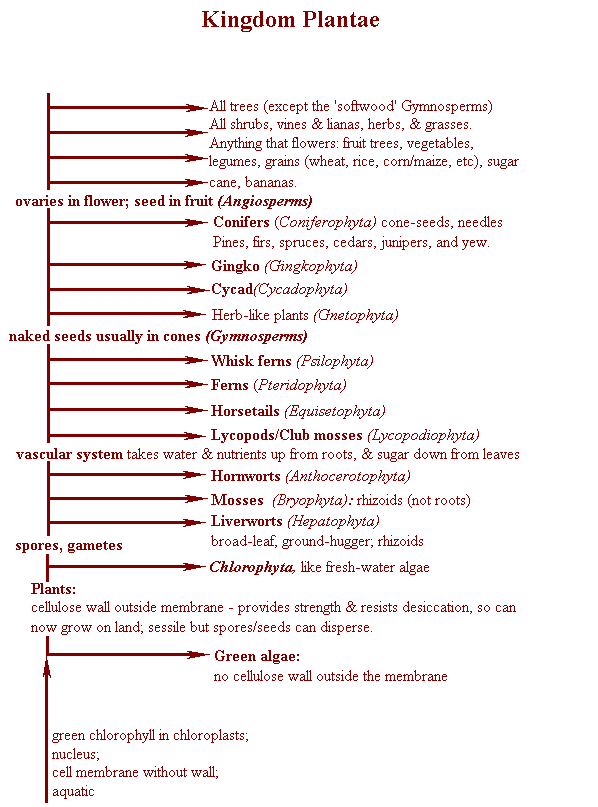
LEARN THIS DIAGRAM BY ROTE; use the next section after the diagram, for reference only; do not learn.
The classification of plants results in an organized system for the naming and cataloging of future specimens, and ideally reflects scientific ideas about plant inter-relationships.
A cladogram showing the relationships, but excluding taxa not placed within an order:
A modern system of plant taxonomy, the APG II system of plant classification was published in 2003 by the Angiosperm Phylogeny Group, APG. This system represents the broad consensus of a number of systematic botanists working at several institutions worldwide.
The color-coding is:
Kingdom > >
Division (Phylum) > >
Class > >
Order > >
Family > >
Genera > >
Species
Main groups in the system (unranked clades):
Division Spermatophyta:
Class Anthophyta:
magnoliids
monocots
commelinids
eudicots
core eudicots
rosids
eurosids I
eurosids II
asterids
euasterids I
euasterids II
In more detail (but excluding a dozen unplaced genera), within the beginning of each listing some families or orders that are not placed in a further clade:
Remember that a clade is not a level in a hierarchy like Kingdom-Phylum-Class-Order etc. A clade is a branching point, a point in evolution where several species or genera or families evolved in different directions from each other.
clade angiosperms
?? no name ??
family Amborellaceae
family Chloranthaceae
family Nymphaeaceae
[+family Cabombaceae]
order Austrobaileyales
order Ceratophyllales
clade magnoliids
order Canellales
order Laurales
order Magnoliales
order Piperales
clade monocots
family Petrosaviaceae
order Acorales
order Alismatales
order Asparagales
order Dioscoreales
order Liliales
order Pandanales
clade commelinids
family Dasypogonaceae
order Arecales
order Commelinales
order Poales
order Zingiberales
clade eudicots
family Buxaceae
[+ family Didymelaceae]
family Sabiaceae
family Trochodendraceae
[+family Tetracentraceae]
order Proteales
order Ranunculales
clade core eudicots
family Aextoxicaceae
family Berberidopsidaceae
family Dilleniaceae
order Gunnerales
order Caryophyllales
order Santalales
order Saxifragales
clade rosids
family Aphloiaceae
family Geissolomataceae
family Ixerbaceae
family Picramniaceae
family Strasburgeriaceae
family Vitaceae
order Crossosomatales
order Geraniales
order Myrtales
clade eurosids I
family Zygophyllaceae
[+family Krameriaceae]
family Huaceae
order Celastrales
order Cucurbitales
order Fabales
order Fagales
order Malpighiales
order Oxalidales
order Rosales
clade eurosids II
family Tapisciaceae
order Brassicales
order Malvales
order Sapindales
clade asterids
order Cornales
order Ericales
clade euasterids I
family Boraginaceae
family Icacinaceae
family Oncothecaceae
family Vahliaceae
order Garryales
order Gentianales
order Lamiales
order Solanales
clade euasterids II
family Bruniaceae
family Columelliaceae
[+family Desfontainiaceae]
family Eremosynaceae
family Escalloniaceae
family Paracryphiaceae
family Polyosmaceae
family Sphenostemonaceae
family Tribelaceae
order Apiales
order Aquifoliales
order Asterales
order Dipsacales
Note: "+ ..." = optional segregrate family, that may be split off from the preceding family.