Horsetails
Horsetails (Division Equisetopsida)
(Many botanists prefer the older term Sphenopsida.)
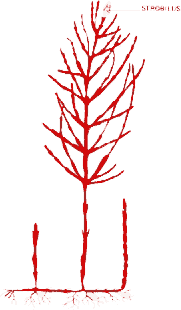
The common name comes from the characteristic pattern of branching: whorls or rings of branchlets arising from an above-ground shoot. The shoot develops each season from an underground stem (rhizome).
Horsetails often grow in sandy places and incorporate silica in their stems. This gives them an abrasive quality which caused them to once be used for cleaning pots and pans, which gave rise to another common name: scouring rush.
Only one genus, Equisetum, containing about 25 species, survives today. However, many other, much larger, species were dominant features of the Carboniferous and, like the early lycopsids, contributed to the formation of coal.
Spores are formed in the strobilus at the very top of the stem.
Chloroplast Genes
Chloroplasts (as well as mitochondria) have their own genome.
For example, the genome of the chloroplast DNA of the liverwort Marchantia polymorpha, contains 121,024 base pairs encoding 128 genes.
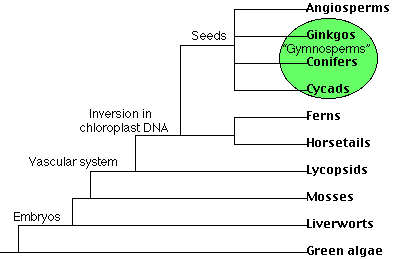 The orders of the chloroplast genes in liverwort and lysopsid are the same, but there is one section which is reversed for each of the other vascular plants:
- horsetails
- ferns
- gymnosperms
- angiosperms
showing that these belong to a separate clade.
The ferns are now considered close relatives of the horsetails, both evolved from a group of Devonian plants that includes the Cladoxylopsida.