Ferns
[After Wikipedia (?) - sorry, I have lost the source.]
Pteridophyta - ferns
 Contents:
- Scientific classification
- Definition
- Life cycle
- Fern structure
- Fern ecology
- Evolution and classification
- Food
- Fertilizer
- Horticulture
- Noxious weeds
- Pollution filters
- Miscellaneous
- Medicinal value
- Classifying ferns
The ferns date back to at least the Devonian, and today number 20,000 species.
Scientific classification
Among the many classifications offered by disagreeing expert-biologists, one new classification by Smith et al. (2006) is based on recent molecular systematic studies, in addition to morphological data.
This classification divides ferns into four classes:
- Kingdom: Plantae
- Division: Pteridophyta
- Classes:
- Psilotopsida:
- Equisetopsida:
- Marattiopsida:
- Polypodiopsida: includes most plants familiarly known as ferns.
Definition
Ferns are vascular plants differing from the more primitive lycophytes by having true leaves (megaphylls). They differ from seed plants (gymnosperms and angiosperms) in their mode of reproduction - lacking flowers and seeds. Like all vascular plants, they have a life cycle referred to as alternation of generations, characterized by a diploid sporophytic and a haploid gametophytic phase. Unlike the gymnosperms and angiosperms, the ferns' gametophyte is a free-living organism.
This is not a definition - you should convert it to a definition, and learn it. Learn definitions, not explanations. That plays a crucial part in the development of your intelligence.
Life cycle
Life cycle of a typical fern:
- A sporophyte (diploid) phase produces haploid spores by meiosis.
- A spore grows by mitosis into a gametophyte, which typically consists of a photosynthetic prothallus.
- The gametophyte produces gametes (often both sperm and eggs on the same prothallus) by mitosis.
- A mobile, flagellate sperm fertilizes an egg that remains attached to the prothallus.
- The fertilized egg is now a diploid zygote and grows by mitosis into a sporophyte (the typical "fern" plant).
Fern ecology
Ferns usually specialize in marginal habitats, especially where flowering plants have difficulty. As a result, some ferns are serious weed species, including the bracken fern and the mosquito fern (Azolla) growing in tropical lakes, both species forming large aggressively spreading colonies. (Bracken ferns send out long runners near the surface and these stabilize newly exposed soil. They can then be limited by improving the soil to allow competitive species to flourish. Removing young stems to limit its ability to reproduce, is time-consuming and requires at least 2 years of daily effort. Mowing above the height of competing plants may be an effective solution, requiring a lot less effort.)
There are four particular types of habitats that ferns are found in:
- moist, shady forests
- crevices in rock faces, especially when sheltered from the full sun
- acid wetlands including bogs and swamps
- tropical trees, where many species are epiphytes.
Many ferns depend on associations with mycorrhizal fungi. Many ferns only grow within specific pH ranges; for instance, the climbing fern (Lygodium) of eastern North America will only grow in moist, intensely acid soils, while the bulblet bladder fern (Cystopteris bulbifera), with an overlapping range, is only ever found on limestone.
Fern structure
Like the sporophytes of seed plants, those of ferns consist of:
- Stems: Most often an underground creeping rhizome, but sometimes an above-ground creeping stolon (e.g., Polypodiaceae), or an above-ground erect semi-woody trunk (e.g., Cyatheaceae) reaching up to 20 m in a few species:
- Dicksonia antarctica, the manfern of wet woodland in Tasmania
- Cyathea cooperi, the Australian tree fern now a pest in Hawaii)
- Cyathea brownii on Norfolk Island
- Cyathea medullaris in New Zealand
- Leaf: The green, photosynthetic part of the plant. In ferns, it is often referred to as a frond, but this is because of the historical division between people who study ferns and people who study seed plants, rather than because of differences in structure. New leaves typically expand by the unrolling of a tight spiral called a crozier or fiddlehead. This uncurling of the leaf is termed circinate vernation.
Leaves are divided into three types:
- Trophophyll: A leaf that does not produce spores, instead only producing sugars by photosynthesis. Analogous to the typical green leaves of seed plants.
- Sporophyll: A leaf that produces spores. These leaves are analogous to the scales of pine cones in gymnosperms or to stamens-and-pistil in angiosperms. Unlike the seed plants, however, the sporophylls of ferns are typically not very specialized, looking and acting like trophophylls with the addition of spore production.
- Brophophyll: A leaf that produces abnormally large amounts of spores; is larger than the other leaves but also resembles trophopylls.
- Roots: The underground non-photosynthetic structures that take up water and nutrients from soil. They are always fibrous and are structurally very similar to the roots of seed plants.
Gametophytes
The gametophytes of ferns are very different from those of seed plants.
They typically consist of:
- Prothallus: A green, photosynthetic structure that is one cell thick, usually heart or kidney shaped, 3-10 mm long and 2-8 mm broad.
The prothallus produces gametes by means of:
- Antheridia: male organ; small spherical structures that produce flagellate sperm.
- Archegonia: female organ; a flask-shaped structure that produces a single egg at the bottom, reached by the sperm by swimming down the neck.
- Rhizoids: root-like structures (not true roots) that consist of single greatly-elongated cells, water and mineral salts are absorbed over the whole structure. Rhizoids anchor the prothallus to the soil.
Gametophytes are often difficult to find in the field because they are far more likely to be food than are the sporophytes.
Evolution and classification
Ferns first appear in the fossil record in the early-Carboniferous period. By the Triassic, the first evidence of ferns related to several modern families appeared. The "great fern radiation" occurred in the late-Cretaceous, when many modern families of ferns first appeared.
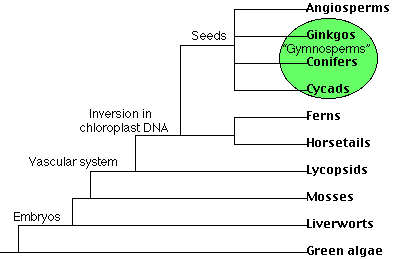
More recent genetic studies have shown that the Lycopodiophyta are only distantly related to any other vascular plants, having radiated evolutionarily at the base of the vascular plant clade, while both the whisk ferns and horsetails are as much "true" ferns as are the Ophioglossoids and Marattiaceae. In fact, the whisk ferns and Ophioglossoids are demonstrably a clade, and the horsetails and Marattiaceae are arguably another clade.
Food
Some ferns are used for food, including the fiddleheads of bracken (Pteridium aquilinum), ostrich fern (Matteuccia struthiopteris), and cinnamon fern (Osmunda cinnamomea). Diplazium esculentum is also used by some tropical peoples as food.
Fertilizer
Ferns of the genus Azolla are very small, floating plants that do not look like ferns. Called mosquito fern, they are used as a biological fertilizer in the rice paddies of southeast Asia, taking advantage of their ability to fix nitrogen from the air into compounds that can then be used by other plants. It grows quickly on still water where nutrients are high, and is easily harvested.
[However do not introduce it since it will become a serious weed, costly to eradicate, when flooding creeks carry it downstream, and ducks spread it everywhere. It will also damage the ecology by overwhelming native species.
Australia has been cursed by Bill Mollison's Permaculture people who introduced many plants from Africa and South America which then became noxious weeds choking our waterways and forests. Permaculture is a dirty word in northern NSW.]
Horticulture
A great many ferns are grown in horticulture as landscape plants, for cut foliage and as houseplants:
- Nephrolepis exaltata: Boston fern
- Asplenium nidus: Bird's Nest Fern
- genus Platycerium: staghorn ferns
- Dicksonia antarctica: and related species, known as tree ferns or manferns.
Coal was formed by the compression of primitive plants, including ferns, in anaerobic swamps.
Noxious weeds
Several ferns are noxious weeds or invasive species, including:
- Lygodium japonicum: Japanese climbing fern
- Onoclea sensibilis: mosquito fern and sensitive fern
- Salvinia molesta: giant water fern, one of the world's worst aquatic weeds
- "Fishbone" fern: the leaflets are short (20mm ?) and at right-angles to the stem; very distinctive.
Pollution filters
Ferns have been studied and found to be useful in the removal of heavy metals, especially arsenic, from the soil.
Miscellaneous ferns
Other ferns with some economic significance include:
- Ceratopteris richardii: a model plant for teaching and research, often called C-fern
- Cyathea cooperi: (Australian tree fern), a major noxious weed in Hawaii
- Diplazium esculentum: (vegetable fern), a source of food for some native societies
- Dryopteris filix-mas: (male fern), used as a vermifuge, and formerly in the US Pharmacopeia; also, this fern accidentally sprouting in a bottle resulted in Nathaniel Bagshaw Ward's 1829 invention of the terrarium or Wardian case
- Matteuccia struthiopteris: (ostrich fern), the fiddleheads used as a cooked vegetable in North America
- Osmunda regalis: (royal fern) and Osmunda cinnamomea (cinnamon fern), the root fiber being used horticulturally; the fiddleheads of O. cinnamomea are also used as a cooked vegetable
- Polypodium glycyrrhiza :(licorice fern), roots chewed for their pleasant flavor
- Pteridium aquilinum: (bracken) fiddleheads cooked as a vegetable in Japan are believed to cause the high rate of stomach cancer. One of the world's worst agricultural weeds, especially in the British highlands, it often poisons cattle and horses.
- Pteris vittata: (brake fern), used to absorb arsenic from the soil
- Rumohra adiantoides: (floral fern), extensively used in the florist trade
- Tree ferns: used as building material in some tropical areas
Medicinal Value
Ferns are sometimes used in medicine to treat cuts and clean them out. Ferns are also good bandages if you are stuck out in the wild. Rubbing a sword fern frond spore-side-down on a stinging nettle sting removes the stinging.
Classifying ferns
Major groups within the ferns are classified based on the structure and location of their sporangia. Most modern ferns produce their sporangia on the underside of their leaves, but most early ferns (and some living groups) produced them along their stems or on specialized stalks that do not look much like leaves at all.
The ferns are now considered close relatives of the horsetails, both evolving from a group of Devonian plants that includes the Cladoxylopsida. (But expect the experts to change their opinion again ... and again ... and again.)