Trees
Definition
A tree is a perennial woody plant. (Perennial means it does not die back each year, like an annual or a herb does.) It is most often defined as a woody plant that has many secondary branches supported clear of the ground on a single main stem or trunk with clear apical dominance. A minimum height specification at maturity is cited by some authors, varying from 3m to 6m;some authors set a minimum of 100mm trunk diameter (300mm girth).
Shrubs: Woody plants that do not meet these definitions by having multiple stems and/or small size.
Compared with most other plants, trees are long-lived, some reaching several thousand years old and growing to up to 115 m high.
Trees are an important component of the natural landscape because:
- of their prevention of erosion
- provision of a weather-sheltered ecosystem in and under their foliage
- producing oxygen and reducing carbon dioxide in the atmosphere
- moderating ground temperatures, deflecting frosts, insulating (plants produce heat - snow melts first where in contact with plants)
- retaining moisture by breaking drying winds and promoting condensation at night
- elements in landscaping and agriculture, both for their aesthetic appeal and their orchard crops (such as apples)
- renewable building material
- primary energy source in many developing countries.
Trees also play a role in many of the world's mythologies. As of 2005, there were approximately 400 billion trees on Earth, about 61 per person.
Contents
Contents:
- Classification
- Morphology
- Record breaking trees:
- Tallest
- Stoutest
- Volume-est
- Oldest
- Trees in culture
History
A tree is a plant form that occurs in many different orders and families of plants. Trees show a variety of growth forms, leaf type and shape, bark characteristics, and reproductive organs.
The tree form has evolved separately in unrelated classes of plants, in response to similar environmental challenges, making it a classic example of parallel evolution.
With an estimate of 100,000 tree species, the number of tree species worldwide might total 25% of all living plant species. The majority of tree species grow in tropical regions of the world and many of these areas have not been surveyed yet by botanists, making species diversity and ranges poorly understood.
The earliest trees were:
- Carboniferous Period: saw tree ferns, horsetails and lycophytes, growing in tall forests (30m)
- Triassic Period: conifers, ginkgos, cycads and other gymnosperms appeared
- Cretaceous Period: subsequently flowering plants.
Tree ferns still survive, but the only surviving horsetails and lycophytes are not of tree form. Most species of trees today are the conifers (gymnosperms) and the flowering plants (angiosperms).
Definitions
Grove or copse: A small group of trees growing together .
Forest: a dense growth of trees over a large area.
Bush: open woodland over a large area, usually dry schlerophyll.
Sapling: a young tree.
Savanna(h): grassland with scattered shrubs or small trees. Usually heavy grazing prevents growth of trees.
Old growth forest a forest of great age; also ancient woodland (in the UK).
Several biotopes are defined largely by the trees that inhabit them; such as rainforest, wet schlerophyll (skleros Gk = hard; phyll = leaf) and taiga.
Morphology
Tree roots anchor the structure and provide water and nutrients.
The parts of a tree are the roots, trunk(s), branches, twigs and leaves.
Tree stems consist mainly of support and transport tissues (xylem and phloem). Wood consists of xylem cells, and bark is made of phloem and other tissues external to the vascular cambium.
Trees may be grouped into:
- exogenous:
grow by the addition of new wood outwards, immediately under the bark
comprise all conifers and the great majority of anthrophytes/angiosperms (and almost all broadleaf trees)
- endogenous:
grow by addition of new material inwards
mainly in the monocotyledons (e.g., palms and dragon trees) but also cacti.
As an exogenous tree grows, it creates growth rings as new wood is laid down concentrically over the old wood. In species growing in areas with seasonal climate changes, wood growth produced at different times of the year may be visible as alternating light and dark, or soft and hard, rings of wood. In temperate climates, and tropical climates with a single wet-dry season alternation, the growth rings are annual, each pair of light and dark rings being one year of growth; these are known as annual rings.
In areas with two wet and dry seasons each year, there may be two pairs of light and dark rings each year; and in some (mainly semi-desert regions with irregular rainfall), there may be a new growth ring with each rainfall. In tropical rainforest regions, with constant year-round climate, growth is continuous and the growth rings are not visible nor is there a change in the wood texture.
In species with annual rings, these rings can be counted to determine the age of the tree, and used to date cores or even wood taken from trees in the past, a practice is known as the science of dendrochronology. Very few tropical trees can be accurately aged in this manner. Age determination is also impossible in endogenous trees.
The roots of a tree are generally embedded in earth, providing anchorage for the above-ground biomass and absorbing water and nutrients from the soil. It should be noted, however, that while ground nutrients are essential to a tree's growth the majority of its biomass comes from carbon dioxide absorbed from the atmosphere. Above ground, the trunk gives height to the leaf-bearing branches, aiding in competition with other plant species for sunlight. In many trees, the arrangement of the branches optimizes exposure of the leaves to sunlight.
Not all trees have all the plant organs or parts mentioned above. For example, most palm trees are not branched, the saguaro cactus of North America has no functional leaves, tree ferns do not produce bark, etc. Based on their general shape and size, all of these are nonetheless generally regarded as trees.
A plant form that is similar to a tree, but generally having smaller, multiple trunks and/or branches that arise near the ground, is called a shrub. However, no precise differentiation between shrubs and trees is possible. Given their small size, bonsai plants would not technically be 'trees', but one should not confuse reference to the form of a species with the size or shape of individual specimens. A spruce seedling does not fit the definition of a tree, but all spruces are trees.
Record breaking trees
The world's champion trees can be rated on height, trunk diameter or girth, total size, and age.
Tallest
The heights of the tallest trees in the world have been the subject of considerable dispute and much exaggeration. Modern verified measurement with laser rangefinders combined with tape drop measurements made by tree climbers, carried out by the U.S. Eastern Native Tree Society has shown that some older measuring methods and measurements are often unreliable, sometimes producing exaggerations of 5% to 15% above the real height.
Historical claims of trees of 130m, and even 150m, are now largely disregarded as unreliable, and attributed to human error. Historical records of fallen trees measured prostrate on the ground are considered to be far more reliable.
The following are now accepted as the top five tallest reliably measured species in recent years:
- Coast Redwood: (Sequoia sempervirens): 115.55m, Redwood National Park, California, United States
- Australian Mountain-ash: (Eucalyptus regnans): 99.6m, south of Hobart, Tasmania, Australia
- Coast Douglas-fir: (Pseudotsuga menziesii): 99.4m, Brummit Creek, Coos County, Oregon, United States.
- Sitka Spruce: (Picea sitchensis): 96.7m, Prairie Creek Redwoods State Park, California, United States
- Giant Sequoia: (Sequoiadendron giganteum): 94.9m, Redwood Mountain Grove, Kings Canyon National Park, California, United States.
Stoutest
The girth of a tree is much easier to measure than the height, as it is a simple matter of stretching a tape round the trunk, and pulling it taut to find the circumference. Despite this, recorded measurements have been very unreliable.
As a general standard, tree girth is taken at 'breast height'.
Breast height is defined differently in different situations, with most forestry measurements taking girth at 1.3m above ground,
while those who measure ornamental trees usually measure at 1.5m above ground.
In most cases this makes little difference to the measured girth. On sloping ground, the "above ground" reference point is usually taken as the highest point on the ground touching the trunk,
but some use the average between the highest and lowest points of ground.
Some of the inflated old measurements may have been taken at ground level. Some past exaggerated measurements also result from measuring the complete next-to-bark measurement, pushing the tape in and out over every crevice and buttress.
Modern trends are to cite the tree's diameter rather than the circumference; this is obtained by dividing the measured circumference by π (3.146); it assumes the trunk is circular in cross-section (an oval or irregular cross-section would result in a mean diameter slightly greater than the assumed circle). This is cited as dbh (diameter at breast height) in tree and forestry literature.
One further problem with measuring baobabs Adansonia is that these trees store large amounts of water in the very soft wood in their trunks. This leads to marked variation in their girth over the year (though not more than about 2.5%), swelling to a maximum at the end of the rainy season, minimum at the end of the dry season.
The stoutest living single-trunk species in diameter are:
Boab, AustraliaClick to enlarge
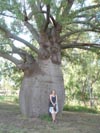
African Baobab: Adansonia digitata: 15m, Big Baobab, Limpopo Province, South Africa.- Montezuma Cypress : Taxodium mucronatum: 11.62m, Árbol del Tule, Santa Maria del Tule, Oaxaca, Mexico.
Note though that this diameter includes buttressing; the actual idealised diameter of the area of its wood is 9.38m.
- Giant Sequoia: Sequoiadendron giganteum: 8.85m, General Grant tree, Grant Grove, California, United States.
- Coast Redwood: Sequoia sempervirens: 7.44m, Prairie Creek Redwoods State Park, California, United States.
Charles Darwin reported finding Fitzroya cupressoides with trunk circumferences of up to 40m
implying a diameter of about 12m, but this may be an anomaly as the largest known measurements are about 5m diameter.
An additional problem lies occurs where multiple trunks (whether from an individual tree or multiple trees) grow together. The Sacred Fig is a notable example of this, forming additional 'trunks' by growing adventitious roots down from the branches, which then thicken up when the root reaches the ground to form new trunks; a single Sacred Fig tree can have hundreds of such trunks.
Occasionally, errors may occur due to confusion between girth (circumference) and diameter.
Largest
The largest trees in total volume are those which are both tall and of large diameter, and in particular, which hold a large diameter high up the trunk. Measurement is very complex, particularly if branch volume is to be included as well as the trunk volume, so measurements have only been made for a small number of trees, and generally only for the trunk. No attempt has ever been made to include root volume. Measuring standards vary.
The top four species measured so far are:
- Giant Sequoia: Sequoiadendron giganteum: 1,487m³, General Sherman
- Coast Redwood: Sequoia sempervirens: 1,203m³, Lost Monarch
- Western Redcedar: Thuja plicata 500m³, Quinault Lake Redcedar
- Kauri : Agathis australis circa 400m³, Tane Mahuta tree (total volume, including branches, 516.7m³
However, the Alerce Fitzroya cupressoides, as yet un-measured, may well slot in at third or fourth place, and Montezuma Cypress Taxodium mucronatum and other giants are also likely to be high in the list.
The largest angiosperm tree is currently a Tasmanian Blue Gum (Eucalyptus globulus) in Tasmania, with a volume of 368m³.
Oldest
The oldest trees are determined by growth rings, which can be seen if the tree is cut down or in cores taken from the edge to the center of the tree. Accurate determination is only possible for trees which produce growth rings, generally those which occur in seasonal climates; trees in uniform non-seasonal tropical climates grow continuously and do not have distinct growth rings. It is also only possible for trees which are solid to the center of the tree; many very old trees become hollow as the dead heartwood decays away.
For some of these species, age estimates have been made on the basis of extrapolating current growth rates, but the results are usually little better than guesswork or wild speculation. White (1998) proposes a method of estimating the age of large and veteran trees in the United Kingdom through the correlation between a tree's stem diameter, growth character and age.
The verified oldest measured ages are:
- African Baobab: Adansonia digitata: 6,000 years according to carbon dating
- Great Basin Bristlecone Pine (Methuselah): Pinus longaeva: 4,844 years
- Alerce: Fitzroya cupressoides: 3,622 years
- Giant Sequoia: Sequoiadendron giganteum: 3,266 years
- Huon-pine: Lagarostrobos franklinii: 2,500 years
- Rocky Mountains Bristlecone Pine: Pinus aristata: 2,435 years
Other species suspected of reaching exceptional age include:
- Ginkgo: Ginkgo biloba (over 3,500 years)
- European Yew: Taxus baccata (probably over 2,000 years)
- Western Redcedar: Thuja plicata.
The oldest reported age for an angiosperm tree after the African Baobab (A. digitata) is 2293 years for the Sri Maha Bodhi Sacred Fig (Ficus religiosa) planted in 288 BCE at Anuradhapura, Sri Lanka; this is also the oldest human-planted tree with a known planting date.
Trees in culture
The tree has always been a cultural symbol. Common icons are the World tree, for instance Yggdrasil, and the tree of life. The tree is often used to represent nature or the environment itself. A common misconception is that trees get most of their mass from the ground.
99 % of a tree's mass comes from the air.