Plant Growth
Growth in plants occurs chiefly at meristems where rapid mitosis provides new cells. As these cells differentiate, they provide new plant tissue.
In stems, mitosis in the apical meristem of the shoot apex (also called the terminal bud) produces cells that enable the stem to grow longer and, periodically, cells that will give rise to leaves. The point on the stem where leaves develop is called a node. The region between a pair of adjacent nodes is called the internode.
The internodes in the terminal bud are very short so that the developing leaves grow above the apical meristem that produced them and thus protect it.
New meristems, the lateral buds, develop at the nodes, each just above the point where a leaf is attached. When the lateral buds develop, they produces new stem tissue, and thus branches are formed.
Under special circumstances (such as changes in photoperiod), the apical meristem is converted into a flower bud. This develops into a flower. The conversion of the apical meristem to a flower bud "uses up" the meristem so that no further growth of the stem can occur at that point. However, lateral buds behind the flower can develop into branches.
Discussion of flowering.The drawing is of a typical woody dicot, the horse chestnut, as seen during the dormant season. The leaves have dropped off, leaving a leaf scar; the dots inside each leaf scar show where the vascular bundles (xylem and phloem) had entered the petiole of the leaf.
A flower had been produced the season before, so that during the season just ended two branches had grown out on either side of the flower bud scar.
Lenticels are openings that allow oxygen and carbon dioxide to diffuse between the living cells of the stem and the air.
Plant Succession
Many plant communities are not self-sustaining. A field in the temperate deciduous forest biome will remain a field only as long as it is grazed by animals or mowed regularly. If these factors are eliminated, the balance tips in favor of other species. The newcomers many, in turn, by their own growth sow the seeds of their own destruction. For example, the gray birch grows well only in sunny locations. The shade it casts prevents its own seedlings from growing beneath it, but permits white pine seedlings to become established. When mature, white pines then cast so deep a shade that the gray birch is no longer able to survive there.
Primary Plant Succession
The process of plant succession begins just as soon as a land area capable of supporting plant life is formed. Some examples:
- accumulation of sand dunes at the edge of the ocean or a lake
- exposure of rock by a retreating glacier
- cooling of a lava flow
Bare rock succession in the temperate deciduous forest biome:
- The first colonizers are lichens and certain mosses.
- Acids secreted by the lichens attack the rock and provide bits of soil.
- Additional soil particles may be formed by weathering or be blown in from elsewhere.
- Damage and decay to the lichens supplies some humus, and eventually enough soil is formed to support other mosses.
- The growth, death, and decay of mosses produces more humus, and soon there is enough to support the growth of:
- grasses
- shrubby growth such as blueberries.
- These, in turn, provide the conditions for such species as
gray birch trees and poplars (quaking aspens), sun-loving, fast-growing, establish on the conditions provided by grasses and shrubby growth.
- In time, white pines replace these.
- In the dense shade of mature white pines, only shade-tolerant maples and beech seedlings thrive. When these large trees finally take over, the succession comes to an end. Maple and beech seedlings are able to develop under the conditions imposed by their parents, and the population becomes self-sustaining. It is known as a climax forest.
Bog succession
Another example of plant succession occurs as shallow ponds gradually fill in with soil washed in from the surrounding terrain and organic matter produced by underwater plants.
As we walk from the edge of a poorly-drained, boggy pond back into the forest, we pass through a series of zones that recreate in space the plant succession that has been occurring in time:
- From the swamp loosestrife and other plants at the waters edge
- past sphagnum moss and pitcher plants
- then blueberries and poison sumac
- followed by black spruce and American larch
- and, finally, swamp maples and white pines.
Each forms a concentric zone, each representing a later stage of plant succession as the soil has become firmer and dryer and the shade denser.
Secondary Plant Succession
Lumbering, grazing, farming, fires, and hurricanes interrupt the process of succession by removing the dominant plants in the community. Their elimination sets the stage for a new succession to begin.
In New England (US) when cultivation and grazing cease, a secondary succession begins:
- abandoned pasture gives way to weeds and low shrubby growth.
- soon gray birch, poplars, and/or cedars establish
- white pines or, in sandy well-drained locations, oaks follow
- reaching a climax forest of maples and beeches.
The colonization of bare rock, the filling in of a pond, and the secondary succession that follows the abandonment of a field each involve different species in the early stages. In any given region, though, the species in the final, self-sustaining climax forest are the same. The tendency for all plant communities to end in the same climax community is called convergence.
In general, plant succession is a reflection of the increasing efficiency of the community at intercepting the energy of the sun and converting it into chemical energy. As one stage of succession follows another:
- the biomass of the community increases. This is the outcome of the increasing amount of net productivity — calories stored by the plant community.
- This, in turn, provides calories for a larger community of consumers.
- As succession continues, the diversity of species in the community increases — at least for a time.
- When the system approaches its climax, the rate of increase in net productivity of the plants is consumed by its own heterotrophs.
- The system comes into equilibrium and reaches peak efficiency at channeling the energy of the sun into the food web of the community.
Number of species, biomass, net productivity.
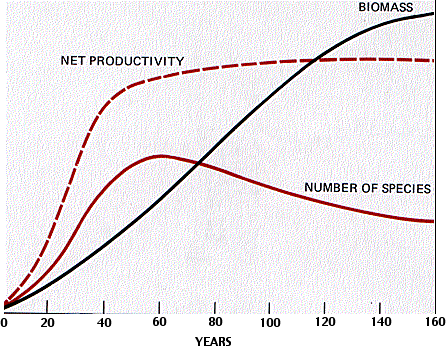
The graph (from Whittaker, R. H., Communities and Ecosystems, Macmillan, 1970) shows the changes in number of species, biomass, and net productivity during secondary succession in a temperate deciduous forest over a period of 160 years.
More recent work has extended such analysis to periods of thousands of years. This is possible by exploiting the phenomenon discussed above in bogs, the fact that zones of succession recreate in space the changes that have taken place over thousands of years of time. Studying succession in six different biomes, including tropical rain forest, temperate rain forests as well as taiga, it was found that, if nothing (such as hurricanes, fire) has disturbed the climax forest, eventually the soil becomes less fertile and the biomass of the forest declines.
Meristematic tissue
A mature vascular plant, e.g., a tobacco plant, contains several differentiated cell types. These are grouped together in tissues. Some tissues contain only one type of cell. Some tissues consist of several types of cells.
The main function of meristematic tissue is mitosis (asexual reproduction of cells). The cells are small, thin-walled, with no central vacuole and no specialized features.
Meristematic tissue is located in:
- apical meristems at the growing points of roots and stems
- secondary meristems (lateral buds) at the nodes of stems (where branching occurs)
- in some plants, a ring of meristematic tissue, called the cambium, that is found within the mature stem.
The cells produced in the meristems soon become differentiated into one or another of several types.
Tissue types
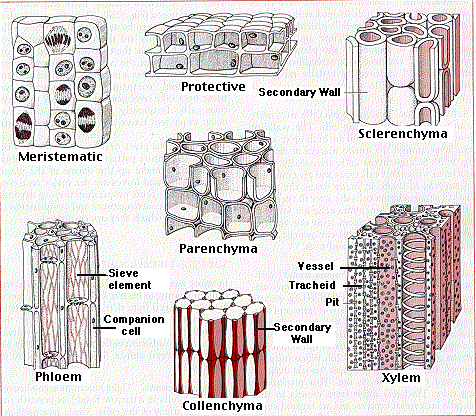
Protective
Protective tissue covers the surface of leaves and the living cells of roots and stems. Its cells are flattened with their top and bottom surfaces parallel. The upper and lower epidermis of the leaf are examples of protective tissue.
Parenchyma
The cells of parenchyma are large, thin-walled, and usually have a large central vacuole. They are often partially separated from each other. They are usually stuffed with plastids.
In areas not exposed to light, colorless plastids predominate, and food storage is the main function. The cells of the white potato are parenchyma cells.
Where light is present, e.g., in leaves, chloroplasts predominate and photosynthesis is the main function.
Sclerenchyma
The walls of these cells are very thick and built up in a uniform layer around the entire margin of the cell. Often, the protoplasts die after the cell wall is fully formed. Sclerenchyma cells are usually found associated with other cells types and give them mechanical support.
Sclerenchyma is found in stems and also in leaf veins.Sclerenchyma also makes up the hard outer covering of seeds and nuts.
Collenchyma
Collenchyma cells have thick walls that are especially thick at their corners. These cells provide mechanical support for the plant. They are most often found in areas that are growing rapidly and need to be strengthened. The petiole ("stalk") of leaves is usually reinforced with collenchyma.
Xylem
Xylem conducts water and dissolved minerals from the roots to all the other parts of the plant.
In angiosperms, most of the water travels in the xylem vessels. These are thick-walled tubes that can extend vertically through several feet of xylem tissue. Their diameter may be as large as 0.7 mm. Their walls are thickened with secondary deposits of cellulose and are usually further strengthened by impregnation with lignin. The secondary walls of the xylem vessels are deposited in spirals and rings and are usually perforated by pits.
Xylem vessels arise from individual cylindrical cells oriented end to end. At maturity the end walls of these cells dissolve away and the cytoplasmic contents die. The result is the xylem vessel, a continuous nonliving duct. The vessels carry water and some dissolved solutes, such as inorganic ions, up the plant.
Xylem also contains tracheids. These are individual cells tapered at each end so the tapered end of one cell overlaps that of the adjacent cell. Like xylem vessels, they have thick, lignified walls and, at maturity, no cytoplasm. Their walls are perforated so that water can flow from one tracheid to the next. The xylem of ferns and conifers contains only tracheids.
In woody plants, the older xylem ceases to participate in water transport and simply serves to give strength to the trunk. Wood is xylem. When counting the annual rings of a tree, one is counting rings of xylem.
Phloem
The main components of phloem are:
- sieve elements: perforated ends allow transmission of photosynthetic products (sugars, amino acids) as though along a tube.
- companion cells: move sugars and amino acids into and out of the sieve elements.
Sieve elements are so-named because their end walls are perforated. This allows cytoplasmic connections between vertically-stacked cells. The result is a sieve tube that conducts the products of photosynthesis - sugars and amino acids - from the place where they are manufactured (a "source"), e.g., leaves, to the places ("sinks") where they are consumed or stored; such as:
- roots
- growing tips of stems and leaves
- flowers
- fruits, tubers, corms, etc.
Sieve elements have no nucleus and only a sparse collection of other organelles. They depend on the adjacent companion cells for many functions.
Companion cells move sugars and amino acids into and out of the sieve elements. In "source" tissue, such as a leaf, the companion cells use transmembrane proteins to take up - by active transport - sugars and amino acids from the cells manufacturing them. Water follows by osmosis. These materials then move into adjacent sieve elements by diffusion through plasmodesmata. The pressure created by osmosis drives the flow of materials through the sieve tubes.
In "sink" tissue, the sugars and amino acids leave the sieve tubes by diffusion through plasmodesmata connecting the sieve elements to the cells of their destination. Again, water follows by osmosis where it may:
- leave the plant by transpiration
- increase the volume of the cells
- move into the xylem for recycling through the plant.
The flowering plants (angiosperms) go through a phase of vegetative growth, producing more stems and leaves, and a flowering phase where they produce the organs for sexual reproduction:
- In "annuals", like the snapdragon, the vegetative phase begins with germination of the seed. Flowering follows and ends with the senescence and death of the plant.
- In biennials, the vegetative phase takes up the first year; flowering followed by death occurs the second year.
- In perennials, flowering typically occurs year after year when conditions are appropriate.
Vegetative growth of the above-ground part of the plant — the shoot — occurs at the apical meristem. This is a mass of undifferentiated cells at the tip of the stem. Mitosis of these cells produces cells that differentiate to form:
- more stem
- leaves
- secondary meristems. Also called lateral buds, these form in the axils of the leaves and will form branches.
The signal to flower
Flowering involves the conversion of the apical meristem into a floral meristem, from which all the parts of the flower will be produced.
Signals that change the fate of the apical meristem include:
- maturity of the plant
- temperature
- and, for many plants, photoperiod — the relative length of day and night.
Temperature
Many annual plants (e.g., winter wheat) and biennial plants have their time of flowering delayed unless they have undergone a preceding period of wintertime cold. The change brought about by this prolonged exposure to the cold is called vernalization.
The buds of many species of woody angiosperms found in temperate climates, such as apples, stone fruit, and lilacs, also need a preceding period of cold weather before they can develop into flowers. So these plants cannot be grown successfully at lower latitudes because the winters never get cold enough (a few days at 0 – 10oC).
This bud dormancy is localized. Prior chilling of one bud on a lilac stem enables it to flower while the other, nonchilled, buds on the stem remain dormant.
Photoperiod
Photoperiod is detected in the leaves. The cocklebur needs at least 8.5 hours of darkness in order to flower. Even if only a part of one leaf is exposed to the correct photoperiod, the entire plant will bloom.
The leaves produce a chemical signal, florigen, that is transmitted to the apical meristems to start their conversion into floral meristems.
Structure of the Flower
See the chapter on Flowers.