Fungal diseases

Overview

Fungi are probably one of the most numerous vegetative families on earth.
By definition they:
Symptoms and disease development come about from the growth of the fungi through the host-parasite interaction. These fungi sometimes produce metabolites (by-products of growth) that are toxic to animals and humans. Reproduction in fungi occurs through the production of spores. These spores can then reproduce without coming into contact with a different plant (asexual reproduction).

The small size of the spores aid in their dispersal. They can become airborne and move by the action of winds and travel from field to field. They also can become attached to insects and birds which then transport them from plant to plant. Transport can also occur by use of contaminated trucks and equipment.

Fungal infection from spores can occur at any of the various stages of crop production. It can begin in the fields, in or on the crop itself.

It can infect healthy products during transportation and storage by coming into contact with contaminated equipment or grain products.

The spores can lay dormant (inactive) in the soil or accumulate on equipment or in storage facilities for months or sometimes years until the proper conditions for growth occur and infect generation after generation.

There are many varied environmental conditions that need to be in place before the spores will germinate or begin to grow. Generally relative humidity over 70% and temperatures over 300C (860F) for extended periods (several days to a week) are generally needed. Stress to the plants such as periods of drought, flooding, or insect infestation are also common factors in the fungus growth cycle. High moisture content of the crops (20% or higher in corn), as at the optimal times of growth and harvest, give the spores the necessary elements to start the growth process.

Any one of these conditions by itself will not promote the fungal growth. It is only when the right conditions as a group occur, for each particular fungus, do the growth cycles begin.

If any one optimal condition is removed, the growth cycle of a particular fungus will stop.

But this may then promote the growth of a different or related fungus. Once the growth cycle begins the crop damage has already started and can not be reversed. The drying of corn lowers the moisture content to a point where growth of molds is prevented or at least stops further damage.

Fungi and mold are normally thought of as mushrooms and the grey fuzzy stuff that grows on food left in the refrigerator too long. Molds and fungi do not necessarily have to be visible to the naked eye to be growing and damaging crops and foods. Many of the spores associated with fungi are microscopic and in their first stages of growth are not visible without the aid of a microscope. Only in the later stages or when large masses of fungi are present, do the fungi become visible to the unaided eye.

The presence of visual mold in grain or feed products does not necessarily mean that mycotoxins are present in the sample. Mold growth indicates that there are some fungi present. Many of the fungi grow under similar conditions and more than one kind of fungi can exist in or on the grain or feed product at the same time. When more than one fungi is present at the same time on the same host, they sometimes increase the toxic effects of each other by attacking different bodily functions when ingested by a human or animal. They can also cancel each other out by growing and attacking each other during the growth process.

The lack of visual mold does not mean that there are no mycotoxins present. Many times during harvest or handling the visual aspects of the mold can be brushed off, but the toxic by-products can remain in the kernel.

Fungal Plant Diseases

The most recent estimate reveals the fact that around thirty thousand different diseases caused by fungi, bacteria, viruses, nematodes etc. cause great loss to crops, fruits etc. every year.
Such losses can occur any time between sowing and consumption of the harvest. Plant diseases can destroy a farmer financially, leading him into an unending cycle of debt with high interest giving more debt the next year, until he loses his land. Crop disease can lead to death from starvation.

Late blight of potato, a disease of potato caused by Phytophthora infestans destroyed the potato crop of Ireland in 1845 and resulted in the death from starvation of a quarter of a million people.

In the last stages of Second World War (1943) Bengal had to face a serious famine.
One of the reasons given for this famine has been attributed to the loss in yield of rice due to attack of the 'Helminthosporium leaf spot disease' which had been affecting the crop for the last several years.

Sri Lanka used to produce maximum coffee in the world in the middle of the nineteenth century. Coffee rust (Hemileia vastatrix) attacked the plantations greatly reducing the yield per acre.
This forced the planters to cut down coffee plants and to start tea plantation and Sri Lanka lost the market for coffee.

Some important fungal diseases of economic significance are listed below:

DiseasePathogen
Late blight of potato
Brown leaf spot of rice
Red rot of sugarcane
Ergot of bajra
Green ear disease of bajra
Blast of Rice
Black rust of wheat
Damping off of seedings
Rust of linseed
Early blight of potato
White rust of crucifers
Loose smut of wheat
Phytophthora infestans
Helminthosporium oryzae
Colletotrichum falcatun
Claviceps microcephala
Sclerospora graminicola
Pyricularia oryzae
Puccinia graminis tritici
Pythium spp.
Melampsora lini
Alternaria solani
Albugo candida
Ustilago tritici

Human (including Animal) Diseases

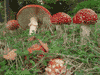
Amanita muscaria
Click to enlarge
<i>Amanita muscaria</i> or 'fly agaric'
Various fungi have proved to be pathogenic to man and animals by:

Non-Mycotoxic Fungi

Fungi are a major cause of spoilage in stored grain. The Food and Agriculture Association estimates that 25% of the worlds food crops are affected by mycotoxins (the by-products of fungal growth) during growth and storage.

The damage of fungi is second only to that caused by insects in stored grain products.

Many of the fungi cause damage to the crops themselves with little or no toxic effects on humans and animals.

Common Smut or Bunt

Common smut is caused by two fungi: Tilletia tritici and Tilletia laevis. Because it requires cool moist soil conditions, the disease is less of a problem on spring planted wheat than winter wheat. Common smut reduces wheat yields and grain quality.
Wheat contaminated with bunt spores has a pungent, fishy odor and a darkened appearance.
Wheat that has an unmistakable odor of smut will be designated “light smutty” on official inspection certificates. In addition, bunt spores released during combining are combustible, and have caused explosions and fires during harvesting with mechanical harvesters.
Plants may be moderately stunted but are not easily distinguished until the heads emerge.
Bunted heads are slender and maintain their green color longer than healthy heads. The glumes may spread apart exposing the smut balls they contain. Smut balls are approximately the shape of normal kernels and are dull gray-brown. The small balls often rupture at harvest, releasing black, powdery spores. Wheat containing smut balls will be designated as “light smutty” (6-30 smut balls) or “smutty” (31 or more smut balls) on official inspection certificates.

Dwarf Bunt or TCK Smut

The Tilletia species of fungi cause smut or bunt diseases in wheat, rye, and barley. Tilletia controversa, commonly known as Dwarf Bunt or TCK Smut, causes dwarfing or stunting in the growth of the plant itself along with reduced yields. The major source of transmittal is by the spores laying dormant in the soil until the next crop year. These spores can lay dormant for up to ten years retaining their infectious properties.

Karnal Bunt

Page 6 Karnal Bunt is thought to have originated in India (therefore the name Tilletia indica) but has since been discovered in many places worldwide. It is thought to be in Afghanistan, Lebanon, Mexico and now the United States. Karnal Bunt has spores that are primarily wind-borne, but infection can occur through planting in contaminated soil, use of infected seed, and coming into contact with contaminated equipment and machinery.

The spores attack the developing kernels within the seed head with little or no outward sign of infection. The infected kernels are shrunken at the germ end and are covered with sori (small hairlike filaments) that will discolor flour made from infected kernels. These kernels will also impart a fishy odor and taste to flour making their commercial use impractical.

Black Tip / Black Point

Black Tip fungus is another non-mycotoxic fungus that attacks wheat and barley. The name Black Tip or Black Point can generally refer to any of a number molds that form dark brown to black sooty mold. The principal species of infection are Alternia, Fusarium, and Helminthosporium, with the species Helminthosporium, generally being the causal agent in infections associated with wheat.

The mold generally occurs when seeds are sown in infected soils, but can also occur when the seeds themselves are infected. The most common forms of Helminthosporium are generally associated with dry, warm soils. Moisture in the form of rain or extended periods of high humidity (over 90% relative humidity) then start the disease on the maturing kernels.

If the mold begins early in kernel growth sterility and germ death occur, often accompanied with a shriveled germ resulting in decreased yields. If the mold attacks in the later stages of kernel development the seed is discolored and often carries an odor causing market discounts.

These molds are also associated with seedling blight and root rot which will effect the overall health of the plant leading to increased susceptibility of other plant diseases and molds.

Blue-Eye Rot

Blue-eye mold occurs in stored corn with high moisture content. Blueeye damage is caused by species of Penicillium and is characterized by a blue-green discoloration in the germ area. The discoloration results when Penicillium fungi invade the germ area through the tip of the kernel. Some corn varieties have a purple colored plumule which can be mistaken for the presence of Penicillium fungi in the germ area.

Corn Smut

Smut is caused by Ustilage maydis and is always present in field corn. No harmful effects have been noted from feeding silage made from smutty corn to livestock.