Choanoflagellata
[From Gk Khoane = funnel, referring to its conical collar.]
Choanoflagellata are small single-celled protists, found in both fresh waters and the oceans, taking their name ("collar-flagellates") from the circle of closely packed microvilli, or slender fingerlike projections, that surrounds the single flagellum by which choanoflagellates both move and take in food. The microvilli are so closely packed that under light microscopy, the collar appears as a single transparent unit.
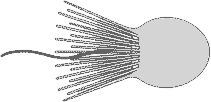 As the flagellum beats, it draws water through the microvilli in the collar, which filter out bacteria and other tiny food particles.
In the case of free-swimming choanoflagellates the flagellum push the cell forward, but many species are attached to a substrate by a thin stalk for part or all of their life cycles.
They reproduce asexually by simple division.

Scientific classification
Domain: Eukaryota
(unranked): Opisthokonta
Phylum: Choanozoa
Class: Choanoflagellatea
Composed of only about 150 species, the Choanoflagellata are not a diverse group of protista.
A few living choanoflagellates, such as Proterospongia, are colonial for part of their life cycle, and show a limited degree of cell differentiation and integration into a unit; these colonial choanoflagellates are the best living examples of what the ancestor of all metazoans may have looked like.
Genome sequencing shows that among living organisms, the choanoflagellates are most closely related to animals. (See the Eukaryota systemic chart at the beginning.)
Choanoflagellates are almost identical in shape and function with the choanocytes, or collar cells, of sponges; these cells generate a current that draws water and food particles through the body of a sponge, and they filter out food particles with their microvilli.
Choanoflagellate-like cells are also found in other animal phyla; in organisms such as flatworms and rotifers, for instance, choanoflagellate-like cells are found in flame bulbs that act as excretory organs. A few living choanoflagellates, such as Proterospongia, are colonial for part of their life cycle, and show a limited degree of cell differentiation and integration into a unit.
These colonial choanoflagellates are the best living examples of what the ancestor of all metazoans may have looked like.
Because choanoflagellates and metazoans are closely related, comparisons between the two groups promise to provide insights into the biology of their last common ancestor and the earliest events in metazoan evolution.
The last common ancestor of animals and choanoflagellates was unicellular, perhaps forming simple colonies.
In contrast, the last common ancestor of all animals was:
- multicellular:
- with differentiated tissues:
- a definite "body plan":
- embryonic development (including gastrulation):
The timing of the splitting of these lineages is difficult to ascertain, but was probably in the late Precambrian, more than 600 million years ago (Ma).
Cell morphology
Choanoflagellates are free-living, single-cell and colony forming eukaryotes ubiquitous in aquatic environments. Composed of only about 150 species, the Choanoflagellata are not a diverse group of protists.
Choanoflagellates are found globally in marine, brackish and freshwater environments from the Arctic to the tropics, occupying both pelagic and benthic zones. Although most sampling of choanoflagellates has occurred between 0 m and 25 m, they have been recovered from as deep as 300 m in open water and 100 m under Antarctic ice sheets.
Appearance and Growth
Each choanoflagellate has:
- an ovoid or spherical cell body:
3-10 µm in diameter
- a single flagellum:
Movement of the flagellum draws water through the collar, and bacteria and detritus are captured by the microvilli and ingested. Water currents generated by the flagellum also pushes free-swimming cells along, as in animal sperm. In contrast, most other flagellates are pulled by their flagella.
- a collar of microvilli:
which forms a ring of 30-40 actin-filled protrusions called microvilli, forming a cylindrical or conical collar around the flagellum
- flagellar basal body:
sitting at the base of the apical flagellum
- non-flagellar basal body:
resting at a right angle to the flagellar base
- nucleus:
in an apical-to-central position in the cell
- food vacuoles:
in the basal region of the cytoplasm
- periplast:
an extracelluar matrix surrounding by the cell body of many choanoflagellates. These cell coverings vary greatly in structure and composition and are used by taxonomists for classification purposes. The functional significance of the periplast is unknown, but in sessile organisms, it is thought to aid in attachment to the substrate. In planktonic organisms, there is speculation that the periplast increases drag, thereby counteracting the force generated by the flagellum and increasing feeding efficiency.
- lorica:
Many choanoflagellates build complex basket-shaped "houses" called lorica, from several silica strips cemented together.
Choanoflagellates are either free-swimming in the water column or sessile, adhering to the substrate directly or through either the periplast or a thin pedicel. Although choanoflagellates are thought to be strictly free-living and heterotrophic, a number of choanoflagellate relatives such as members of Ichthyosporea or Mesomycetozoa follow a parasitic or pathogenic lifestyle. The life histories of choanoflagellates are poorly understood. Many species are thought to be solitary; however coloniality seems to have arisen independently several times within the group and colonial species retain a solitary stage.
Choanoflagellates grow vegetatively, with many species undergoing longitudinal fission. It is not known if there is a sexual phase. Some choanoflagellates can undergo encystment, which involves the retraction of the flagellum and collar and encasement in an electron-dense fibrillar wall.
Colonial behaviour
A number of species such as those in the genus Proterospongia form simple colonies, planktonic clumps that resemble a miniature cluster of grapes in which each cell in the colony is flagellated or clusters of cells on a single stalk.
Ecology
There are over 125 extant species of choanoflagellates, distributed globally in marine, brackish and freshwater environments from the Arctic to the tropics, occupying both pelagic and benthic zones. Although most sampling of choanoflagellates has occurred between 0 m and 25 m, they have been recovered from as deep as 300 m in open water and 100 m under Antarctic ice sheets.
Choanoflagellates feed on bacteria and link otherwise inaccessible forms of carbon to organisms higher in the trophic chain. They are important in the carbon cycle and microbial food web.