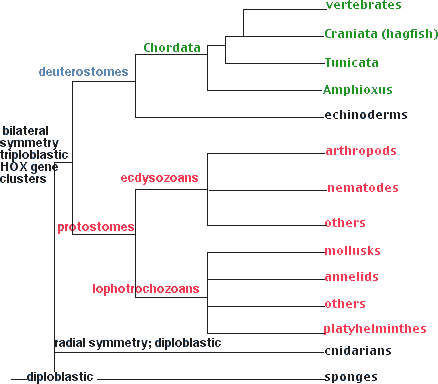
Metazoan table

We learn quickest by rote-learning a frame.
Unfortunately the frame for evolution has not yet been finalized. Biologists have yet to finish the molecular coding of all species, so they do not know enough to decide on all the family relationships. But here are severall versions of one modern frame which should not change much in the future. We each have our own way of learning. Choose the style of frame which best suits you, or modify one to your liking.

Metazoa clade

Here is a table showing the taxonomy for Metazoans. As far as I know this is the latest taxonomy put forward by prominent biologists. It will change as more information is researched.

CladePhylum
Parazoans (note 1)Porifera: (full of pores) sponges
"Subkingdom" Eumetazoa
cells truly cooperate
(note 1)
Radiata: radial symmetry, 2 layers of cells (diblastic). They have no head or tail and can be cut into identical halves along many lines.Cnidaria: (stingers) corals, jellyfish, hydra
Ctenophora: comb jellies
Conulariida:
Bilaterians
bilaterally symmetrical.
(triblastic) If cut in 2 from head to toe, the two halves would be mirror images of each other. Tend to move more quickly and precisely than the radially symmetrical.
(note 2)
Superphylum Lophotrochozoa:Annelida: segmented worms
Echiura: spoon worms (note 3)
Brachiopoda: lamp shells
Bryozoa: "moss animals"
Hyolitha:
Mollusca: (soft bodies) snails, clams, squid
Phoronida:
Superphylum Ecdysozoa:
molting animals
Lobopodia: (note 4)
Onychophora: velvet worms
Nematoda: roundworms
Priapulida:
Arthropoda: (jointed legs) crabs, spiders, insects
Superphylum Deuterostomia: mouth appears second (note 5) Vetulicolia: (note 6) - Extinct
Hemichordata: acorn worms, graptolites
Echinodermata: (spiny-skinned) crinoids, starfish, sea urchins, sea cucumbers, etc.
Chordata: (spinal cord) vertebrates and related invertebrates having a notochord

Notes:
  1. Some phylogenists believe sponges and eumetazoans evolved separately from single-celled organisms, which would mean that the entire animal kingdom does not form a distinct clade descended from a common ancestor. However, some genetic studies and some morphological characteristics support a common origin and ancestor.
  2. The Bilaterians are distinguished by bilateral morphological symmetry, and are a major group of animals that contains the majority of phyla. Sponges and cnidarians are notable exceptions. Most Bilaterian bodies develop from three different germ layers, called the endoderm, mesoderm, and ectoderm, thus earning the developmental term triploblastic. Nearly all Bilaterians are bilaterally symmetrical, or approximately so. The most notable exception is the echinodermata that are bilaterally symmetrical as larvae, but become radially symmetric as adults.
  3. Echiura initially grouped as annelid, but remains unresolved. Echiura fossilize poorly. Are Echiura derived from a segmented ancestor ?
  4. The Lobopodians are worms with legs that occur in the early Cambrian, and are mainly known from the Burgess Shale and Chengjiang Biota. Most theories hold they are related to arthropods, and like here they are often placed with the predatory Onychophora (or Velvet Worms) that are extant.
  5. Deuterostomes (taxonomic term: Deuterostomia; from the Greek: "other mouth") are a superphylum of animals. They are a subtaxon of the Bilateria branch of the subregnum Eumetazoa, and are opposed to the protostomes. Deuterostomes are differentiated by their embryonic development where the first opening (the blastopore) becomes the anus, while in protostomes it becomes the mouth.
  6. Vetulicolia is a recently-erected phylum comprising several early Cambrian fossils from Chengjiang, China that are suggested to have been among the earliest deuterostomes.

Table: Classification according to Cavalier-Smith, 1998

ClassificationCharacteristics
Kingdom Metazoa/Animalia
Subkingdom Radiata
Infrak'm Spongiaria
Phylum Porifera
Infrak'm Coelenterata
Phylum Cnidaria
Infrak'm Placozoa
Subkingdom Myxozoa
Subkingdom Bilateria
Branch Protostomia
Infrak'm Lophozoa
Phylum Bryozoa
Phylum Kamptozoa
Phylum Mollusca
P. Brachiopoda
Phylum Sipuncula
Phylum Annelida
P. Nemertina
Infrak'm Chaetognathi
P. Chaetognatha
Infrak'm Ecdysozoa
Phylum Arthropoda
P. Lobopoda
P. Nemathelminthes
Infrak'm Platyzoa
P. Acanthognatha
P. Platyhelminthes
Branch Deuterostomia
Infrak'm Coelomopora
P. Hemichordata
P. Echinodermata
Infrak'm Chordonia
P. Urochorda(ta)
Phylum Chordata
Subkingdom Mesozoa
[meta = with, after; zoa, from zoon = animal]
[radiate = symmetrical about the center]

[porus = pore/hole] Sponges
[coelenterata = hollow gut]
Coelenterates, anemones, corals, jellyfish, hydra
[flat animals; plakodes = laminated, flaky] simplest animals known
[myxo = muxa = slime, mucus] aquatic parasites
[2-sided; lateris = side; symmetrical along its length]
[proto = first; stoma = mouth]
[lophomore: ciliated feeding arm]
[bryo- = moss] "moss animals"

Snails, clams, mussels, squids, toredo worms,
Marine, 2-valve chalky shell; lamp shells
Marine worms
Segmented worms - garden worms

[khaite = long hair = chitinous bristle; gnathos = jaw] ribbon worms
"Arrow worms"

Insects, spiders, crabs, scorpions, exoskeleton molts


Flatworms, tapeworms,
[deuteros = second; stoma = mouth] deuterostomes

Acorn worms, pterobranchs, graptolites
Starfish, sea urchins, sea cucumbers,

Tunicates, sea squirts
Sharks, bony fish, amphibians, reptiles, birds, mammals
Between protozoa and metazoa.

Kingdom Metazoa/Animalia:

This list is includes more groups than tables given earlier. It is not necessary to learn such detail, but this is given when you need to research some obscure animal. This list also gives more detail on each group.

Kingdom Metazoa/Animalia: Develop from a blastula, cellular to organ-systems grade, food ingesting without chloroplasts, subdivided on grade of organization, symmetry, and coelomic development.
Subkingdom Radiata: Radial to modified radial symmetry, tissue grade organization with incipient organs, diploblastic, mesenchyme of ectodermal origin, digestive cavity the sole body cavity, no anus.
Infrakingdom Spongiaria:
Phylum Porifera: porous with one to many internal cavities lined with choanocytes; (the sponges).
Infrakingdom Coelenterata:
Phylum Cnidaria: Symmetry radial, biradial, or radio-bilateral, mouth usually encircled by tentacles armed with nematocysts; (the coelenterates, jellyfish, anemones, corals, etc.)
Infrakingdom Placozoa: Cellular (multi-cellular) grade, no tissues, organs, digestive tract or mouth. (the most simple animals known, placozoans, Trichoplax)
Subkingdom Myxozoa: parasitic animals of aquatic environments
Subkingdom Bilateria: Primary bilateral symmetry, secondarily modified to pentameral or radial, organ-system grade of organization, most triploblastic with well-developed mesoderm of endodermal origin, most with body cavity other than the digestive cavity, anus typically present.
Branch Protosomia: Blastopore becomes mouth, typically schizocoelous with spiral cleavage.
Infrakingdom Lophozoa:
Phylum Bryozoa: (Ectoprocta): Colonial lophophorate, oligomerous.
Phylum Kamptozoa:
Phylum Mollusca: Pseudometamerous, reduced coelom, visceral mass covered by a body fold, the mantle, which secretes a calcareous shell of one or more pieces. (snails, clams, squids, etc.)
Phylum Brachiopoda: Solitary lophophorate with bivalve shell, oligomerous, enterocoelous. (bryozoans, brachiopods, etc.)
Phylum Sipuncula: Marine worms, amerous; no fossil record.(peanut worms)
Phylum Annelida: Metamerous, segmented, vermiform, without jointed appendages. (segmented worms)
Phylum Nemertina: (ribbon worms) ?????
Infrakingdom Chaetognathi
Phylum Chaetognatha: "Arrow worms" and conodonts; without gill slits or endoskeleton; "teeth" of calcium phosphate (apatite). (arrow worms)
Infrakingdom Ecdysozoa
Phylum Arthropoda: Metamerous, segmented; uniramous or biramous jointed (segmented) appendages. (insects, spiders, crabs, etc.)
Phylum Lobopoda:
Phylum Nemathelminthes:
Infrakingdom Platyzoa:
Phylum Acanthognatha:
Phylum Platyhelminthes:(flatworms, tapeworms,etc.)
Branch Deuterostomia: Blastopore becomes anus, typically enterocoelous with radial cleavage, and oligomerous.
Infrakingdom Coelomopora:
Phylum Hemichordata: With gill slits and nerve chord; no notochord. (acorn worms, pterobranchs)
Phylum Echinodermata: With secondary, pentamerous radial symmetry; water vascular system; calcareous endoskeleton of mesodermal origin.(starfish, urchins, etc.)
Infrakingdom Chordonia:
Phylum Urochorda:
Phylum Chordata: "Vertebrates"; gill slits, nerve chord and notochord; endoskeleton of mesodermal origin. (sea squirts, vertebrates.)
Subkingdom Mesozoa: