Metazoa intro
Metazoa vocabulary
clade: a complete grouping of organisms descended from a common ancestor
ecto-: outside, external
ectoderm: outer germ layer of the early embryo leading to epidermis and neural tissue; outer layer of the body of a coelenterate etc.
endo-: within, inside
endothelium: layer of cells lining serous cavities (blood vessels, heart, lymphatic vessels).
epi: near to, on, above, in addition
epithelium: tissue covering body surface and lining some hollow structures in animals, consisting of sheets of cells bound closely without intervening connective tissue
eumetazoans: metazoans. Interchangeable. Used when "metazoans" is used for animals in general.
meso- : middle
mesothelium: layer of cells lining the embryonic body cavity and which eventually lines the pleurae, peritoneum and pericardium).
metazoans: eumetazoans.
myxozoa: Gk: myx- = slime, mucus + zoa = animals; a group of parasitic animals of aquatic environments.
para-: beside
paraphyletic: all other animals are probably descended from an ancestor in this group. Example: Within the Kingdom Metazoa, the Phylum Porifera is probably paraphyletic. That is, all other members of Metazoa are probably descended from an ancient member of Porifera. [From para Gk = beside, beyond; phule, phuletes, phuletikos Gk = tribe, race => phyletic = of a phylum or race]
phyletic: pertaining to the evolution of a species or the evolutionary line of a species.
phylogeny: geneaological tree (like a human family's hereditary line). Hypothesis: phylogeny maps evolution. Since most biological phenomena have an evolutionary explanation, phylogeny is Biology's equivalent of chemistry's Periodic Table.
radiata: radiating; along any diameter, there is symmetry about the midline, eg jellyfish, starfish, sponge. Imagine a line thru the center. Imagine the cross-section. The left half is a mirror image of the right half.
-thelium: thele = nipple.
History
A few living choanoflagellates, such as Proterospongia, are colonial for part of their life cycle, and show a limited degree of cell differentiation and integration into a unit; these colonial choanoflagellates are the best living examples of what the ancestor of all metazoans may have looked like.
Genome sequencing shows that among living organisms, the choanoflagellates are most closely related to animals. (See the Eukaryota systemic chart at the beginning.)
Choanoflagellates are almost identical in shape and function with the choanocytes, or collar cells, of sponges; these cells generate a current that draws water and food particles through the body of a sponge, and they filter out food particles with their microvilli.
Choanoflagellate-like cells are also found in other animal phyla; in organisms such as flatworms and rotifers, for instance, choanoflagellate-like cells are found in flame bulbs that act as excretory organs. A few living choanoflagellates, such as Proterospongia, are colonial for part of their life cycle, and show a limited degree of cell differentiation and integration into a unit; these colonial choanoflagellates are the best living examples of what the ancestor of all metazoans may have looked like.
Because choanoflagellates and metazoans are closely related, comparisons between the two groups promise to provide insights into the biology of their last common ancestor and the earliest events in metazoan evolution.
The last common ancestor of animals and choanoflagellates was unicellular, perhaps forming simple colonies.
In contrast, the last common ancestor of all animals was:
- multicellular:
- with differentiated tissues:
- a definite "body plan":
- embryonic development (including gastrulation):
The timing of the splitting of these lineages is difficult to ascertain, but was probably in the late Precambrian, more than 600 million years ago (600Ma).
Quick summaries
Warning: Taxonomy is in its infancy, needing much more information with much research yet to be done. The system given below is one of many options.
The Kingdom Metazoa shows this path of increasing complexity:
- Subkingdom RADIATA
- true multi-cellularity (no endoderm, no true gut)
- sessile adult, superficial radial symmetry
- monociliated cells
- radial, indeterminate cleavage
- blastula stage embryo
- diplosome
- type IV collagen
- Subkingdom EUMETAZOA
Eumetazoans = Radiata and Bilateria - all animals except the sponges, placozoans and mesozoans. When treated as a formal taxon Eumetazoa is typically ranked as a subkingdom. The name Metazoa has also been used to refer to this group, but more often refers to the Animalia as a whole. Many classification schemes do not include a subkingdom Eumetazoa.
Eumetazoa is a clade comprising all major animal groups except sponges. The clade is usually held to contain at least Ctenophora, Cnidaria, and Bilateria. Whether mesozoans and placozoans belong is in dispute.
Characteristics of Eumetazoa:
- true tissues in germ layers; basal lamina underlies epithelia
- diploblastic organization
- embryo goes thru a gastrula stage
- true gonads
- true nervous system with synapses
- striated muscle
- Subkingdom MYXOZOA
The Myxozoa (etymology: Greek: myx- "slime" or "mucus" + zoa "animals") are a group of parasitic animals of aquatic environments. Over 1300 species have been described and many have a two-host lifecycle, involving a fish and an annelid worm or bryozoan. Infection occurs through valved spores. These contain one or two sporoblast cells and one or more polar capsules that contain filaments which anchor the spore to its host. The sporoblasts are then released as a motile form, called an amoebula, which penetrates the host tissues and develops into one or more multinucleate plasmodia. Certain nuclei later pair up, one engulfing another, to form new spores.
- Subkingdom BILATERIA
- bilateral symmetry
- cephalization
- triploblastic organization (extensive mesoderm)
- organ-system level of organization
- protonephridia
- Branch PROTOSTOMIA
- spiral or modified spiral, determinate cleavage
- mesoderm from single (mesentoblast) cell
- mesoderm develops from mesenchyme cells
- fate of first derm cell set at 5th cleavage
- mouth (and sometimes anus) from blastopore
- sheets of subepidermal muscles
- multiciliated cells
- Branch DEUTEROSTOMIA
- radial, indeterminate cleavage**
- mesoderm from epithelial cells
- coelom via enterocoely
- blastopore yields anus
- tripartite coelom and body plan
- monociliated cells** (some multiciliated)
Phylogenetic Organization of Metazoa
To recap
Kingdom Metazoa:
- Porifera: no specialized tissues; sponges
- Eumetazoa: specialized tissues in 2 or 3 layers:
- Radiata: specialized tissues in 2 layers - "outside" (ectoderm) & "inside" (endoderm); jellyfish, coral polyps
- Myxozoa: "slimy animals", aquatic parasites.
- Bilateria: specialized tissues in 3 layers - ectoderm, endoderm, mesoderm; 2-sided; from silverfish to gorillas:
- Protostomia
- Deuterostomia
Porifera - sponges
The base of the animal tree is moderately non-controversial.
Animals are closely related to a particular group of protists, the choanoflagellates.
The first metazoans were probably sponges, Porifera.
Sponges are multicellular animals with specialized cell types, but no specialized tissues. The different cell types are intermingled, and one part of a sponge looks rather like another. Within the Kingdom Metazoa, the Phylum Porifera is probably paraphyletic [paraphyletic = parallel phylum; para Gk = beside, beyond; phule, phuletes, phuletikos Gk = tribe, race => phylum, phyletic = of a phylum or race]. That is, all other members of Metazoa are probably descended from an ancient member of Porifera. In that sense, all animals may be members of the Porifera. However, we will use the term only as it applies to sponge-like animals.
Diagram: Broad phylogeny from unicellular to bilateria
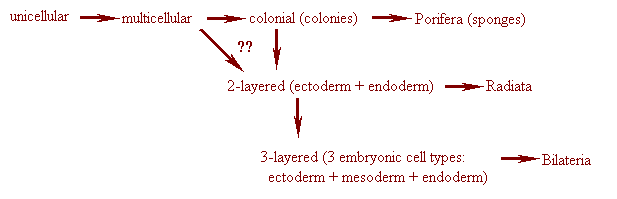 2- and 3-layered organisms are also called Eumetazoa.
Bilateria (2-sided: bi = 2; lateria = sides; has left-right sides, top-bottom, most have front-back)
All animals with distinct tissue types are referred to as the Eumetazoa. Phylogenetically, we might define the Eumetazoa as the crown group uniting jellyfish (Radiata) and silverfish (Bilateria).
Radiata
The jellyfish lineage includes the Cnidaria (jellyfish, corals, etc.) and some related types. These animals, the Radiata, seem to have derived from a single common ancestor who was not in our direct line of descent. The Radiata all have differentiated tissues, but normally nothing much more complicated than "inside" (endoderm) and "outside" (ectoderm), with some level of front-to-back specialization. From an embryological standpoint, they lack mesoderm, a tissue type which characterizes all more derived animals. Most are radially symmetrical. Their body plan is based on a cylinder open at one end, with the open end serving both for ingesting food and eliminating waste.
All other animals are Bilateria.
Bilateria
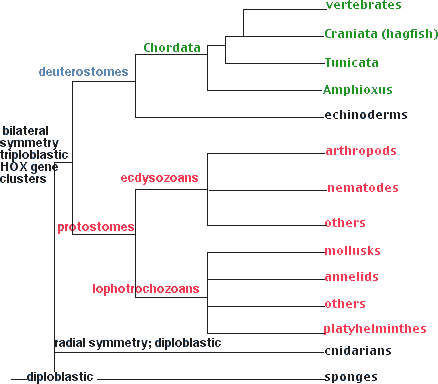
- Deuterostomia (including echinoderms and chordates)
- Lophotrochozoa (including annelid worms and mollusks)
- Ecdysozoa (including arthropods)
- A large number of mostly worm-like groups are left out of this scheme; and their positions are sometimes too vague even to guess.
Of these three main groups, the deuterostomes arguably branched off earliest.
Bilaterians undergo a more complex gastrulation and possess mesoderm [mesos Gk = middle]. Thus, the early cells of the fetus differentiate into three embryonic cell types [exo-, meso-, endo-derm]. Furthermore, they are bilaterally symmetrical.
In addition to a more complex inside-outside pattern of tissues and the ancestral front-to-back organization, Bilateria have a separate top and bottom, with symmetrical left and right sides. In many worm-like forms, this top-and-bottom asymmetry is not well developed on the outside.
However, the internal organization generally involves distinct dorso-ventral organization, with, for example, muscles and circulatory structures located dorsally, and the gut and a major nerve chord located ventrally. Most (but not all) also have a separate mouth and anus, so that the flow of digestion is one way.
At this point, things become much less clear.
Metazoa - phylum by phylum
Kingdom Metazoa or Animalia
[Latin meta = with, after; zoa, from zoon = animal; anima = vital breath or soul.]
What distinguishes Metazoa ?
| Property | Eukaryota | Archaea | Bacteria |
|---|
| Metazoa | Fungi | Plantae | Algae | Protista |
|---|
| eukaryotic | Y | Y | Y | Y | some | | |
| multicellular | Y(1) | Y | Y | | | | |
| heterotrophic | Y | Y | | some | | some | many |
| photosynthesis | some (2) | | Y | Y | Y | some | some |
| thermal energy | | | | | | some | |
| cell walls (3) | | Y | Y | Y | | most | many |
| motile | Y | | | | Y | most | many |
| blastula stage in embryo | most | | | | | | |
| ECM (4) | Y | | | | | | |
| digestive chamber (5) | Y | | | | | | |
Eukaryotic = "true nuts", referring to each nucleus being wrapped in its own membrane thus becoming an organelle.
Multicellularity occurs when an organism consists of more that one cell. Some organisms are no more than colonies where cells cohabit, and in some cases, take on specialized roles. Some Archaea form such colonies, evening incorporating bacteria within. There are indications that early in evolution, eukaryote cells combined with bacteria to use them as organelles (ex: chloroplasts). Multicellularity has been independently developed in at least seventeen different groups of organisms, including plants, chromists, fungi, and slime molds.
Autotrophic = requiring only simple inorganic compounds for nourishment, usually by drawing on chemicals from their environment while obtaining energy from sunlight, heat or radioactivity. (Plants, algae, archaea, some bacteria)
Heterotrophic = deriving nourishment from complex organic compounds produced by other organisms, which provide both nutrients and energy, usually by eating or parasitizing autotrophs and/or heterotrophs (such as metazoa, fungi, some protista, bacteria):
- Except Myxozoa
- Some sponges use photosynthesis and nitrogen fixation
- Cell walls are in addition to cell membranes. Plants - cellulose. Fungi - chitin. Algae - peptidoglycan. The rigid cell wall of plants is made of fibrils of cellulose embedded in a matrix of several other kinds of polymers such as pectin and lignin.
The linear nature of cellulose molecules and the many opportunities for side-to-side intermolecular hydrogen bonding provide enable the building of long, stiff fibrils.
- ECM = Extracellular Matrix
- Internal digestive chamber, with one opening (Radiata, ex: sponges) or 2 openings (mouth and cloaca/anus; Bilateria).
Characteristic
Characteristic of a 'thing' = a property such that:
- all such 'things' possess this property
- only these 'things' possess this property.
Then you know:
- if something has this characteristic then this something is included in this set
- If something does not have this characteristic, it is excluded from this set.
.
Unfortunately even scientists mistakenly use the word characteristic to mean property. This leads to ambiguity so common with poor expression. Please choose words carefully.
The only Metazoan characteristic is an extracellular matrix (ECM). The ECM fills the spaces between cells, serving as structural elements. Its four types of molecules are:
- collagen:
Most collagens are made of long proteins that wind around each other to form a triple helix, and the resulting fibers have a high tensile strength.
- proteoglycans:
Proteo = of protein. Proteoglycan = a protein that is covalently bonded to one or more glycos-amino-glycan chains; a mucoprotein.
- glycosaminoglycan (glycos-amino-glycan) = any of a group of polysaccharides which contain amino-sugar residues, often found in complexes with protein molecules as proteoglycans, and include heparin, chondroitin, hyaluronic acid, and the blood-group substances.
- adhesive glycoproteins:
Glycoproteins are large molecules which branch. These molecules have the property of resisting compressive forces. That is, they are kind of like springs; they can be squished and then return to their old shape.
- integrin:
Integrin is the molecule that connects the outside of the cells to the extracellular matrix.
These four types of molecules are created inside, but exist outside, the cells of animals. These molecules fill up the spaces between cells and serve as structural elements.
The mechanical properties of these molecules are extremely important:
- they often form a scaffolding that becomes mineralized and so forms bones, shells, or spicules of various animals
- the extracellular matrix also plays a key role in the development of animals, from sponges to sea otters:
- In the early development of animals, some cells are immobile and form sheets called epithelia.
- Other cells are motile, i.e., they move inside the animal. Cell motility is necessary for animals to develop from single cells into working individuals composed of many many cells. Extracellular matrix not only facilitates not only the mobility of motile cells and guides their movements within the developing embryo, but also helps to control the transition of cells from one type to another.
It appears that all animals share this complex system of development mediated by extracellular matrix, whereas all other multicellular organisms do not. This characteristic is common to all animals as the result of their being descended from a common multicellular ancestor that also possessed this characteristic.
Each organism is limited in its abiltities to overcome the trials of survival. Each advance in complexity can be seen as overcoming at least one of those trials.
For example, simple plants like liverworts, have no veins to carry fluid upwards, and so cannot grow tall. Ferns developed with veins which solve this problem, but lack woody tissue to grow taller (manferns overcame this problem - how ?). Trees developed woody tissues, grew tall, but became handicapped by drying climates. Later trees coated their leaves with wax to stop them drying out, and shed them in times of drought. And on it goes ... in never-ending evolution.
Evolution of the Metazoa
What property characterizes animals ? Animals all share multicellularity but multicellularity has been independently developed in at least seventeen different groups of organisms, including plants, chromists, fungi, and slime molds.
The Animal Kingdom (Metazoa) is usually considered to include multi-cellular, heterotrophic eukaryotes in which (unlike Plants) the cells are without cell walls.
Everything from sponges and jellyfish to insects and vertebrates belongs in "Metazoa", and considered to have evolved from a single unicellular choanoflagellate ancestor, sometime during the Ediacaran period.
From a simple colonial choanoflagellate, animals developed through increasing grades of specialization and complexity:
first sponges,
then coelenterates
and finally bilateral animals (possessing a head and distinct right and left sides).
A recent interpretation is that choanoflagellates contained within the monophyletic assemblage both the Metazoa (= "animals") and the Fungi, making Fungi the closest sister group to Metazoa.
The problem here is that, although choanoflagellates seem clearly related to sponges, it is not clear how closely related sponges are to the rest of the Metazoa.
It is also difficult to see how such a locally organized organism as a sponge (essentially nothing but a glorified colonial protozoan) can develop into an organism with a specific body structure and internal organs.
The most widely held theory seems to be that a colonial choanoflagellate evolved into a hollow spherical ball of cells, the blastula, which constitutes the earliest embryonic stage of development, and even occurs in sponges.
However, it is not certain that such a blastaea animal ever even existed. There was an hypothesis championed by 19th century German Darwinist Ernst Haekel which was enormously popular for some time. This hypothesis states that "ontogeny recapitulates phylogeny," by which the growing embryo passes through all its past evolutionary stages, such as when the early human fetus possesses gill slits and a tail.
During the Late Proterozoic era an unknown protozoan (or protistan) organism developed into a tiny colonial form, which eventually became the common ancestor of the Metazoa.
The actual nature of this organism is not known, as it was soft-bodied and left no trace.
Why phylogeny ?
Phylogeny maps evolution. Therefore, a phylogenetic hypothesis is essential if you want to understand biological phenomena, most of which have an evolutionary explanation.
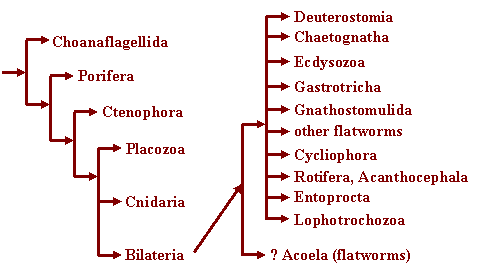
Since many scientists would like to know how animal diversity and animal body plans came to be, presently there is a great deal of work on resolving the evolutionary relationships among the major groups of animals. Much of this research has relied upon morphological characters, especially those expressed in early development (e.g. embryological characters). More recently, a significant advance in our understanding of animal phylogeny has been brought about by the study of molecules (in particular genes and their protein products) contained within animal cells. The phylogeny presented here is a relatively conservative guess based upon various published studies of 18S ribosomal RNA sequence data. As you can see, there are quite a few unresolved branches, and therefore a great deal of work to be done in this area.
Note that the phylum Porifera (the sponges) is paraphyletic. A few lines of independent evidence suggest that one group of sponges is actually more closely related to non-sponge animals than it is to the other sponges. This is an important finding for it implies that the lineage leading to all other animals (including ourselves) was directly descended from an animal with a sponge body and a sponge life style.