Nematoda
["nematode" from Gk nema = thread. The body of a nematode is long and narrow, often resembling a tiny thread.]
Nematoda = roundworms.
Nematodes live not only in almost every geographic location on Earth, but live in such extreme habitats as ice and hot springs, as well as living on or in almost every other kind of animal and plant alive today. Free-living nematodes are extremely abundant in soils and sediments, where they feed on bacteria and detritus.
Other nematodes are plant parasites and may cause disease in economically important crops. Still others parasitize animals (including humans); well-known parasitic nematodes include hookworms, pinworms, Guinea worm (genus Dracunculus), and intestinal roundworms (genus Ascaris).
There are thousands of nematodes. Not only are there more than 15,000 known species of roundworms, but there are many thousands of individual nematodes in even a single handful of garden soil. Some species of roundworm may contain more than 27 million eggs at one time and lay more than 200,000 of them in a single day.
Some scientists have estimated that there may be as many as half a million more unkown species of roundworm yet to be discovered, an estimate based on the fact that many new species are still being discovered, that relatively few people are looking for more species, and that most roundworms look pretty much alike. If the estimated number of species is anywhere close to correct, it would mean that roundworms are the second most diverse group of animals, trailing behind only the arthropods.
It is likely that the simple body plan of Nematoda has resulted from reduction and simplification from more than one group of ancestral organisms, and so the pseudocoelom is neither a uniquely derived nor useful character. The simplicity is thus a result of secondary simplification from a more complex body design, and not necessarily an indication of primitive or simple origins. Current studies indicate that nematodes are actually related to the arthropods and priapulids in a newly recognized group, the Ecdysozoa.
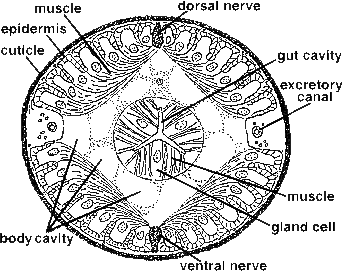 A diagrammatic view of the internal anatomy of a roundworm, showing the simplicity of its organization:
- epidermis (skin):
The epidermis (skin) of a nematode is highly unusual; it is not composed of cells like other animals, but instead is a mass of cellular material and nuclei without separate membranes. This epidermis secretes a thick outer cuticle which is both tough and flexible.
- cuticle:
The cuticle is a feature shared with arthropods and other ecdysozoans. As in those other groups, the cuticle is periodically shed during the life of a nematode as the organism grows, usually four times before reaching the adult stage. The cuticle is the closest thing a roundworm has to a skeleton (exoskeleton), and the worm uses its cuticle as a support and leverage point for movement.
- muscles:
Long muscles lie just underneath the epidermis. These muscles are all aligned longitudinally along the inside of the body, so the nematode can only bend its body from side to side, not crawl or lift itself. A free-swimming roundworm thus looks rather like it is thrashing about aimlessly.
- nerves:
The muscles are activated by two nerves that run the length of the nematode on both the dorsal (back) and ventral (belly) side. Unlike other animals, where the nerves branch out to the muscle cells, a nematode's muscle cells branch toward the nerves.
The ventral nerve has a series of nerve centers along its length, and both nerves connect to a nerve ring and additional nerve centers located near the head.
- head:
The head of a nematode has a few tiny sense organs, and a mouth opening into a muscular pharynx (throat) where food is pulled in and crushed.
- gut:
The mouth leads into a long simple gut cavity lacking any muscles, and then to an anus near the tip of the body. Food digested in the gut is not distributed by any specialized vascular system.
- no respiratory system:
There is no respiratory system for the uptake or distribution of oxygen. Rather, nutrients and waste are distributed in the body cavity, whose contents are regulated by an excretory canal along each side of the body.
Many nematodes are able to suspend their life processes completely when conditions become unfavorable; in these resistant states they can survive extreme drying, heat, or cold, and then return to life when favorable conditions return. This is known as cryptobiosis, and is a feature nematodes share with rotifers and tardigrades.
Fossil nematodes have been found in rocks from as early as the Carboniferous. Most living roundworms are microscopic, meaning that their discovery as fossils is likely to be difficult. On the other hand, one species of parasitic nematode can reach 13 meters in length; it parasitizes the sperm whale.
Nematodes also lack any substantial hard parts, again resulting in a spotty chance for fossilization. Despite these problems, fossil nematodes are occasionally found in amber (fossilized tree resin) from the Cenozoic. Because many of their relatives have left fossils dating from the Cambrian, it is likely that the nematodes have been around at least that long in some form.