Chordata

Source:
John W Kimball, Faculty of Molecular & Cellular Biology, Harvard University, US
This is an excellent article, clear, concise, and crystallizing the essence of chordata; to be mastered and remembered by everyone in order to understand our place in the world.

Contents


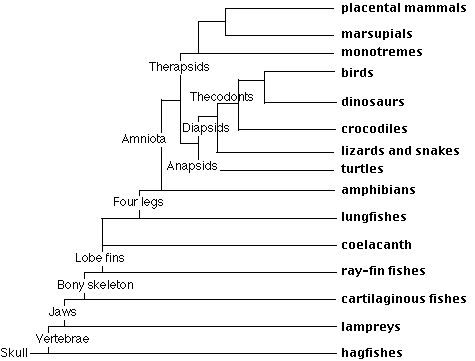
Craniata taxonomy

Chordata


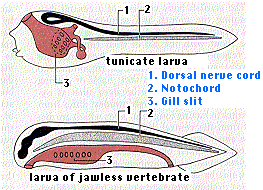
Chordata embryo During their embryonic development, all chordates pass through a stage called the pharyngula with these features:
There are three subdivisions of the chordates:

Vertebrata

Although one group, the hagfishes, never replaces their notochord with a vertebral column, and thus might seem not to qualify as vertebrates, they share a number of other features with other vertebrates and certainly should be classified with them. Still uncertain is whether they represent the most primitive vertebrates or are simply degenerate vertebrates.

All the other members of the craniata convert their notochord into a vertebral column or "backbone" (even though in some it is made of cartilage not bone). They also differ from all other animals in having quadrupled their HOX gene cluster; that is, they have 4 different clusters of HOX genes (on 4 separate chromosomes). Perhaps this acquisition played a key role in the evolutionary diversity that so characterizes the vertebrates.

The vertebrates are subdivided into:

Agnatha

Lampreys and hagfishes are the only jawless vertebrates to survive today. They both have a round mouth and for this reason are often referred to as cyclostomes. They are the most primitive of the vertebrates. "Primitive" means that they are little changed from the first vertebrates.
Characteristics of Agnatha:

Gnathostomata

Characteristics of Gnathostomata:

Chondrichthyes (Cartilaginous Fishes)

Fossils of cartilaginous fishes become abundant in deposits dating to the Devonian period. They were very much like the sharks of today. The group gets its name from the fact that their skeleton is made of cartilage, not bone; and today has some 800 species.
Chondrichthyes (cartilaginous fishes) consist of:
With their gills exposed to sea water, all marine fishes are faced with conserving body water in a strongly hypertonic environment. Sea water is about 3.5% salt, over 3 times that of vertebrate blood. The cartilaginous fishes solve the problem by maintaining such a high concentration of urea in their blood (2.5% - far higher than the 0.02% of other vertebrates) that it is in osmotic balance with - that is, is isotonic to - sea water.

This ability develops late in the embryo, so the eggs cannot simply be released in the sea. Two solutions are used:
Both these solutions require internal fertilization, and the cartilaginous fishes were the first vertebrates to develop this. The pelvic fins of the male are modified for depositing sperm in the reproductive tract of the female.

Osteichthyes (Bony Fishes)

As their name indicates, the skeleton in this group is made of bone.
Osteichthyes (Bony Fishes) consist of:
Ray-finned fishes:
Although the earliest bony fishes may have appeared late in the Silurian period, their fossils become abundant in freshwater deposits of the Devonian period. In addition to gills, these fishes had a pair of pouched outgrowths from the pharynx which served as lungs. They were inflated with air taken in through the mouth and may have provided a backup gas exchange organ when the water became too warm and stagnant to carry enough dissolved oxygen. Their kidneys were adapted for the hypotonic environment in which they lived.

These animals diversified through the remainder of the Devonian period (which is often called the "Age of Fishes"). Some migrated to the oceans. In this more stable environment, their lungs became transformed into a swim bladder with which they could alter buoyancy. Their kidneys became transformed as well adapting them to their new, hypertonic, surroundings.

Lobe-finned fishes

The only ones to survive today are:
The nostrils of bony fishes open only to the outside and are used for smelling. Some of the lobe-finned fishes developed internal openings to their nostrils. This made it possible to breath air with the mouth closed as modern lungfishes do.

Judging from present-day lungfishes, two other adaptations evolved in this group:
These rare modern lobe-finned fishes are the sole survivors of once-flourishing groups that also gave rise to the tetrapods - the four-legged vertebrates. Late in the Devonian (about 360 million years ago), the paired fins of some sarcopterygians moved under the body and developed limbs (complete with digits). This enabled them to venture out on land. So once again, evolution was opportunistic giving rise to the first land vertebrates, the amphibians.

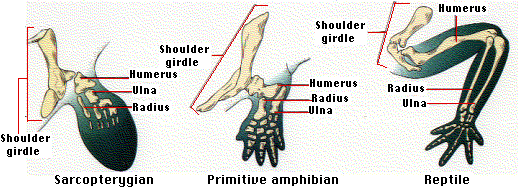
Evolution 1

The figure shows the evolution of the pectoral fin to tetrapod foreleg. [The sarcopterygian is used as an example of an ancient fin, and not to be taken as a direct ancestor of the frog.]

Amphibians

With their bony limbs and lungs inherited from their lobe-finned ancestors, amphibians were so successful during the Carboniferous (Mississippian and Pennsylvanian periods) that these periods are known as the Age of Amphibians. The Carboniferous was followed by the Permian, when the earth became colder and dryer. The fortunes of the amphibians began to decline until only three groups - totaling about 5700 species - remain today.
Last amphibians:
As the name suggests, amphibians are only semiterrestrial:

Reptilia (Reptiles)

Reptiles evolved from amphibians during the Carboniferous.
The earliest reptile fossil found is Hylonomus lyelli. It is also the first animal known to have fully adapted to life on land. Hylonomus lived about 315 million years ago, during the Late Carboniferous Period (= Pennsylvanian, Coal Age).
Hylonomus were about 20 cm (8 in.) long, counting the tail. These lizard-like reptiles were primarily insectivores, probably feeding on millipedes, insects and land snails. (At this time, plant-eating, backboned animals had not yet appeared). Females probably deposited eggs on land in moist, sheltered areas

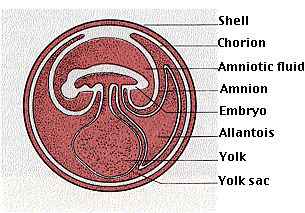
With the arrival of the cold, dry Permian, they were well-adapted to survive because of their development of a shelled, yolk-filled egg which could be deposited on land without danger of drying out.

A shelled egg is just as impervious to sperm as to water, so its arrival coincided with the development of internal fertilization.

1M_reptile_embryo.gif not found The embryo developing within the egg produces 4 extra-embryonic membranes:
The amniotic egg was such a successful adaptation for land living that it has been retained by:
Collectively, these three groups are often called the Amniota.

Other adaptations that enabled the reptiles to flourish for the next 220 million years were:
Beginning late in the Paleozoic era and exploding in the Triassic period, the reptiles underwent a remarkable adaptive radiation producing:
The dominance of the reptiles during the Mesozoic era has giving it the name, the Age of Reptiles.

Birds (Aves)

Feathers are the feature that most clearly distinguishes the birds from their dinosaur ancestors. These scaly skin outgrowths provide:
Other adaptations are:
All of these adaptations help birds to fly (to escape predators and find suitable food and nesting sites). Approximately 10,000 species are known today.

Mammalia (Mammals)

Special features:
There are about 4,600 species living today.

Mammals first appeared over 200 million years ago early in the Mesozoic. By 166 million years ago, they had diverged into the:

Metatheria (Marsupials)

Developing marsupials are retained for only a brief time within the reproductive tract of the mother. During this time they receive some nourishment from the yolk sac which grows into the wall of the uterus. They are born at such an early stage of development that they must crawl into a pouch on the mother's abdomen, attach themselves to one of her milk-dispensing nipples, and complete development there.

Only one marsupial, the opossum, survives in North America; some 69 species in South America. In Australia, however, where they were protected far longer from an influx of placental mammals, there is still an broad array of marsupials.

Eutheria (Placental Mammals)

These animals retain their young within the mother until development is well along. The egg contains little yolk, but the extra-embryonic membranes form
The table shows the orders of placental mammals (Eutheria) and representatives of each. The members of orders shown with the same color belong to a single clade; that is, they are more closely related to each other than to the mammals in any other orders. These clades are based on the most recent analysis of DNA sequences of several genes, both nuclear and mitochondrial, and the building of phylogenetic trees from these data.

OrderSpeciesComment
Afrotheria Tubulidentata
Macroscelidea
Hyracoidea
Sirenia
Proboscidea
aardvarks
elephant shrews
hyraxes
manatee, dugong
elephants
These 5 orders are found in Africa. They appear to be the most primitive of the placental mammals.
Xenarthra Cingulata


Pilosa
armadillos


anteaters, sloths
These animals (armadillos, sloths, giant anteaters) probably arose in the part of Gondwana that today is South America.
Dermoptera
Primates


Scandentia
flying lemurs
lemurs, New World monkeys, Old World monkeys, great apes (hominoids), humans
tree shrews
Euarchontoglires Rodentia


Lagomorpha
rats, mice, squirrels, beaver

rabbits, hares
The hugely-successful glires (rodents and rabbits) form a clade (light blue) that is so closely related to the clade that includes the tree shrews, primates, and our closest relatives, the flying lemurs (dark blue), that they are grouped together.
Laurasiatheria

These 7 orders have been assigned to the Laurasiatheria because their oldest fossils appear in the supercontinent of Laurasia.
Insectivora
Chiroptera
Pholidota
Carnivora

Perissodactyla

Artiodactyla


Cetacea
shrews, moles
bats
scaly anteaters
dogs, cats, lion, skunk, walrus, sea lion
(odd-toed ungulates) horse, zebra, rhinoceros
(even-toed ungulates) cow, sheep, pig
giraffe, hippopotamus
whales, dolphins, porpoises
The even-toed ungulates and the cetaceans are so closely related that they are now in the same order Cetartiodactyla. Hippos appear to be more closely related to the cetaceans than they are to the other even-toed ungulates.

Summary

Return to the cladogram at the top of the page to review the evolutionary relationships of the craniata.
Craniata taxonomy

Monotremes

Monotremes are a small but remarkable group of mammals that consists of a single species of duckbill platypus (Ornithorhynchus anatinus) found in Australia and three (perhaps four) species of spiny anteaters (echidnas) found in Australia and New Guinea.
These animals retain several traits of their therapsid ancestors including:
Despite these reptilian features, the monotremes meet all the criteria of true mammals:
The complete genome of the platypus has been sequenced, with 18,527 protein-coding genes distributed on 52 chromosomes, reflecting the mix of mammalian and reptilian phenotypic features. Examples:
Other features of their genome reflect their unique biology: