Amphibians

Amphibians = frogs, salamanders, newts.
[From Gk amphí = both, bios = life; amphíbios = both kinds of life.]

Scientific classification

Classific'nNameCharacteristics
Kingdom
Phylum
Subphylum
Superclass
Class


. . Order
. Subclass
. Subclass
. . Order
. . Order
. . Order
Animalia
Chordata
Vertebrata
Tetrapoda
Amphibia


. . Temnospondyli - extinct
. Lepospondyli - extinct
. Lissamphibia
. . Anura
. . Caudata
. . Gymnophiona
Animals (cells are surrounded by ECM)
Spinal cord
Vertebrates
4-legged
  • adapted to both land and water
  • simple sac-like lungs
  • moist respiratory skin
  • no scales (like precursor fish)
  • breed in water; fertilization external
  • gills in larve; lungs in adult
  • aquatic larva metamorphoses into land adult


Frogs and toads; 5,602 species, 48 families.
Salamanders, newts; 571 species, 9 families.
Caecilians; 174 species, 3 families.
 

Characteristics

Amphibians (class Amphibia), such as frogs, toads, salamanders, newts, and gymnophiona, are cold-blooded animals that metamorphose from a juvenile, water-breathing form to an adult, air-breathing form. Typically, amphibians have four limbs. Unlike other land animals (amniotes), amphibians lay eggs in water, as their fish ancestors did. Amphibians are superficially similar to reptiles.

Declining populations

In recent decades, there has been a significant drop in amphibian populations around the world, possibly the result of water pollution from industrial waste, habitat destruction, over-exploitation, introduced species, climate change, destruction of the ozone layer (ultraviolet radiation has shown to be especially damaging to the skin, eyes, and eggs of amphibians), and diseases like chytridiomycosis. Please do not collect frogs and tadpoles to introduce into another area without having an expert diagnosis guaranteeing they are free of disease.

Many of the causes of amphibian declines are still poorly understood, and are a topic of ongoing discussion.
The top 10 endangered species include:

Taxonomy

Traditionally, amphibians have included all tetrapods that are not amniotes. They are divided into three subclasses, of which two are only known as extinct subclasses:
Of these only the last subclass includes recent species.

All recent amphibians are included in the subclass Lissamphibia, superorder Salientia, which is usually considered a clade (which means that it is thought that they evolved from a common ancestor apart from other extinct groups), although it has also been suggested also that salamanders arose separately from a temnospondyl-like ancestor.

Reproduction

For reproduction most amphibians are bound to have fresh water. A few tolerate brackish water, but there are no true seawater amphibians. Frogs will dehydrate in saltwater owing to osmosis across their very permeable skin. Several hundred frog species in adaptive radiations, however, do not need any water for breeding in the wild, such as Eleutherodactylus, the Pacific Platymantines, the Australo-Papuan microhylids, and many other tropical frogs. They reproduce in their wet tropical rainforests, by passing through the tadpole stage within the egg and hatching directly into miniature versions of the adult. This has allowed them to be completely independent of free-standing water. Several species have also adapted to arid and semi-arid environments, but most of them still need water to lay their eggs.

Symbiosis with single-celled algae that lives in the jelly-like layer of the eggs has evolved several times.

The larvae (tadpoles or polliwogs) breathe with exterior gills. After hatching, they start to transform gradually into the adult's appearance, a process called metamorphosis. Typically, the animals then leave the water to become landed adults. However there are exceptions to this type of reproduction.

Evolution

Amphibians evolved in the Devonian Period. Early amphibians were top predators in the Carboniferous and Permian Period, but many lineages were wiped out during the Permian-Triassic Extinction. One group, the metoposaurs, remained important predators during the Triassic, but as the world became drier during the Early Jurassic they died out, leaving small remnants.

The first major groups of amphibians developed in the Devonian Period from fish similar to the modern coelacanth and lungfish where the fins had evolved into legs. These amphibians were around one to five meters long. At that stage of evolution there were no land animals, so the land was safe from predators. However, there were two problems with living out their entire lives on land:
In the Carboniferous Period, the amphibians moved up in the food chain and began to occupy the ecological position currently occupied by crocodiles. These amphibians were notable for eating the mega-insects on land and many types of fishes in the water. In the Triassic Period, the amphibians started competing with proto-crocodiles, which led to their drop in size in the temperate zones, or leaving for the poles. Amphibians were able to hibernate during the winter, whereas crocodiles could not, allowing the amphibians in higher latitudes protection from the reptiles.

Structural evolution

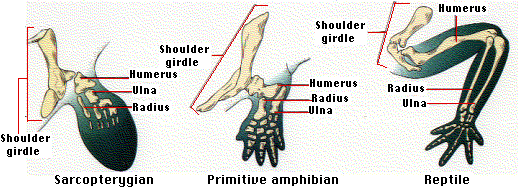
The structural evolution for amphibians was necessary to enable a water creature to live on land.

Evolution 1

The figure shows the evolution of the pectoral fin to tetrapod foreleg. [The sarcopterygian is used as an example of an ancient fin, and not to be taken as a direct ancestor of the frog.]

The noticeable changes were:
Amphibians were followed by reptiles which evolved scales and amniote eggs, which distinguish reptiles from amphibians.

Habitat and distribution

The distribution of amphibians is worldwide, except in Antarctica and Greenland. They are found on landmasses and in fresh water. Frogs are the most widespread of the three groups, occurring on all major landmasses inhabited by amphibians. They live in a great variety of habitats, ranging from deserts to rain forests, permanent ponds to high mountain meadows. With some exceptions, an aquatic situation is required for breeding and tadpole development.

Salamanders are primarily a north temperate group, occurring in North America, Europe, and Asia. Some species are found in Africa north of the Sahara, and one group of some 200 species has had an extensive adaptive radiation in the New World tropics in Central and South America to northern Argentina. Salamanders occupy a variety of terrestrial and aquatic habitats; those found in dry environments, such as the Mexican plateau, usually live in ponds. When on land, they are often found in moist leaf litter and under rocks and logs. In northern areas several species are found in ponds, streams, or rivers. Many species require water for breeding and development, but many other species breed on land and forgo the larval stage.

The caecilians are tropical in distribution. They occur in the New World from southern Mexico to northern Argentina, in tropical Africa, and in Southeast Asia. These limbless elongate, virtually tailless animals are usually burrowers. They are found in stream banks, under debris, and along root channels from sea level to 3,000 m (9,840 ft). One group in South America is aquatic and lives in streams, especially in the drainage basin of the Amazon River. The larvae of certain species in Southeast Asia and South America, and probably Africa, also inhabit streams.

Range of appearance

The order Anura or Salientia, the frogs and toads, includes the giant frog of Africa (Conraua or Giganturana goliath), which may reach 1 m (39 in) in body length; Sminthillus, the smallest frog, at 12 mm (0.5 in) in body length, which lays one egg a year; Centrolene of Central America, whose skin is translucent and whose bones are green; and Pseudis paradoxicus, whose tadpoles are in fact larger than the adult frogs into which they metamorphose. Some brightly-colored frogs are so poisonous secretions of their skin are used on arrows.

The largest salamander is the Japanese giant salamander (Andrias), which extends up to 135 cm (53 in) in length; the smallest is the tropical genus Thorius, at 16 mm (0.6 in).

The caecilians, of the order Gymnophiona or Apoda, arelimbless, mostly tailless, elongate, tropical amphibians that burrow or swim. These are considered wormlike because of shape and the presence of many rings, which resemble the segments of worms. The smallest caecilians (Idiocranium) are mature at 90 mm (3.6 in); the largest (Caecilia) are more than 1,300 mm (52 in).

Structure and function

The three orders of amphibians are allied by:
Amphibians are poikilotherms, cold-blooded organisms; their body temperature is slightly higher than that of the environment. They are active at optimal temperatures and withdraw from extreme heat or cold.

Locomotion

Mode of locomotion varies greatly among amphibians. Limbless caecilians burrow, using their heads like shovels and gaining thrust through contraction of muscles to force the body against the soil. The caecilians that swim, and most swimming salamanders, are like eels, using body muscle contraction to propel themselves through the water. Salamanders use their limbs very little in swimming. On land, the limbs give considerable propulsion to the body, and several salamander gaits have been described. The limbs are sprawled out from the body, and the middle of the trunk usually rests on the ground,in contrast to the faster lizards, whose legs are under the body and raise it above the ground. Frogs make use of their long hind-limbs to effect several kinds of locomotion:

Life cycle and behaviour

Breeding in most amphibians is seasonal, usually correlated with temperature and optimal moisture. Male frogs attract females by using sounds or actions; salamanders depend primarily on visual and tactile cues. It is not known how male and female caecilians find each other. The modes of fertilization vary. Most frogs practice external fertilization, the females laying eggs in water and the males spraying sperm over them. Primitive salamanders have external fertilization, but most have internal fertilization, with the female taking up the male's spermatophore. All caecilians have internal fertilization, and the male deposits sperm in the cloaca of the female by using the end of his cloaca as an intromittent organ. Other trends in amphibian reproductive biology include the following:

Protective behaviors

Ecological indicators

Many amphibians are barometers of the degradation of the environment, as populations are dying because of such factors as environmental contaminants and their effect, and changes in land use. These factors can modify the effects of diseases, predators, and even evolution, especially through human actions.

Uses

They are major components of their ecosystem, both predator and prey. They are food for several human cultures. Interest in them ranges from their aesthetic appeal to their use as a source of arrow poison. They are of considerable importance to science, furnishing material for study of cell function, genetics, and development. As laboratory specimens they are used in the study of anatomy, behavior, ecology, and evolution.