Primates
Primate groups
- Prosimians:
- Tree shrews: SE Asia
- Lemuroids: only in Madagascar (off east coast of Africa)
- Lorisoids: Africa, SE Asia
- Tarsiers: SE Asia
- New World monkeys = Platyrrhines (Sth America from northern Argentina to southern Mexico):
- Cebids: leap or swing from tree to tree
- Squirrel monkeys
- Titis + Dourocoulis
- Sakis + Uakaris
- Capuchins *
- Woolly monkeys * + Spider monkeys *
- Howlers *
'+' = species on same branch, closely related; * = prehensile tail (there should be 5)
- Marmosets: scamper like squirrels
- Maned marmosets
- Pygmy marmosets (body length 75-100mm + tail)
- True marmosets + Tamarins
- Callimicos
- Old World monkeys:
- Colobus & langurs:
- Baboons & macaques: macaques have ranged from Africa through India, high in the Himalayas, through China and as far as Japan. Baboons have ranged from Cape of Good Hope to Dakar to Ethiopia and up to Spain. Baboons and macaques, both the most successful of the ground-dwellers, live in troops with dominnt males ruling by 'totalitarian' aggression. They can swim.
- Guenons & mangabeys:
- Anthropoid apes:
- Gibbons: SE Asia
- Orangutan: Borneo & Sumatra
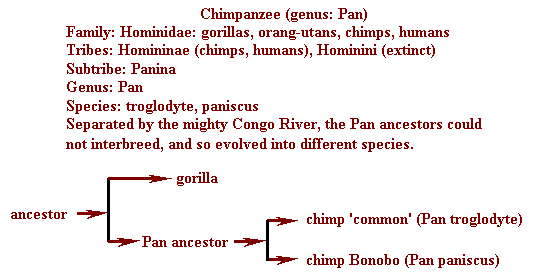
- Chimpanzees: red chimpanzee and smaller black bonobo, separated by the Congo River.
- Gorillas: Rwanda and nearby.
These locations are mainly tropical and sub-tropical, but in previous eras, primates ranged to higher latitudes when the climate was warmer. However, macaques have adapted to the snows of Japan's winter by using hot springs.
Mammal Characteristics
Primate characteristics are all built on mammal characteristics.
Therefore when we think primate, think mammal first, primate second.
Thermoregulation:
- maintain and change body temperature
- hair to insulate
- sweat glands to cool off. Most non-primate mammals lack the equivalent of human sweat glands, which allows man to do persistent hunting (running down prey by exhausting them through overheating).
- “warm-blooded”, so ready for instant action, unlike reptiles which need to warm up.
- heavy nutritional requirements. Needs to spend much of the day gathering food. High risk of hyperthermia, which quickly depletes energy resources.
Nutritional Efficiency:
- Thermoregulation needs much energy, thus primates need to eat and digest a lot.
- A hard palate separates the mouth cavity from the nasal passage, so they can eat and breathe at the same time.
- They have two sets of teeth over the lifetime.
- Primates have several different kinds of teeth for different functions incisors, canines, premolars, molars.
Locomotion and posture
Primates move in many different ways: walk, run, sprint, jump, swim.
They are able to rotate limbs, twist, turn rapidly and even to use tails to maintain or change orientation in mid-air.
Their hands and feet have apposite thumbs, giving gripping power.
All these abilities combine to give a variety of options when traveling through the different habitats seeking food.
Multiple, Developed Life Stages
Spread growth and development over a longer period
Four main stages:
- In Utero
- Infancy
- Juvenile
- Adult
Humans add Childhood between Infancy and Juvenile, to increase period of learning.
Behavioral Flexibility
Larger and more sophisticated brains give a better chance of using resources, surviving and reproducing. Mammals can change their behavior to cope with changes in the environment. Many mammals have culture, that is, they transmit techniques learnt to their offspring. Elephants learn from their matriarch the migration trails and also those clays which provide nutritional salts. Some macaque monkeys in a Japanese zoo, learnt to separate peanuts from sand by dropping the mixture in water. The others copied their technique and then everyone taught the offspring.
What Makes a Primate a Primate ?
Related to teeth and snout
- Shortened snout. Primates rely less on their sense of smell and more on vision.
- Fewer teeth. Primates have a reduced number of teeth as compared to other mammals.
There are several types of teeth to eat a variety of foods and process food efficiently:
- incisors for biting
- canines for shearing
- premolars and molars for chewing food, making it mose accessible to digestive juices.
- Smaller heads for tree-dwellers: less weight at the top end, makes tree-jumping more accurate, and tails more effective.
Related to eyes and ears
- The ear: Three bones of the middle ear are housed in a skull outgrowth (the auditory or petrosal bulla). Primates tend to have reduced ear flaps compared to ungulates and elephants. Humans do not rotate ear-flaps to judge direction; they turn the head. The slight difference in reception of signal, and the difference in volume, indicates direction.
- eye orbits: Primates have an increased emphasis on vision, so have evolved forward-facing eye orbits giving binocular vision for tree-jumping.
- Stereoscopic vision: Stereoscopic or binocular vision means that the fields of vision provided by each eye overlap, resulting in what is called depth perception. Human eyes are set 75mm apart so each eye has its own image, and these are slightly offset from each other. When these images are passed to the brain, they are reconciled to give an indication of distance. This is extremely useful for forest-dwelling primates, as it lets them judge how far away the next branch is as they are jumping from tree to tree. Human binocular vision is good for up to 10m, the distance range suited to arboreal animals.
- Distance vision: Human eyes are designed for maximum depth of field, as far as the horizon. The first 10 metres is indicated by binocular vision (stereoscopic eyes), but from 10 metres to the horizon, depth is defined by color (distance increases blueness), size (inversely proportional to distance), clarity, and focus.
- Retina: has both b/w and color receptors. During day, color brings recognition of fruit, etc. At night, b/w receptors operate at much lower energy, and thus are more efficient for night use. In contrast cat's eyes are designed for night-vision, and so are blinded by the glare of the African sun.
- Color: The distinctive color of ripe fruit enables it to be recognized at a distance, so less time and effort is expended when searching the tree-tops for fruit. Ungulates, eating grass, do not need this sensitivity.
- Small iris restricts night vision: food gathering occurs usually in the daytime only. (Some exceptions, like the tarsier and one lemur, have the benefit of large eyeballs.)
Related to arms and legs
- Shoulder: The shoulder uses a clavicle (collarbone) and open socket, with the clavicle providing the only bony link between the upper limb and the trunk. This enables the arm to be rotated almost 360 degrees. That is vital for tree-jumping and later enabled rock- and spear-throwing.
- Hand & foot control: Two separate bones in the forearm and lower leg allow for better rotation of foot and hand, giving precise control.
Related to fingers and toes
- Nails instead of claws: Nails allow primates to manipulate objects more easily. The tree shrew and marmoset have claws.
- Increased thumb mobility: Again, related to manipulating objects. As you move across the primate order from lemurs and lorises to great apes, including humans, the thumb becomes more and more mobile. The thumb is usually opposite to the index finger, enabling us to hold objects between them.
- Grasping feet: Primates have more big toe mobility for grasping and climbing. The only exception is humans (Homo sapiens). We have lost the grasping ability in our feet because our feet are designed to serve as a platform for walking
Primate Evolutionary Trends
- Increasing vertical posture: Primates tend to move with a more vertical posture, even if they are rarely upright. This is advantageous in tree-climbing and also when seeing over tall grasses in the savannahs to see predators.
- Different use of forelimbs and hindlimbs: Primates use their limbs for more than just locomotion (moving around), such as climbing, sampling food, breaking open nuts, picking fruit out of reach of mouths, making and using tools, catching and killing predators and prey.
- Longer lives: allows for longer periods of infancy, childhood and adulthood.
- Bigger brains: Primates have larger brains for their body size than a lot of other mammals. Large brains need large heads which endanger birth, so the brain and head must delay final growth till after birth. This continuing growth of the brain and the need to learn food gathering and tribal culture, require longer periods of infancy and childhood.
- Re-allocation of brain cells: Increased portion of the brain for vision; decreased portion for olfaction (smelling); creation of portions for communication, and in man, for speech and conscious thought. Massive enlargement of frontal lobe, for gorilla, chimpanzee and man.
Primate Behavior
So what do primates DO that makes them primates? They spend time:
- Use their limbs to climb in trees by grasping with hands and feet (possums do it too).
- Use their hands to bring food to their mouth for feeding (possums do it too).
- Are part of social group life, building and reinforcing bonds between individuals and learning from their mothers and others.
- Use sex for bonding long enough to train offspring in culture. Much of the human body such as large lips and breasts, body shape including narrow waist, crotch gap and long neck, are sexually stimulating. Combine this with the ability to be sexually aroused at almost any time, and the tendency for sexual intercourse to be bonding, enables many parents to remain bonded for 15-20 years, long enough to raise their offspring in the culture. Many marriages last till the offspring leave home (and a few persevere for a lifetime).