Evolution 1 – overview
Ba = Billion-years-Ago or Billion-years-old, depending on the context.
Ma = Million-years-Ago or Million-years-old.
Genotype: Most cells contain DNA, which are strings of genes attached to each other in a set sequence. Genes stimulate chemical processes in the organism. Some of these genes are not used. They have been inherited from distant ancestors and have become irrelevant. Other genes are used and some of these create processes which determine the way we look, what we sense and even how we act in and react to our environment. These latter qualities, the expression of our genes, are grouped within the term 'phenotype'. The shape of your nose is determined by your genotype, but the actual shape is your phenotype. Your passport photo shows your phenotype, but your genotype is hidden inside the nucleus of your cells.
Refer to: History >> Universe-to-man >> Geological periods.
Evolution, in a list
The path of evolution may have been:
- Life may have originated around hydrothermal vents (volcanic cracks on the ocean floor). Some like cyanobacteria would have produced oxygen as a waste product, thus leading to oxygen dissolved in the oceans, as well as to a changing atmosphere.
- Only then was it possible for single-celled organisms to evolve, which could remove the oxygen dissolved in the water, and use it to generate energy by cell-respiration.
- Eventually single-cells evolved with the nucleus enclosed within its own nuclear membrane, the Protista which began the Kingdom Eukaryota.
- Finally multicellular organisms appeared and colonized benthic zones.
- All this time, the photosynthetic organisms gradually produced the chemically unstable oxygen-rich atmosphere which would eventually allow organisms to evolve out of the water.
- (Fish developed the 5-fingered pairs of pectoral and pelvic fins which have been inherited all the way down to us.) When some fish developed the ability to extract oxygen from the air, there emerged onto the land the water-based 4-legged 5-toed amphibians.
- Other fish, on leaving the water, retained their scales which prevented dehydration, and evolved into land-based scaly 4-legged 5-toed reptiles.
- Later, some reptiles evolved into birds, some into mammals, some into crocodiles and lizards, and others into dinosaurs.
- The birds turned their scales into feathers; the mammals turned them in fur; the crocodiles and lizards think they look nice as they are; and the dinosaurs died out.
And that is 3.5 billion years of history in one neat list.
(Why not learn it ?)
Evolution Theory's 3 tenets
The modern theory of evolution is based on 3 primary tenets:
- Over generations, organisms tend to evolve. (We have it on film; we have it on records over the last 2000 years in our farming. We know how it happens, and we produce the effects artificially in genetic engineering. Evolution is indisputable. )
- All life forms have a single common ancestor (as shown by every organism having the same piece of DNA **) with each new species evolving from another by the accumulation of genetic changes.
- The origin of a new species results from random heritable genetic mutations (changes), some of which are more likely to spread and persist in a gene pool than others. Mutations that result in an advantage to survive and reproduce are more likely to be retained and propagated than mutations that do not result in a survival to reproduce advantage.
** This assumes that the probability of different organisms producing the same DNA is significantly low. This in turn assumes that atoms and molecules do not have a propensity, in the same environmental conditions, to form the same bonds in the same order. This lack of propensity is very likely but not proven.
Incidently, this shared DNA, the DNA which both bacteria and humans have, has been turned off in humans. Most of the human genome comprises unused sequences that are a legacy of evolution. As we evolved, many genetically-derived processes became unnecessary, and so were 'switched off'.
It is also possible for structures that have been lost in evolution to reappear due to changes in developmental genes, such as a mutation in chickens causing embryos to grow teeth similar to those of crocodiles. We are beginning to understand how genes are 'switched off', both temporarily and permanently.
One prominent misconception is that evolution proceeds in a specific direction leading to the improvement of organisms. This is often stated as climbing an evolutionary ladder. This is not correct. Instead, organisms either adapt to environments that are always undergoing change, or they risk extinction. Who knows whether an alternative path of evolution forced upon us by different environmental conditions, would not have produced a 'better' human ? One less gullible, greedy and aggressive, perhaps ?
How do we meazure perfection in evolutionary terms ? The diploblastic sponge and the jellyfish have persisted from the Precambrian Age with little change. Who has the better life – the jellyfish swimmng all day and exploring the oceans or the materialistic 9-to-8 office-worker ? Other ancient creatures that survive because of specialized adaptation are fungi, mosses, sharks, and horseshoe crabs. Thus, evolution is not for 'perfection' but for survival-to-breed.
Genes mutate. Mutations increase the diversity of phenotypes. Changing environments favor some phenotypes over others. The less-favored tend not to breed so their genes are removed from the population. Thus genotypes change over the generations, and species evolve.
Evolution's 3 processes
In biology, evolution is change in the inherited traits of a population of organisms from one generation to the next. These changes are caused by a combination of three main processes:
- variation
- reproduction
- selection.
Genes that are passed on to an organism's offspring produce the inherited traits that are the basis of evolution. These traits vary within populations, with organisms showing heritable differences in their traits. When organisms reproduce, their offspring may have new or altered traits.
These new traits arise in two main ways:
- mutations in genes
- transfer of genes between populations and between species.
In species that reproduce sexually, new combinations of genes are also produced by genetic recombination, which can increase variation between organisms. Evolution occurs when these heritable differences become more common or rare in a population.
Evolution's 2 mechanisms
Two major mechanisms drive evolution:
- The first is natural selection, a process causing heritable traits that are helpful for survival and reproduction to become more common in a population, and harmful traits to become more rare. This occurs because individuals with advantageous traits are more likely to reproduce, so that more individuals in the next generation inherit these traits. Over many generations, adaptations occur through a combination of successive, small, random changes in traits, and natural selection of those variants best-suited for their environment.
- The second major mechanism driving evolution is genetic drift, an independent process that produces random changes in the frequency of traits in a population. Genetic drift results from the role probability plays in whether a given trait will be passed on as individuals survive and reproduce. Though the changes produced in any one generation by drift and selection are small, differences accumulate with each subsequent generation and can, over time, cause substantial changes in the organisms. This process can culminate in the emergence of new species. Indeed, the similarities between organisms suggest that all known species are descended from a common ancestor (or ancestral gene pool) through this process of gradual divergence.
Evolutionary biologists document the fact that evolution occurs, and also develop and test theories that explain its causes. This powerful explanatory and predictive theory directs research by constantly raising new questions, and it has become the central organizing principle of modern biology, providing a unifying explanation for the diversity of life on Earth.
Epochs of Evolution
Epochs of evolution:
- Precambrian 4500 - 544 Ma
- Hadean 4500 - 3800 Ma
- Archaean 3800 - 2500 Ma
- Proterozoic 2500 - 544 Ma
- Palaeo-Proterozoic 2500 - 1600 Ma
- Meso-Proterozoic 1600 - 900 Ma
- Neo-Proterozoic 900 - 544 Ma
- Vendian or Ediacaran 650 - 544 Ma
- Phanerozoic 544 Ma - now, Age of Visible Life
- Paleozoic 544 - 245 Ma
- Cambrian 544 to 505 Ma
- Ordovician 505 to 440 Ma
- Silurian 440 to 410 Ma
- Devonian 410 to 360 Ma
- Carboniferous 360 to 286 Ma
- Permian 286 - 245 Ma
- Mesozoic 245 - 65 Ma
- Triassic 245 to 208 Ma
- Jurassic 208 to 146 Ma
- Cretaceous 146 to 65 Ma
- Cenozoic 65 Ma - now
- Tertiary 65 - 1.8 Ma
- Paleocene
65 - 54 Ma
- Eocene
54 - 37 Ma
- Oligocene
38 - 23 Ma
- Miocene
23 - 5 Ma
- Pliocene
5 - 1.8 Ma
- Quaternary 1.8 Ma - now
- Pleistocene 1.8 Ma - 11,000
- Holocene 11,000 - now
The chapter Evolution 4 looks in detail at each epoch's evolutionary trends.
Epochs of extinction
Extinction is the disappearance of an entire species. Extinction is not an unusual event, as species regularly appear through speciation, and disappear through extinction. Indeed, virtually all animal and plant species that have lived on earth are now extinct, and extinction appears to be the ultimate fate of all species. These extinctions have happened continuously throughout the history of life, although the rate of extinction spikes in occasional mass extinction events:
- Vendian or Ediacaran extinction:
544Ma; probably due to cold, with glaciation in late Proterozoic draining shallow seas.
- Ordovician:
440Ma; Mass extinction; 60% of marine invertebrate genera, 25% of all families. Glaciation drains seas.
- Devonian (F-F) extinction:
360Ma; Mass extinction.
- Permian–Triassic (P-T) extinction:
245Ma; 96 percent of species driven to extinction. Major extinction of invertebrates.
- Cretaceous–Tertiary (K-T) extinction:
65Ma; the dinosaurs & ammonites went extinct
- Holocene extinction:
an ongoing mass extinction associated with humanity's expansion across the globe over the past few thousand years. Present-day extinction rates are 100-1000 times greater than the background rate, and up to 30 percent of species may be extinct by the mid 21st century. Human activities are now the primary cause of the ongoing extinction event; global warming may further accelerate it in the future.
The role of extinction in evolution depends on which type is considered. The causes of the continuous "low-level" extinction events, which form the majority of extinctions, are not well understood and may be the result of competition between species for limited resources (competitive exclusion). If competition from other species does alter the probability that a species will become extinct, this could produce species selection as a level of natural selection. The intermittent mass extinctions are also important, but instead of acting as a selective force, they drastically reduce diversity in a nonspecific manner and promote bursts of rapid evolution and speciation in survivors.
Clades
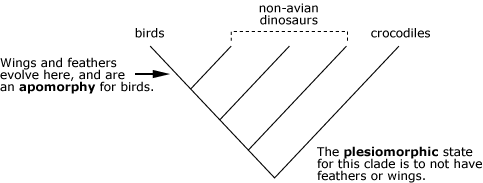
A clade is a diagram showing where one species 'left' the evolutionary path followed by another.
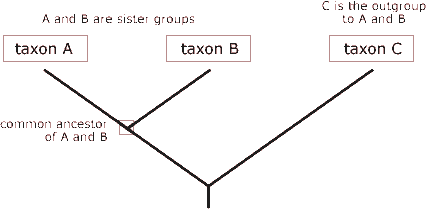
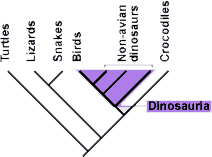 It also gives a relative degree of difference between 2 species.
Clades are diagrams representing the divergence of species, that is, the diverging paths followed by phenotypes with their acumulating genetic mutations.
Another way of describing it is: a clade is a group containing related genera linked to their common ancestor.
A cladogram is a diagram representing the evolutionary history of related groups.
The closer on the cladogram, the closer they are to their common ancestor.
Evolutionary trees depict clades.
It is only when characteristics change that we are able to recognize different lineages or groups. We call the "original" state of the characteristic plesiomorphic and the "changed" state apomorphic.