What is a solvent ?
When you add sugar to your coffee, the solid crystals of sugar fragment as the individual molecules float off and roam freely by themselves. The sugar is the solute and the water in the coffee is the solvent. A solvent separates the molecules of a solute (solid or liquid) so those molecules roam individually thru the solvent. As the solute separates into individual molecules, the solvent becomes the matrix containing individual molecules of the solute.
Why is water such a good solvent ?
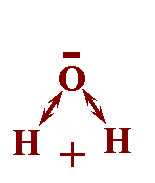
When hydrogen combines with oxygen to form water, the hydrogen atoms share their electrons with oxygen. That causes hydrogen elctrons to spend more time in the sphere of the oxygen, tending to give it an excess of negative elctrons over its positive protons. And leaving the positive protons of hydrogen unbalanced by negative electrons. In addition the 2 hydrogens are on one side of the oxygen atom, making the oxygen side of the molecule negative and the hydrogen side positive. This makes water a polar molecule, (a bit like the poles on a magnet).
Now let us dissolve common salt in water to see why water is such a good solvent.
Common salt, sodium chloride, consists of molecules each of 2 ions, a positive sodium and a negative chlorine. When this salt is dissolved in water, the charges on each water molecule attracts its opposite charge. The positive hydrogen attracts the negative chlorine, and the negative oxygen attracts the positive sodium. Once these ions are separated, the water molecule can insert itself between them, thus increasing the distance and lessening the attraction between the sodium and chlorine.
This 'intervening' of water molecules between salt ions, results from the weak ionic bonding. The force of attraction between metal and non-metal is so weak that the water molecule, with the help of its own polarity, can slide between them.
This also works with organic polar molecules, allowing water's polar molecules to separate organic polar molecules so that they float thru the water matrix, open to chemical reactions with other molecules. This is important because all chemical reactions in cells occur in aqueous solution.
But this works with ionic bonds of metal salts, and with organic polar molecules, but not with the nonpolar organic compounds. The carbon in organic compounds has covalent bonds which, resulting not from the donation of electrons but from the sharing of electrons, are much stronger bonds between atoms with the molecule. Thus metal salts and polar molecules dissolve in water while most organic compounds need organic solvents to dissolve in. (Note that vitamins A and D are lipid-soluble but not water-soluble, so they are not excreted in urine, which may lead to toxic levels of Vitamin A, especially if you take vitamin supplements or eat dog's liver. All other vitamins are water-soluble and excreted in urine, so you need daily intakes.)
The polarity of water molecules causes them to be attracted towards each other, giving rise to surface tension seen in water droplets sitting on glass. Watch 'spiders' skating over pond-water. See lizards run across rivers.
This polarity causes water molecules to gather in small clusters. The hydrogen-oxygen attraction between molecules is called hydrogen-bonding, and plays an important role in holding organic molecules together.
Heat capacity is the number of Calories required to raise the temperature of 1 kg by 1oC. (Specific heat is the ratio of the heat capacity of a liquid over the heat capacity of water. Obviously the specific heat of water is 1.0. The heat capacity of water is higher than that for most liquids. Thus most liquids have specific heats less than 1.0.
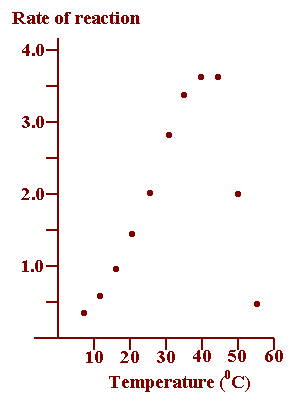
As this graph shows for enzyme-controlled reactions, the rate of biochemical reactions varies greatly with temperature. Biochemical reactions, usually controlled by enzymes, are fastest at about 42oC but a slight increase causes the reactions to plummet. Obviously it would be risky for an animal to operate normally at this temperature because there is little margin-for-error, that is, a slight infection causing a temperature rise would decelerate the reactions just when they are needed to be fastest. Mammals usually operate at around 37oC altho dromedary camels, in the hot extremes of desert, can allow their body temperature to reach 44oC without suffering. That is near the upper safe limit.
At 25oC the metabolic rate is halved. At 5oC, the animal is either dead or in a state of hibernation, as done by those who hibernate, like bears, or topor as done by bats and some humming-birds. At zero an animal must have some means of preventing the tissues from freezing. At slightly lowered body-temperatures, humans suffer a condition known as frost-bite when capillaries contract, blood-flow slows and insufficent oxygen reaches the extremities, causing the tissues to turn blue and then die. When the dead tissue becomes grangenous, and the whole body is threatened with infection. Antibiotics may stave off this problem till a hospital is reached.
Since the range of temperatures in which biochemical processes occur is narrow (proteins, including enzymes, are denatured over 60oC, at which temperature meat changes color and is considered to be cooked) the ability of water to absorb a lot of heat while remaining at close to the same temperature, is important. While the temperature of land varies considerably from day to night, the adjacent seas remain at much the same temperature. This enables the fish, so vulnerable to temperature change, to survive.
Another important point is that water has a relatively high boiling point for a liquid with such low molecular mass. Otherwise water might have vaporized early in our planet's history and been lost to outer space. With no water, we would not have evolved. Just think - no people, no politicians and no priests - doesnt that put us in our place ?
In the above list-item we introduced surface tension of water, due to the attraction of water molecules towards each other, owing to their polarity.
This gives water the highest surface tension of any liquid except mercury. (Compare the meniscus of water in a bottle and of mercury in a mercury thermometer, both containers made of glass.)
Molecules dissolved in water lower its surface tension and tend to collect at the interface between its liquid phase and other phases. This may have been important in the development of a plasma membrane, and plays an important part in the movement of molecules across that membrane.
The high surface tension of water, together with the strong cohesive forces existing between water molecules, moves water up capillary-like vessels and tracheids in plant stems. It also enables the surface film to support, and provide a habitat for, certain aquatic organisms.
A capillary is a very narrow tube. find a glass one and insert in water - watch the water rise up it without any help from you. It rises till the pressure at the bottom of the column of water equals the atmospheric prssure on the water around the mouth of the capillary tube.
Pressure at bottom of column = density of water (1000kg/m3 x gravity (9.8m/s) x height of column.
Explorers used this to determine the altitude of mountains.
How did they do this ?
Most liquids decrease in volume as temperature falls because the intermolecular distance decreases with the fall in molecular energy due to temperature drop. (Temperature is proportional to the degree of molecular vibration.)
Another way of saying this is that the density of a liquid increases with temperature fall. Watch your soup next time you make it. Watch it simmer (no bubbles, please). The soup at the bottom, nearer the heat source, because it has a higher temperature, rises to the top while the cooler soup at the top sinks down to the bottom, thus demonstrating that the warmer the liquid the less dense it is.
But water is a liquid with a twist. Like other liquids, as it cools its density increases till it reaches 4oC, then, unlike other liquids, its density decreases and it rises above water remaining at 4 degrees. This means that the bottom of the ocean never freezes because the surface freezes first and acts as an insulator. Marine life at the poles, can survive at 4oC. Were it otherwise our oceans would be sterile, and again we would never have evolved.