Lipids
Lipids are the organic compounds known as oils, fats, and waxes.
Lipids are used by plants and animals for:
- plasma membranes as phospholipids in cell, nucleus and organelle membranes
- store concentrated energy in muscles, under skin
- provide insulation as blubber, fat cells under the skin (the notorious 'cellulite')
- waterproof coating as wax to prevent dehydration (from leaves) or water penetration (in ears, feathers on waterbirds)
- lubricant (under arms, between legs and toes, provided by sebaceous glands)
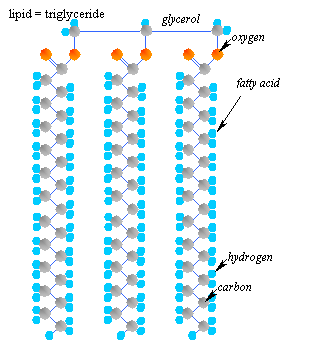
Lipids contain complex molecules, triglycerides, which store energy. Triglyceride molecules hinge 3 fatty acids onto one glycerol molecule. A fatty acid is a long chain of carbon atoms with hydrogen atoms attached, and two oxygen atoms at one end. In each fatty acid, one of these oxygen atoms links to the glycerol molecule.
Seeds of plants usually have much oil to provide energy for quick early growth. Fatty acids have carbon atoms bonded to other carbon atoms in long chains. If all carbon-carbon bonds are single bonds the fatty acid is said to be saturated. If there is at least one double bond, it is unsaturated.
These saturated lipids are solid (fat) at room temperature whereas unsaturated lipids are liquid (oil). In making margarine solid and spreadable, some unsaturated vegetable oils are converted to the saturated (fat) form. This breaking of a double bond into two single bonds by adding hydrogen, is called hydrogenation.
A wax is soft, resists abrasion and chemical attack. The bluish coating on leaves in dry climates, which can be rubbed back with your fingers, is wax to reduce dehydration. Bees use wax for honeycomb; sheep's wool is coated with lanolin; ducks coat their feathers.
A phospholipid molecule has two 'tails' which repel water (hydrophobic) and a 'head' which attracts water (hydrophilic). In water they line up to form a double layer with the heads of each layer facing the water.
Steroids are animal lipids, including some vitamins and hormones, often having 4 connected rings of carbon atoms. Cholesterol is one such group of steroid, some of which are believed to cause hardening of the arteries.